132. The Great Strike, August 1917

Throughout August 1917, a series of strikes spread along the eastern seaboard. The initial strike involved railway workshop employees in Sydney who went out over attempts to introduce a US style card system, based on Taylorism, intended to speed up work. This first action was on 2 August. However, virtually from the very next day, strike action began to spread to an ever increasing range of industries. In NSW, the strike spread across the railways, collieries and then the wharves. Initially, it took in the full range of workers in the railways, and then miners, wharf labourers and seamen. By mid August, strike action spread to Victoria where the key workers involved were the wharf labourers and seamen. On a lesser scale, other industries and specific enterprises became involved and the unrest spread to other centres including Broken Hill. All the various actions are usually described, collectively, as the ‘Great Strike’ of 1917.

The end to the NSW railway strike on 9 September is taken as the end of the Great Strike, even though some workers continued their action for some time after. For example, the Melbourne wharf workers did not vote to return until 4 December.

The Great Strike of 1917 was a conflict that went beyond industrial action, as large scale as this was. It is possible to see it more as a wider working-class revolt than a series of strikes. Certainly by 1917 there was considerable disaffection in the working class. There was ‘war weariness’ but the War had also eroded real wages. Price rises had been extreme. There was also war profiteering. Above all, there was widespread concern that hard-won, pre-War industrial conditions were being eroded under the cover of patriotism. Opposition to the Yes vote in the recent conscription referendum had been strengthened by the fear that conscription was to be used to weaken organised labour. As pointed out in Post 105 even soldiers on the front line shared this concern that conscription would be used to undermine the working conditions and job security of Australian workers. The sense that the hard-won industrial conditions of the (white) working class were under attack was very strong.

Another interesting feature of the Great Strike was the degree to which the traditional power brokers in organised labor – the union hierarchy and the ALP itself, as the political wing of the movement – were by-passed by more rank-and-file leadership and agitation. The organisation was entrusted to an ad hoc ‘Defence Committee’. Also, in many instances the traditional power brokers were opposed to the specifics of the industrial action. In several key instances, unions voted to strike, against the advice of the union leadership.

Importantly, the industrial unrest was not restricted to just the act of striking. There were very large public demonstrations and marches – portrayed as unruly, mob-like and dangerous by the popular press – in Melbourne and Sydney. The role of women in these highly visible activities was striking. In Melbourne through August there were almost daily demonstrations in locations such as Treasury Gardens, Exhibition Gardens and Yarra Bank. Extra police were brought in from rural areas to maintain public order. To some extent, the month long strife was more an expression of the ‘direct action’ promoted by radical worker groups like the IWW than the conventional strike. Not surprisingly, the press was keen to push the claim that this radicalisation of the workers was the handiwork of the IWW and other extremist labor or socialist groups. There was speculation that the massive social dislocation in Russia could even play out in some form in Australia.

Another important feature of the action was the so-called ‘black doctrine’. According to this doctrine, no unionist could work alongside a ’scab’ worker or handle or have anything to do with goods or services provided by scab labour. The speed with which this doctrine prompted other unions to strike and the way it acted as a rallying call – often against the direct advice of the union hierarchy – suggests that the ever-expanding wave of strikes represented not just specific industrial grievances but also a declaration about the fundamental beliefs of the union movement. Specifically, the focus was on the very definition of the union notion of ‘mateship’. This ties in with the argument that after 3 years of War, and ongoing attacks on the union movement, the working class itself pushed back with the equivalent of a public manifesto of what it stood for and what it would never tolerate.

Ironically, the ‘black doctrine’ was arguably the main reason for the failure of the Great Strike. Essentially it meant that the strikes went too wide, too quick and too shallow. While many industries across state boundaries became involved very quickly there were important segments in these industries, and other whole sectors of the economy, where production and business continued unaffected. From the beginning, union organisers had sensed the inherent weakness of the campaign but, it appears, workers generally were not in the mood to listen to their leadership. Indeed, even when the various strikes collapsed and the workers were forced back under very punitive conditions, many workers believed, unrealistically, that they had been on the point of victory and saw the return to work as a ‘sell-out’. This sense of betrayal was heightened by the severity of the conditions surrounding their return to work; and in many cases they were never taken back.

In a real sense the Hughes Government was always going to win. To begin with, after the split over conscription, the ALP was in a weak position. Further, it was clear that the union movement itself was divided over the strikes. Also, the popular press lined up behind the government. The government also had the very powerful War Precautions legislation to employ as required. Finally, Hughes set up the National Service Bureau which in effect recruited volunteers to act as strike breakers. The large number of such volunteers and the efficient organisation of the scheme were enough to break the strike.

When the strikes collapsed, the workers, if they were re-employed at all, had to accept reduced conditions. In many cases their positions were taken by those who had volunteered for Hughes’ scheme of ‘national service’. The strikers were defeated and a brief period of working-class solidarity and direct action, built round idealistic notions of ‘industrial mateship’, came to a bitter end. At the same time, the victory against the strikers virtually made it inevitable that any second vote on conscription would fail. Arguments that conscription was by its very nature an attack on the working class designed to break the unions and reduce wages and working conditions – as well as open the country to cheap non-White labour – were obviously set to have more appeal. Equally, those who argued that the War was nothing but a sordid trade war were going to attract considerably more attention. For many, the War was turning into a war on the Australian working class.

It is interesting to consider the attention that the strikes over August attracted in the local media in the Shire of Alberton. Overall, the ongoing, daily accounts of the strikes were left to the metropolitan dailies. At the same time, the Gippsland Standard and Alberon Shire Representative did highlight how serious the national situation was. The following appeared on 17/8/17:

Industrial Australia is now engaged in the greatest upheaval known in the nation. Emanating from the strike of the railway men in New South Wales it has extended in the past few days to numerous industries in which labor is concerned, and present indications are that serious trouble will ensue before a settlement is effected. The Federal Government is taking a firm stand in the matter, and appears determined to fight the Unions and those who have attempted to disturb and upset railway and shipping facilities. Gradually the strike mania is being extended by the originators to centres of industry which, prior to the outbreak, had no cause for complaint, but are drawn into the trouble by the influence of their fellow workers.

As usual, the local paper lined up behind the Hughes Government. It was keen to support the call for volunteers to break the strikes. There was not as much call in Victoria for volunteers from the country as there was in NSW. In Melbourne there were ample volunteers from the metropolitan area, including students from the University of Melbourne and private boys’ colleges. The following appeared in the Gippsland Standard and Alberon Shire Representative on 24/8/17:

The Government is now receiving offers from country volunteers, and many have taken up the work in Sydney. An individual, a former sailor, walked into our offices [Yarram] yesterday and offered to go and help the Government wherever his services might be of any assistance. We believe a number of others have volunteered from this district.

The paper also reported on the Shire Council’s resolve to support the Government. The following resolution appeared on 31/8/17:

That this Council grant all possible assistance to the Government in the matter of providing labor during present strikes and that the [Shire] secretary be instructed to accept applications from volunteers.

And on 29/8/17 it noted the strong support from at least one local branch of the Victorian Farmers’ Union:

Alberton branch of Victorian Farmers’ Union … resolved that, in the event of it [strikes] becoming more serious, the Alberton branch pledged itself to endeavor to obtain volunteer workers to assist the Government.

The paper also reported (24/8/17) when the local police constable was called to Melbourne … to do duty should trouble arise.

The following article appeared on 29/8/17:

Serious Extension of the Strike Trouble to Womerah. Ferns Declared “Black” – “Trouble never comes alone” was demonstrated at the office of a leading grazier in this district last week. The overseer was waited upon by a deputation of three at “Smoko” requesting a substantial increase in wages, or ferns would be declared “black.” The increase was at once acceded to, pending official confirmation. The official presented the objects of the deputation under threat of dismissal. The strike was of short duration, extending from forenoon “Smoko” on Friday, 17th and terminating on Saturday, 18th when at 5 p.m. the spokesman was dismissed, and one of his senior colleagues resenting such treatment left in sympathy. The dismissed agitator when last seen, was making his way toward Morwell Shire seeking ”White Ferns” and “Pastures New.” We are pleased to state that the strike is ended, as it was causing much concern amongst local employers. The call for volunteer labor was quickly answered by one recruit, who has accepted the agitator’s place without the right of spokesman.

Presumably the article is meant to be a parody – albeit a very clumsy one – of the situation in Melbourne and Sydney. Country employers know how to handle unionists. There does not have to be any workplace bargaining, the boss just gets rid of those who cause ‘trouble’. And there are plenty of other workers who will take up the positions of those dismissed.

The article does at least serve to remind that organised labour was very weak in country areas. This was particularly so in areas like the Shire of Alberton, where the nature of settlement and ongoing development had meant that there was little, if any, history of organised labor. With the exception of the timber industry and state-wide industries like the railways, there was no large concentration of workers in the one economic activity or location. Instead, the stronger history of labour in the Shire was that of the struggling selector and the family-based farm.

The history of selection was one characterised by the lack of capital, equipment, technology, and services, including transport. There were major environmental challenges – drought, flood, fire – and the endless struggle to ‘clear the land’. In this  world, the sense of ‘labour’ was the diametric opposite to that which had grown up in the late 19C in the large urban centres of Melbourne and Sydney. In the rural setting, the focus took in, on the one hand, self-help and rugged individualism, with the family as the basic economic unit, and on the other hand a commitment to a form of agrarian communalism. Only by coming together at this second level were ‘settlers’ able to establish schools, community halls and services such as the bush nurse. Their understanding of ‘mateship’ was one of looking out for their own interests and being self-reliant but at the same time supporting the neighbouring farms in times of crisis or against common threats. Local farming families had to rely on each other to establish the necessary social, economic and even political infrastructure for the community survive.

Not surprisingly, in this environment there was an inherent fear of and antagonism to the idea of ‘organised labour’ and the threat of the strike. Moreover, even when casual labour was taken on – for example, the large number of young, single, immigrant English farm workers – the nature of the work, the isolation of the workplace and the living arrangements of the workers – commonly they lived on the farmer’s property – meant that there was a completely different master-worker relationship to the one that existed in the metropolitan factory.

For a more detailed analysis of prevailing attitudes to the unionisation of rural workers in the local area see Post 10.

One industrial action that caused great angst in the rural community was the strike on the railways or at the ports that held up the transport and/or export of their primary produce. It was unconscionable that their livelihood could be threatened by secondary industrial action that had nothing to do with them. They saw their interests exploited by organised labour in an industrial conflict that was not of their making. The appeal in August 1917 to go tho the city and stand in as volunteer wharf labourers was a very powerful and natural call to arms in farming communities.

It is also important to acknowledge that the rural communities also viewed the Great Strike as a direct threat to the War effort. As they saw it, the union movement was undermining the nation’s ability to prosecute the War. At the very least, the series of strikes was a major distraction and drag on the Hughes’ Government’s ability to proceed with its singular focus on maintaining Australia’s commitment to the Empire. At their worst, according to the official narrative, the strikes were intended to cripple the Hughes’ Government and pull Australia out of the War. The strikes were overlaid with accusations of treachery, if not treason. The hand of the mythically powerful and omnipresent Industrial Workers of the World (IWW) was said to be behind it all. For its part, the Government was keen to retaliate by employing the considerable force of the War Precautions Act to defeat the strikes.

Even though they have faded from the nation’s memory, the events of August 1917 in Australia were highly significant at the time. The speed with which the strikes spread and the number of industries affected caused considerable anxiety. With only limited support from the union hierarchy – and even less from the demoralised and broken ALP – the workers themselves fashioned the strikes into the radical defence of their hard-won conditions and the commitment to fundamental union principles and values. The strikes were symptomatic of deep and divisive concerns about the true cost of the War and the future of the working class. The strikes became an expression of class solidarity and class conflict. But the strikes were also destined to fail and the Hughes Government was keen to settle scores. For all these reasons the “Great Strike’ of August 1917 was a unique chapter in our history. And at the time, the events of August virtually guaranteed that any second referendum on conscription would be defeated. As the workers saw it, the impact of the War was now being carried disproportionately by the urban working class.

References

Gippsland Standard and Alberon Shire Representative

For general background on the Great Strike see:

Beaumont, J 2013, Broken Nation: Australians in the Great War, Allen & Unwin, Crows Nest NSW. [pp 329-335]

Bollard, R 2013, In the Shadow of Gallipoli: The hidden history of Australia in World War I, New South Publishing, UNSW, Sydney NSW [Chapter 6]


135. J R O’Day

James Robert O’DAY (2691)
2 Pioneer B DoW 29/9/17

James Robert O’Day was born at Darriman. He came from a large family of 14 children. The family had been living in the Darriman area from the 1880s. His father – Samuel O’Day – was a farmer at Darriman with 45 acres.  During the War, the mother – Mary O’Day – was actively involved in patriotic fundraising for causes such as the Australian Sick and Wounded fund.

James O’Day attended the state school at Darriman. He belonged to the Yarram Rifle Club and he worked, as a grocer, at the Co-Op Stores in Yarram.

Private O’Day enlisted on 1/7/15. He had his initial medical at Yarram. At the time he was 24 yo and single. He gave his mother as next-of-kin and his religion was (Roman) Catholic.

He was given a formal farewell from Yarram in early November 1915. There were 2 other locals farewelled at the same time. The event was written up in the Gippsland Standard and Alberton Shire Representative (3/11/15). There were few townsfolk at the farewell so the speakers that day were critical of the perceived lack of interest in the young men’s patriotism and sacrifice. They were particularly annoyed that no clergyman was there. One of the speakers … remarked that it was a pity the boys were present to hear the discordant note. At the same time he felt the criticisms needed to be made. Private O’Day thanked those there for the farewell and his medallion. He promised that when he got to the front … he would do his best with the rest of them.

Private O’Day enlisted as reinforcements for 2 Pioneer Battalion. His group left Melbourne on 18/9/16, well over a year after he had enlisted.

On 19/1/17, the local paper published a very detailed letter that Private O’Day had written of his experiences on the voyage to the UK. One short extract gives some of the flavour. The theme about supposed ’equality’ between the officers and other ranks in the AIF was commonplace, as was the casual racism. When the boat reached Dakar, only the officers were allowed to go ashore.

When we got to Dakar the “heads” there would not stand us getting off. The officers were allowed off. We were anchored out in the bay about 200 yards from the wharf. A lot of darkies were around us in their little canoes, selling cigarettes and diving for coins. About 30 of the boys decided to follow the officers, who reckoned they had a right to go if the officers had. So they got the darkies to come in close, and they lowered themselves down a rope into the canoes and the darkies took them ashore. They all came back alright, but they had to pay dearly for their bit of fun. One was fined £6 and 20 days detention as soon as we land [when they reached the UK], which was the heaviest fine, and the lowest was 14 days detention.

The letter finished as Private O’Day reached Perham Downs, Salisbury in a bitter English winter.
His group of reinforcements reached France in January 1917. In February he was hospitalised with mumps and then in April he was hospitalised again, this time with tonsillitis. He did not rejoin his unit until early May. He was appointed lance corporal in the middle of July 1917 and by the end of September he was dead.

2 Australian Pioneer Battalion was working in the area of Bellewaard, near Westhoek, about 5 kilometres from Ypres. They were engaged in the construction, and repair, of both the tramway and the roads. The roads were being re-surfaced with wooden planks (‘planking’). At the time there were major problems with movement of artillery, troops and all necessary supplies because of the state of the ‘roads’. At the same time, the roads, as bad as they were, were more effective than the light tram rail because it was easier and quicker to repair – or detour round – the road when it was hit by artillery. The traffic was tightly congested and there was constant artillery shelling all along Menin Road. Drivers of both horse/mule-drawn wagons and lorries could be caught on the roads in such barrages with no cover and nowhere to go. There were also attacks from the air.

The war diary entry for 2 Pioneer Battalion on 29/9/17 noted that there was … very heavy shelling of Bellewaarde Circuit Road and that the road was broken in several places. It took 3 hours to carry out the repairs. Tragically, a platoon from B Company was hit by an ‘aerial bomb’ when the men stopped for a drink at a ‘comforts’ shelter on Menin Road. An officer and 6 other ranks were killed outright. Another 19 other ranks were wounded and one other rank – Lance Corporal O’Day – died from his wounds.

L/Cpl O’Day was still alive when they got him to the closest casualty clearing station, where his leg was amputated, but he died the same day. He was buried in the Lijssenthoek Military Cemetery, Lijssenthoek, Belgium.

The cable advising of L/Cpl O’Day’s death was dated 8/10/17. On 14/11/17, the following bereavement notice appeared in the Gippsland Standard and Alberton Shire Representative:

Mr. and Mrs. S O’DAY and family, Darriman, desire to sincerely thank all kind friends for calls, cards and letters of sympathy in their sad bereavement.

The paper (5/4/18), reporting on the annual general meeting for the Yarram Co-Operative Society, noted that the chairman – T G McKenzie – paid tribute to Corporal O’Day, a former employee:

I feel sure I am voicing the feelings of all present when I desire to express on your behalf the deepest sympathy for the relatives of the late Corporal Robert O’Day, who has made the supreme sacrifice for his country. Prior to enlisting he was employed by the society, and was a general favourite of all who knew him.

In May 1918, the mother received her son’s personal kit: Letters, Photos, Post-Cards, Wallet, Metal Wrist Watch and Strap, Rosary, Knife, Safety Razor, 1 Mark German Note, Razor in Case, 4 Rings (One- 9 Carat and three – metal), Steel Mirror, 5 Keys on Steel Ring, 3 Coins.

L/Cpl O’Day’s name is recorded on the honor roll for Darriman state school. It is also recorded on the Shire of Alberton Roll of Honor. However his death is not marked on this roll and his name is not included on the Alberton Shire Soldiers’ Memorial. Given that he was obviously a local, his family had been in the district for so long and he personally was well known, it is surprising that his name was left off the soldiers’ memorial.

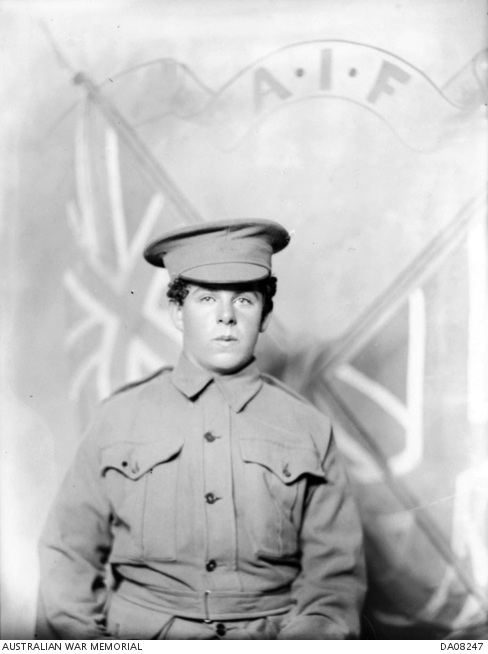
Private James Robert O’Day, courtesy AWM

References

Gippsland Standard and Alberton Shire Representative

O’Callaghan G (Comp) 2006, Clonmel to Federation: Guide to people in the Port Albert area 1841-1901, Vol 1, The Alberton Project

National Archives file for O’DAY James Robert 2691
Roll of Honour: James Robert O’Day
First World War Embarkation Rolls: James Robert O’Day


pix DA09775.jpg
References

134. Polygon Wood, Sept. 1917: S Jolly, A Jones & J D Robertson

Polygon Wood September 25-26, 1917

Following the ‘success’ of Menin Road, the British high command was keen to push their advantage and cut deeper into the German line on the Gheluvelt Plateau. As before, 2 Australian divisions – 4 and 5 on this occasion – were to support 5 British divisions. Also as before, the use of artillery was to be the defining tactic. At the same time, Polygon Wood was to be a scaled-back attack: there was less artillery, the front was not as wide and the ground to be taken was not as deep.

But events did not go as planned. On the morning of 25/9/17, the day before the scheduled attack, the Germans launched their own attack on the section of the front defended by the Australian 5 Division and the British 33 Division. The German attack, supported by an intense artillery barrage, was eventually contained but not before 3 Australian battalions – 57, 58 and 60 – had suffered heavy casualties. Moreover, the plans for the scheduled attack the next day were thrown into disarray. Brigadier-General Pompey Elliott (15 Brigade: 57, 58, 59, 60 Battalions) wanted the attack called off. Birdwood insisted it go ahead.  Elliott’s forces had to be supported by 2 additional battalions: 29 and 31.

The next morning (26/9/17) the planned attack commenced at 5.50 A.M. The AIF forces captured their targets relatively easily and, again, Bean was fulsome in his praise of the artillery. The barrage was said to have rolled with precision across the German lines and it was so accurate and powerful that the Australians were on top of Germans before they could get out of pill boxes and fortified positions. As at Menin Road the Germans were said to be shell-shocked. Many German prisoners were taken.

However, the British 33 Division ran into difficulties and the Australians were critical of their efforts. They thought the British had failed to protect the Australian flank.

The overall battle was considered another ‘success’. The total cost over the 3 days of fighting from 25 to 27 September – was 15,300 British and Australian casualties. For the 2 Australian divisions the total figure was 5,460: 1,730 dead and 3,730 wounded. 5 Division suffered the higher level of casualties. The running score of AIF casualties – from September 20 to September 27 – was approximately 9,500.

References

Bean, CEW 1941, Official History of Australia in the War of 1914-1918, Volume IV – The Australian Imperial Force in France, 1917, 11th Edition 1941
Chapter XIX – Second Step – Polygon Wood

For a general background on Polygon Wood see,

Beaumont, J 2013, Broken Nation: Australians in the Great War, Allen & Unwin, Crows Nest NSW. [p 343 ff]

Carlyon, L 2006, The Great War, Pan Macmillan, Sydney NSW
[Chapter 30]


Sydney JOLLY (2679)
58 B KIA 25/9/17

Sydney Jolly was born in Brighton, Middlesex and was another young English immigrant to come to Australia prior to WW1. He migrated at the age of 26. At the time of his enlistment he was married (Elizabeth Jolly) and living at Gelliondale. His occupation was variously given as labourer and horse driver. At the same time, he appears to have had a more senior position – a ‘manager’ of some kind – with a butter factory (Handbury & Son) at Gelliondale. His religion was given as Church of England.

He enlisted in July 1916 (6/7/16) in Melbourne in 58 Battalion. At the time he was 33 yo, suggesting that he had been living in Australia for about 7 years. It appears that his wife was also English. It is not clear if she came to Australia with him or joined him later.

Private Jolly had failed the medical test on multiple occasions before finally being accepted in the AIF. His name appears on the list of those rejected by the local doctors and he acknowledged on his enlistment forms that he had been rejected. In the end he underwent some form of operation – it appears to have been on both legs – to meet the medical standard.

His group of reinforcements left Melbourne in October 1916 (2/10/16) and reached England in mid November. Another 2 months of training in England followed. He was finally taken on the strength of the 58 Battalion in France in early February 1917. Barely 3 weeks later he was wounded – shrapnel or gun shot wound to right elbow – and repatriated to hospital in England. He was discharged from hospital at the end of April and at this point was transferred across to 67 Battalion. However he continued to remain in England until the end of June 1917 when he left again for France and finally rejoined his original unit (58 Battalion) at the start of August 1917.

Less than 2 months after rejoining his unit, he was killed in action on 25 September, the day before the attack on Polygon Wood. There was no record of any burial. The only reference at the time was the very general reference that he had been buried …in the vicinity of Polygon Wood.

His wife, as next-of-kin, was advised of the death by cable dated 8/10/17 and the formal report of death was dated 14/11/17. His death was reported in the Gippsland Standard and Alberton Shire Representative on 17/10/17:

Many of our readers will have pleasant recollections. of Private S. Jolly, of Gelliondale whose genial personality won many friends. Eighteen, months ago he was accepted as a soldier, after repeated attempts to enlist, and got his wish gratified to join the boys at the front: -We regret to announce he has paid the supreme penalty for his country.’Word came to Mr: Amos Wood on Friday to break the news to his widow, but being an intimate friend of the deceased soldier his heart failed him. Mrs. Jolly was in Yarram when the wire came and the sad task was entrusted to the Rev. Mr. Raymond. Private Jolly. No. 2697. was killed in action on 25th Sept. He was before enlisting manager for Handbury & Son. Gelliondale.

An in memoriam appeared, much later, on 27/2/18:

IN MEMORIAM.
JOLLY.-In loving memory of my dear husband, Private Jolly, who gave his life for his country on 25th Sept., 1917.

In the bloom of life God claimed him.
In the prime of his manhood days;
None knew him but to trust him,
None mentioned his name but to praise.
There came a day when the roll was called,
That he did not answer “Here!”
For he slept with comrades his last long sleep.
And he died without a fear.
To live in hearts we leave behind
is not to die.
-Inserted by A. E. Jolly, Gelliondale

Private Jolly’s kit was returned in May 1918. It was very basic: 2 photos, Card, Wallet. His wife received a widow’s pension of £2 per fortnight from 11/12/17. There was no indication of any children.

There was no Red Cross report for Private Jolly, although there was a brief, undated, note from the CO of the 58 Battalion – Major H Lane – indicating that,

No. 2679. Pte. S. Jolly late of this Unit was killed in action on 25.9.17. He was badly wounded about the head and died instantaneously. He was not buried by this Unit. Map location of where he fell is (Sheet. 28. J.9.b. Central.).

The war diary for 58 Battalion indicates that on the morning of 25/9/17, the day before the scheduled major attack by the Australians on Polygon Wood there was a heavy enemy artillery barrage which was followed by an all out German assault on the lines. The Germans made some advances but by early afternoon, after heavy fighting, the original lines had been retaken.

The war diary also records the very high casualty levels sustained by the battalion over the 3 day period 25/9 – 27/9. Total casualties were 290. Private Jolly was one of 54 killed.

It is clear that at the time of his death there was no formal burial and, like so many others killed at Menin Road and Polygon Wood, there was little chance of his body ever being recovered. However, in 1921, as part of the work of the Graves Registration Unit, the body of Private Jolly was recovered. He was then re-buried in Tyne Cot Cemetery.

It is not entirely clear how the body of Private Jolly was identified, but it appears that a diary belonging to him was found on the remains. There may well have been other evidence – for example, his medical report from the time of enlistment was very detailed, even including the observation that a portion of his first finger on the right hand was missing.

When it was recovered with the body, the diary was in a poor state of preservation. However it is possible to read some entries that cover the time when he was recovering in England in the first part of 1917. There are several entries about ‘doing nothing’; and he was obviously trying to get himself returned to France. There is one entry, apparently June 11th 1917, when he wrote … Saw Colonel playing golf so went right up to him and asked to be transferred to France. The day before he had written, Still going for my transfer. He wrote elsewhere how he didn’t like the idea of being in England while … someone else is doing my bit. Far from being relieved to be out of the fighting and back in England with a ‘blighty’, the diary suggests that Private Jolly was keen to get back to his unit and do his ‘share’ of the fighting.

Private Jolly’s determination to rejoin his unit after being wounded and then hospitalised in England was also referred to in a letter written to his wife by one his officers in 58 Battalion. The letter was published in the Gippsland Standard and Alberton Shire Representative on 27/2/18.

THE LATE PRIVATE JOLLY.
Lieutenant George Wood, France, writes Mrs. Jolly, Gelliondale, 7/10/17, as follows:-You will have been notified ere this of the death of No. 2679 Private S. Jolly, who was killed in action near Polygon Wood on 25th September 1917. He was killed instantaneously by a machine gun bullet through the head, and we buried him just behind the front line. He was doing splendid work in the brilliant engagement fought by our battalion. He came over from Australia with me and when transferred to the 6th division in England, after being in hospital, pleaded to get back to our company, and to my platoon. All through he earned the highest respect and reward of all his officers and mates. I regarded him as a personal friend, and he was due for promotion. He always worked with enthusiasm and cheerfulness, and in battle showed no trace of fear. He died a hero’s death and earned the admiration of his comrades by his gallant actions. On behalf of the officers and men of A Company I beg to tender you our deepest sympathy in your sad bereavement.

Similarly, his determination to enlist was common knowledge in the local community. The following account of a farewell for him was published in the local paper on 1/9/16:

The residents of Gelliondale gave their old friend, Private S. Jolly, a send-off in the West Alberton hall on 30th ult. This soldier tried no less than five times to pass the medical test, and eventually got fit by undergoing an operation, necessitating 66 stitches. He would not accept leave from camp—only final—for fear he would not get back again. Private Jolly is a married man, having married an old sweetheart whom he met in the Old Country. He gave her the choice of returning to England, or remain at Gelliondale. She chose the latter. At the social Mr. F. Blane presided, and eulogised Private Jolly for his tenacity of purpose. He was presented with a marble clock, wristlet watch, and a purse of sovereigns is to follow. Mr. N. H. Lowe congratulated the popular soldier on the step taken. Private Jolly excelled himself in his response, and pleasingly referred to all kind friends he was parting with for a time.

Private Jolly’s name is included on both the Shire of Alberton Roll of Honor and the Alberton Shire Soldiers’ Memorial.


References

Gippsland Standard and Alberton Shire Representative

National Archives file for JOLLY Sydney  John 309B
Roll of Honour: Sydney Jolly
First World War Embarkation Rolls: Sydney Jolly


Alfred JONES (2198)
59 B KIA 26/9/17

Alfred Jones was born in Bung Bong near Maryborough. When he and his older brother – Arthur Jones – enlisted together in March 1916, they gave their father’s address, as next-of-kin, as PO, Bung Bong. However, by that point the brothers themselves were living and working at Madalya. The 1915 rate book indicates that they had some land – 10 acres, held in joint names – at Binginwarri, but the extent to which they were farming in their own right is unclear. Probably they were trying to establish themselves as farmers and working on other local properties at the same time. Nor is it clear what happened to their small holding when they enlisted.

The farewell of the 2 brothers from Madalya was written up in the Gippsland Standard and Alberton Shire Representative on 19/5/16. The tension at the time associated with recruitment and the prospect of conscription was very evident:

The residents of Madalya and the surrounding district gathered in the hall on Friday night last to enjoy a social dance. Mr. Recruiting Sergeant Newland happened to be there, and somewhere about midnight a halt was called for the business of the evening, to bid farewell to the recruits, Messrs. Alf. and Arthur Jones, and Ernest Anderson. …

The boys were then presented with wristlet watches, fastened on by three young ladies.

The Chairman then called on the recruiting sergeant-to make a few remarks, which was done in full earnestness. He expressed pleasure at being present to wish the three men good luck, but by the appearance of the hall he felt sure there were at least a dozen more eligible to go than the three who had enlisted. The Jones Bros, were only just making a start in life, and as to young Anderson, he was only a boy. It was, he thought, a shame that one so young should have to go, when older and more mature men hung back. …

Mr. Alfred Jones replied on behalf of himself and brother. When he got his card [as part of the Government’s ‘Call to Arms’] he replied flippantly, but after speaking to the recruiting sergeant his views had changed. He thanked the people for the present and the nice evening’s entertainment. Personally, he would prefer to have gone as a conscript, knowing that everyone eligible would be doing his share.

The brothers had their initial medical in Yarram and then completed their enlistments in Melbourne. They both enlisted on 17/3/16 and they both joined as reinforcements for 59 Battalion. Alfred was 22 yo and Arthur 24 yo. Both were single and their religion was given as Church of England.

Arthur Jones survived the War but he was badly wounded in March 1917 – shrapnel wounds to both legs – and was repatriated to Australia and given a medical discharge in April 1918. After the war he became a soldier settler in the local area.

The 2 brothers embarked for England at the start of August 1916. They joined 59 Battalion in France in early December.

Private Alfred Jones was hospitalised with mumps just before Christmas 1916 and did not rejoin his battalion until mid February 1917. Then on March 3 he was wounded – gunshot wound left elbow – and repatriated to hospital in England. As indicated, his brother was also wounded round this time (20/3/17) and also transferred to England. The 2 brothers were charged with being absent without leave for 1 day in July 1917 when they were recovering in hospital. Each received the fairly severe punishment of 8 days field punishment No. 2 as well as losing 11 days pay. As indicated, after this Arthur was repatriated to Australia while his brother went back to the front.

Private Alfred Jones rejoined 59 Battalion in August 1917 (26/8/17). Exactly one week later, he was killed in the battle of Polygon Wood (26/9/17).

It appears that the family was advised of the death in late October. The cable was dated 25/10/17. The formal report of death was dated 7/11/17. Correspondence from a member of the family shows that the father had died in May 1917, 4 months before his son was killed.

There is no record of any burial or grave and Private Jones’ name is recorded on the Menin Gate Memorial. Nor was there a Red Cross report completed on his death. There was not even any kit returned to the family. A letter from Base Records in March 1921 acknowledged that …no personal effects of any description have been received here in connection with the late No. 2198 Private A. Jones 59th Battalion. It went on to point out that given the length of time already elapsed … it is considered improbable that any of his personal belongings were recovered at the time of the casualty.

As already indicated, the particulars for the (National) Honour Roll were not completed. There is also a declaration from Private Jones dated 19/9/17 – just a week before he was killed – that he did not desire to make a will. It was as if fate conspired to leave hardly any trace of Private Alfred Jones.

The war diary for 55 Battalion gives some indication of the events surrounding his death. Prior to the battle there had been training to rehearse the attack at Polygon Wood. 59 Battalion launched its attack 3 minutes after the barrage started at 5.50AM on 26 September and quickly captured its first objective; but its flank was exposed and there was specific criticism of the effort and effectiveness of the British troops in the adjoining sector. There were numerous German counter attacks throughout the day that were repelled. The following day there was a heavy German bombardment:

The whole of this day [27/9/17] we endured the heaviest of shell fire which hardly ceased all day. The enemy had excellent observation by balloon. It was remarkable that the casualties were not more than they were. I think it was because the men were distributed in irregular shell hole positions. They showed wonderful endurance; I did not see a man stir.

The battalion was relieved on the night of 27 September. Casualties were very high. For just 2 days of fighting the battalion suffered 268 casualties. The diary gave a more detailed breakdown: 48 killed, 203 wounded and 17 missing. The diary also gave the battalions strength prior to the battle – 22 officers and 694 other ranks – and calculated a casualty rate of 37.4%. Basically, over just 2 days, the battalion lost one third of its fighting strength.

Private Alfred Jones’ name is included on both the Shire of Alberton Roll of Honor and the Alberton Shire Soldiers’ Memorial. The 2 brothers’ names are also recorded on the Madalya School and District honor roll.

References

Gippsland Standard and Alberton Shire Representative

National Archives file for JONES Alfred 2198
Roll of Honour: Alfred Jones
First World War Embarkation Rolls: Alfred Jones


John Douglas ROBERTSON (7244)
14 FCE KiA 26/9/17

John Douglas Robertson was born in Glasgow, Scotland. It is not clear when he came to Australia. On his enlistment forms he recorded that he was a widower – again, it is not known when or where, he married – and that both his parents were dead. He gave as his next-of-kin a sister – Mrs Grace Hanley – who was living in Scotland. This sister completed the information for the (National) Roll of Honour and noted that her brother had moved to Australia when he was 32 yo.

On the same form, the sister was obviously not sure about her brother’s location in Victoria as she gave ‘Melbourne, Gippsland’ as the place with which he was ‘chiefly connected’. In fact, there is no doubt that John Robertson was living and working at Mullundung. His name appears on the local (Yarram) 1915 electoral roll as a carpenter of Mullundung. On his enlistment papers he described himself as a carpenter working for the Goodwood Sawmill Company, Port Albert.

He was obviously well known in the local area and received, in absentia, the Shire of Alberton medallion. In fact, on 3/3/16 the Gippsland Standard and Alberton Shire Representative published a short piece acknowledging his gratitude for receiving the medallion:

Sapper J. D Robertson, writing to Mr. G. F. Sauer from Egypt, says: – I received the shire medal and card alright, and I must thank you and the shire people for the kindness. I am very proud of them both. I only hope I will be able to show you the medal if I come back from the front, as I expect to be sailing in a fortnight’s time. Give the Alberton shire people my best thanks.

John Robertson’s name appears on the Shire of Alberton Honor Roll. However, his death on active service is not acknowledged on this roll and nor is his name included on the Alberton Shire Soldiers’ Memorial. It is hard to believe that word of his death never made it back to Gippsland but, at the same time, because the sister in Scotland was the next-of-kin, news of the death and other formalities – e.g., return of personal kit – would have been directed to her rather than anyone back in Australia. In his file there is latter from someone in Australia enquiring after him, in June 1918. However, the person – Mrs M Campbell – who stated that she had not heard from him for 12 months was in NSW. She was then informed of his death but, again, people in Gippsland could have remained in the dark and assumed that, like many others, John Robertson was given his discharge from the AIF in the UK and did not return to Australia.

Sapper John Robertson enlisted in Melbourne on 29/12/15. He had been rejected earlier. His name appeared on the list, compiled in July 1915, of those rejected by the local doctors at Yarram. He was 34 yo when he enlisted and he gave his religion as Presbyterian.

He enlisted as reinforcements for 5 Field Company Engineers and left for overseas from Melbourne in late March 1916. His unit proceeded to France in August 1916 and he was taken on strength for 14 Field Company Engineers on 1/9/16. He was hospitalised for about one week in December the same year.

Initially he was reported as wounded in action on 26/9/17. On 2/11/17 this was changed to ‘wounded and missing’ and then on 5/11/17 it was changed to ‘killed in action’ on 26/9/17. The body was never recovered and Sapper Robertson’s name is recorded on the Menin Gate Memorial.

There is a detailed Red Cross report and, allowing for the usual inconsistencies, it appears that he was caught in an artillery barrage when the engineers were digging strong points as part of the infantry advance towards Polygon Wood very early on the morning of 26/9/17. Witnesses saw him fall – they were unsure if he was dead or wounded – but he was left lying in a shell hole as the advance continued. Later that day they tried to locate him but there was no trace. A couple of the witnesses, from his unit, thought that he came from, and had enlisted in, Sydney. Probably he had spent some time working in Sydney before he moved to Gippsland.

The war diary for 14 Field Company Engineers does not provide much detail for 26/9/17 but it does state that one of the strong points it was tasked to set up was only … partially dug but not garrisoned, a failure owing to swampy ground and heavy casualties.

The following witness statement gives some idea of the intensity of artillery fire on the battle field. Essentially it suggests that Sapper Robertson, either dead or wounded and lying in a shell hole, left behind when his unit continued its advance, was buried not by human hand but by the shell fire itself:

He was badly wounded in the head [others claimed it was the stomach], about 6 o’clock on Wednesday morning 26.9.17, whilst going through Glencorse Wood. He was left there whilst the remainder of No. 3 Section went on. At 10 o’clock, 4 hours later, I passed over the ground, but could not find any trace of him. Enquiries were made at the dressing station near by, but he had not passed through. No. 3 Section officer and some sappers made a thorough search next morning, but could not trace him. It is probable that he was buried by the heavy shell fire at the time of being wounded.
Sapper R H Mitchell 2614 (No. 3 section,14 FCE)

As indicated, the sister, as next-of-kin, was advised on 12/10/17 that her brother had been wounded. The on 29/11/17 this was changed to ‘wounded and missing’. Finally, the cable advising of the death was sent on 8/12/17.

It appears that personal kit was returned to the sister in Bathgate, Scotland in April 1918 but there is no list in the file of the actual items. On 4/6/17, Sapper Robertson 7244 had formally advised the Estates Branch of the AIF that he had ’no desire to make a will’. There is no record of any pension being issued to anyone – e.g. dependent children – in his name. Sapper Robertson was yet another member of the AIF who in so many ways ‘disappeared’ in the intense fighting near Ypres in September 1917.

References

Gippsland Standard and Alberton Shire Representative

National Archives file for ROBERTSON John Douglas 7244
Roll of Honour: John Douglas Robertson
First World War Embarkation Rolls: John Douglas Robertson
Red Cross Wounded and Missing file: John Douglas Robertson


131. E J Appleyard

Edgar John APPLEYARD (609)
8 LHR   DoW 3/8/1917

Edgar John Appleyard was born in Alberton in 1888 and grew up in the district. He attended the Alberton State School. He was a cousin of the six Appleyard brothers, also from Alberton, who enlisted. Two of these cousins (Gordon William Appleyard and Charles Courtney Appleyard) like Edgar, died on active service. Edgar Appleyard had 2 brothers, one of whom – Frank Appleyard – also enlisted, and survived the War.

Edgar Appleyard’s father – Arthur Horatio “Crib” Appleyard – had been the Shire Engineer for the Shire of Alberton. He had died in 1898. The mother – Mary Ann Appleyard – was listed as next-of-kin on the enlistment forms. When her son enlisted her address was given as Alberton but she changed address several times from that point and, at the time of his death, she was living at Windsor in Melbourne.

Edgar was nearly 24 yo when he enlisted and he gave his occupation as ‘labourer’. The father had held land in the local area but there is no indication that, after the father’s death, the wife or sons held land and were farming. Presumably, Edgar was working on other local properties as a farm labourer.

He enlisted in Melbourne, early in the War, on 20/10/14. He was single and he gave his religion as Church of England. It appears he nearly failed the medical because of poor teeth. He was taken on in the newly formed 8 Light Horse Regiment.

His unit left for Egypt in February 1915 and was involved in the fighting at Gallipoli from mid May. 8 LHR was involved in the disastrous attack on the Nek on 7 August 1915. At the end of October Trooper Appleyard was hospitalised for a week. He was returned to duty but after only a few days was hospitalised gain. This time he was taken off the peninsula, transported to Alexandria and admitted to hospital in Heliopolis with ‘debility’. By the time he rejoined the unit in mid December the Gallipoli campaign was effectively over.

On 19 April 1917, 2 years after arriving in the Middle East, Trooper Appleyard was wounded in action. The wounds were serious and he subsequently died of them in early August (3/8/17).
The action in which Trooper Appleyard was wounded was the second unsuccessful attack on Gaza. The war diary of the 8 LHR recorded 6 killed and 67 wounded in the action on that day (19/4/17). The diary also made a point of explaining how the use of two armoured cars in the operation increased the number of casualties. The 2 armoured cars were driven to an advanced position in the Australian lines and, not surprisingly, drew intense enemy fire thereby increasing the number of casualties. The diary was dismissive of the overall value of the armoured cars, both of which were easily put out of action by the enemy, but not before one of them had run over and seriously injured an Australian trooper.

There is an additional reference in the diary that might be highly relevant to trooper Appleyard’s fate. Essentially, the diary notes that the regiment was at that time using the new ‘H. K. Auto Rifles’ – Hotchkiss M1909 – and while this light machine gun had proved ‘invaluable’ it had also been responsible for deaths and injuries amongst the Australians themselves. Poor training in its use had meant that in some cases it was being fired from the shoulder, with deadly consequences for those nearby. There is the possibility that Trooper Appleyard, whose wound was described as a gunshot wound to the back, was in fact the victim of ‘friendly fire’.

Trooper Appleyard was transferred to hospital in Cairo via various casualty posts. He reached there on 24/4/17, 5 days after he had been wounded. It appears that his mother back in Australia learnt of his serious injury by cable on the 26 April. He was described as ‘dangerously ill’. He lived for more than 3 months and over this period there were at least 10 further cables back to Australia to advise that he remained on the ‘dangerously ill list’. There was one cable early on (5/5/17) that advised that he was ‘out of danger’ but this was definitely the exception. The following letter makes it clear that from the start there was no chance of survival. It was written in September 1917 by the Registrar of the hospital in which Trooper Appleyard was nursed and died (14 Australian General Hospital, Cairo). It was written in response to a Red Cross appeal for information on Trooper Appleyard’s death and, presumably, the contents, in some form or other, would have been forwarded to the mother.

I have to state that this soldier [Trooper E J Appleyard, 609] was wounded on the 19th April at Gaza by a rifle bullet which entered the spine and injured the spinal cord, causing complete paralysis of the lower limbs immediately.

He was admitted to this hospital on the 24th April in a paralysed condition and his general condition was naturally serious from the start. The damage to his spinal cord was irreparable, and there was never any prospect of his recovering or of his being sufficiently strong to travel to Australia on a hospital transport.

He lived until the 3rd of August growing progressively weaker all the time. During these months he was always cheerful, was a great reader and wrote a large number of letters. He was entirely free from pain and never made any complaint, and his death was a gradual and very easy one….

Trooper Appleyard’s file contains extensive medical notes, including a post mortem report, which make for graphic reading. In a sense, this material is the medically objective – and far more confronting – version of the letter written by the Registrar, who was presumably trying to give some sort of comfort and our modern day sense of ‘closure’ to the family. The post mortem gives as the cause of death … GS wound of spinal cord – myelitis and Septic cystitis & extensive bed sores. The bed sores were described as … large deep excavating bed sores on buttocks extending to the sacrum. There were similar lesions on the heels. The medical notes reveal the ongoing, but ultimately unsuccessful, attempts to control infection in the bladder. They also indicate that the patient was being treated on a water bed.

The mother was advised by cable within two days of her son’s death. His funeral service was conducted by Chaplain Captain E Warren Tompkins and he was buried in the British Military Cemetery, Cairo. Uncharacteristically, there is no record of any personal kit being returned to the mother.

Death notices appeared in the Gippsland Standard and Alberton Shire Representative on 15/8/17:

APPLEYARD – Died of wounds 3rd August, at 14th A.G. Hospital, Cairo, Gunner Edgar John, fourth son of the late Arthur H. Appleyard, of Alberton, South Gippsland, and dearly loved brother of Alice, Annie, Harriet, Fred, Frank (on active service), and Muriel, aged 28 1/2 years.

A call to duty, ’twas nobly done,
In doing his duty a crown he won:
No fear for self, in trying to save
The lives of others his life he gave.
For him, our gallant hero,
We breathe a silent prayer:
We love and honour his noble name,
We know he is in God’s care.

APPLEYARD. – Died of wounds on 3rd Aug. at 14th A. G. Hospital, Cairo, Gunner Edgar John, 4th son of the late Arthur H. (formerly shire engineer) and Mary Ann Appleyard, of Alberton, Sth. Gippsland, and brother of Alice, Annie, Harriet, Fred, Frank (on active service) and Muriel, aged 28 1/2 years.

Though Thou hast called me to resign
What most I prized, it ne’er was
mine,
I have but yielded what was Thine:
Thy will be done.

Ironically, these notices of his death appeared just 2 weeks after the local paper had encouraged locals to write to Trooper Appleyard in hospital in Egypt. The mother by this point was living in Melbourne and it appears that it had taken time before people in the district knew that he had been wounded and that his condition was so serious. The information appeared in a short article on 1/8/17, just 2 days before he died and, obviously, far too late for his benefit:

Mrs. Appleyard, Windsor, has received word from the Australian Red Cross Information bureau that her son, Private Edgar Appleyard, of the 8th Light Horse, is in the 14th Australian General Hospital at Heliopolis. His legs are paralysed and his condition is regarded as dangerous. Those of his friends in this district who would like to write to him, should address letters No. 609, Private E. Appleyard, !4th Australian General Hospital, Heliopolis, c/o Officer Commanding Australian Section Base, Cairo, Egypt.

On 7/9/17 the local paper published another article on the death of Trooper Appleyard. It is worth reproducing in full because it shows the incredible paths that information on serving soldiers could take to reach the family back in Australia. The episode also shows the power of the local paper to present the narrative of the War, at the immediate level of individual soldiers, including those who as locals had until recently lived among them. The lessons from this particular section of the narrative are all about kindness, compassion and courage:

Tribute To A Brave Soldier
Mrs M. A. Appleyard, Windsor, has received the following letter from Private T. P. Payne, Melbourne, referring to the death of her son: –
Dear Mrs. Appleyard. – You will please pardon me intruding upon you at this time, but you will understand my reasons when I tell you that it is my great admiration for a gallant gentleman and sympathy for his loved ones that impels me to write you. By the last mail from Egypt I received a letter from my brother who is attached to the staff of the 14th A.G.H. In it he states: “I am now engaged in attending a very serious case. It is a laddie named Appleyard, who comes from Albertan, near the Lakes. He was wounded on 19th April at Gaza, and since that time has been partially paralysed from hips down. The injuries are most serious, and it takes us an hour each day to dress them. “Appy” is the gamest boy I have ever seen, and although his case is helpless he is always laughing and joking whilst we are dressing him; never a word of complaint escapes his lips. Just as I am writing (2.15 a.m.) he is sitting up in bed as happy as can be puffing a cigarette. His chief thought is of his home.” I might tell you my brother was very fond of him, and I’m sure nothing that his mind could suggest would be omitted to comfort and cheer your boy. Jim used to go to Cairo every chance to get sweets, etc for him. In another letter he described the bed upon which your lad was, and it will surely interest and somewhat console you to know that all that science and goodness could produce was at his disposal. Jim says: “In bad cases water beds are used – that is an india-rubber mattress is filled with water; his hips are on an air cushion, and he is packed up up in the most convenient way with pillows.” It is indeed a very sad duty to write you in this way, but I felt it would be somewhat of a comfort to hear from a stranger of the wonderful courage of your son. I do trust that you are bearing your sorrow with a spirit as brave as that of your boy. I am sure that you all are, and you in particular. If you should care to correspond with to my brother I am enclosing his address, and I am sure he will be as happy to serve you as he was proud to assist your gallant soldier son. Once again I ask your pardon for intruding myself.

Trooper Appleyard’s name is included on the Alberton Shire Soldiers’ Memorial in the main street of Yarram. His name is also included on the Shire of Alberton Roll of Honor, but, inexplicably, the entry does not mark his death on active service.

Trooper Edgar John Appleyard, courtesy Yarram and District Historical Society.

References

Gippsland Standard and Alberton Shire Representative

O’Callaghan G (Comp) 2006, Clonmel to Federation: Guide to people in the Port Albert area 1841-1901, Vol 1, The Alberton Project

National Archives file for APPLEYARD Edgar John 609
Roll of Honour: Edgar John Appleyard
First World War Embarkation Rolls: Edgar John Appleyard
Red Cross Wounded and Missing file: Edgar John Appleyard


130. W Browney

William BROWNEY (1071)
5 Divisional Ammunition Column KiA 28/7/1917

Wllliam Browney was born in Ipswich, Queensland. The details of his background are sketchy. In his file there is extensive correspondence about the distribution of his medals. This was because before the AIF was prepared to give them to his foster mother they needed to be sure that there were no surviving male family members who, in terms of the legislation, had a more substantial claim. Correspondence from the foster mother – Susan Adelaide Beadmore – offers a brief account of the boy’s childhood:

I took W Browney 15 [this was subsequently corrected to 25] years ago he was then 7 years old. His mother was dead & I have not heard of any living relations since infact I dont think he had any bros or sisters I was the only one that had anything to do with him & he looked to me as a mother. 3/1/1921

The foster mother resided at Korumburra and William Browney – also known as William Beadmore – attended the local state school there. When he enlisted, he did so at Foster and he gave his address as that of his foster mother at Korumburra. She also recorded on the (National) Roll of Honour that the place with which he was ‘chiefly connected’ was Korumburra.

At the same time, William Browney had a definite connection to the Shire of Alberton. His death – 28/7/17 – was written up in the Gippsland Standard and Alberton Shire Representative on 17/8/17:

We learn with much regret that Driver W. Browney, of Wonyip, was killed in action in Flanders, France on 31st July [sic]. He was one of the oldest residents in that district, the adopted son of Mrs. Beadmore. When he enlisted 19 months ago [it would have been closer to 30 months earlier] the residents gave him a send-off at Ryton Hall.

The reference to William Browney being one of the ‘oldest residents’ points to the fact that Wonyip was not really opened up for settlement until the turn of the century. William must have gone there for work after he finished his schooling.

Even though he was working and living in the Wonyip district he was not identified as someone from the Shire of Alberton. His name is not recorded on either the Roll of Honor or the Soldiers’ Memorial. It appears that his connection to the Shire of South Gippsland was seen as stronger. As indicated, his foster mother linked him to Korumburra and his name is recorded on the roll of honor for the South Gippsland Shire.

William Browney enlisted as a 27 yo on 7/1/15. He was single and he gave his occupation as labourer. His religion was listed as Church of England. He left Australia as reinforcements for 9 Light Horse Regiment. However, in Egypt in May 1916 he transferred to the artillery and joined 5 Divisional Ammunition Column. He left the Middle East in August 1916.

Not long after he reached France he was hospitalised with influenza for 2 weeks, in September 1916. Then in November 1916 he was hospitalised again, with ‘cattarh’.  It appears that this general condition was subsequently re-diagnosed as another bout of influenza, and also asthma, and he was transferred to hospital in England in December 1916. It appears that there was further illness, again influenza, in February 1917. His general health was clearly problematic. He did not return to the front line in France until the end of June 1917. He was killed in action one month later on 28/7/17.

There is no Red Cross file for Driver Browney but there is some information in the war diary of the 5th Australia Divisional Ammunition Column. At the time, the unit was working in the Poperinghe area, just over the border with Belgium, near Ypres. The main work appeared to be the rebuilding of ammunition dumps which had been destroyed by enemy shell fire. For example, 3 days before the death of Driver Browney, the diary records:

Forward Dump in Cambridge Road destroyed by enemy shell fire. 2 Officers and 100 Other Ranks sent out to re-establish dump, which was completed by dawn on 26.7.17.

Then for 28/7/17 the entry reads:

Another Forward Battery Dump destroyed. The working party despatched to re-establish same reported work complete by dawn 29.7.17

and, for the same day:

1 Other Rank Killed and 1 O.R Wounded by explosion of enemy bomb dropped from aeroplane.

Driver Browney was of the very few members of the AIF killed by enemy aerial bombing.

The body was recovered and Driver Browney was buried in the nearby Vlamertinghe New Military Cemetery, Vlamertinghe, Flanders.

His mother was advised by cable dated 2/8/17, less than a week after he had been killed.

In April 1918 his meagre personal kit – 2 Wallets, Photos, Cards, Blank disc, 2 Religious books – was returned to his foster mother at Korumburra.

Apart from the correspondence in the file to do with the issuing of the medals there is nothing else that throws light on this man’s story. It appears that it was inevitable that his personal history would fade, and certainly the recognition of his presence in the Shire of Alberton did not last, even to the end of the War. Others from Wonyip were remembered and celebrated but William Browney, also known as William Beadmore, was not.

Driver William Browney, also known as William Beadmore, Wonyip. Courtesy of Australian War Memorial

References

Gippsland Standard and Alberton Shire Representative

National Archives file for BROWNEY William 1071
Roll of Honour: William Browney
First World War Embarkation Rolls: William Browney


128. Enlistments in the first half of 1917: background characteristics Part 2 – religion, units and service history

This post continues the analysis of

Post 23: Enlistments to the end of 1914: background characteristics Part 2 – religion, units and service history

Post 57:  Enlistments in the first half of 1915: background characteristics Part 2 – religion, units and service history

Post 63: Enlistments in the second half of 1915: background characteristics Part 2 – religion, units and service history

Post 83: Enlistments in the first half of 1916: background characteristics Part 2 – religion, units and service history

Post 103: Enlistments in the second half of 1916: background characteristics Part 2 – religion, units and service history

It continues the ongoing work to describe and interpret the essential character of all those associated with the Shire of Alberton who enlisted in WW1.

Religion

The table below gives the religious affiliation of all those enlisting from the Shire over the period August 1914 to the end of June 1917. It also shows the equivalent figures for males in the 1911 Census for the county of Buln Buln.

The numbers are small and variations of 1 or 2 can have a dramatic impact on the percentages.With only 3 of the cohort of 31 recorded as Roman Catholic it is arguable that the level of enlistments from this group was in decline. At the same time, with so few enlistments taking place, the local population would have noted, against an increasing level of anti-Catholic sentiment, that at least some Roman Catholics were still coming forward to enlist.

Units

Most of this cohort of enlistments went to reinforce the infantry. There was a small group of enlistments who never made it out of camp:  2 men were discharged as medically unfit and another deserted. Of the men – and one woman –  who did embark, 55% went to reinforce the infantry battalions. As before, there was a small group of light horse reinforcements and the rest of the enlistments were spread across specialist units, including the Australian Army Nursing Service and the Australian Army Veterinary Hospital.  The largest single group of enlistments (22%) went to 7 Battalion. This figure reflected the efforts of Lt Crowe and other recruiting officers in the district in May 1917 when they organised specific recruiting demonstrations calling for volunteers to join the “Sportsmen’s 1000” or “Sportsmen’s Unit

It is worth recalling that while at the time the success of Lt Crowe was widely publicised and celebrated in the local area, the reality was that for every 3 men he managed to ‘recruit’, only 1 went on to become a successful enlistment. The other 2 failed the medical – either in Yarram itself with Dr Rutter or at the follow-up medical in Melbourne – or their parents would not give consent.

Service History

Again, the size of this cohort is far smaller than the previous ones and the percentages more problematic. This is strikingly obvious with the death rate. Only one of this cohort – Frank Harrison DoW 19/5/18 – died on active service. Yet the figure of 3% could hardly represent the death rate across the entire cohort of enlistments in the AIF in this specific period (the first half of 1917). As we will see, there was still a considerable loss of life to come, in the second half of 1917 and well into 1918.

Where the death rate for each of these successive cohorts of enlistments appears to be falling, the rate of medical discharge appears to have settled round 40%. Conceivably, after such horrific casualty levels in 1916, military commanders had become less reckless with the lives of their men and improved strategies, tactics and training were reducing the overall levels of casualties. Also, presumably, improved medical services and training were reducing the overall death-in-combat levels. However, while this line of argument could explain the declining death rate it hardly accounts for the observation that there does not appear to have been an equivalent decline in the rate of men being discharged as medically unfit.

It is obviously a complex area. However, it is worth re-visiting an observation raised in Post 103. There the point was made that, increasingly, men were accepted in the AIF even though their overall health and fitness were questionable. This, inevitably, led to more men being discharged on health grounds. As already indicated, some were discharged on medical grounds in camp in Australia, before they even left for overseas service. Others were discharged in the UK in training before they were sent to France. Overs saw service in France but their overall poor health was exacerbated by their service at the front and they had to be repatriated to the UK and thence to  Australia where they were discharged as medically unfit. Moreover, the general health of men who had enlisted, earlier in the War, was bound to deteriorate the more they were exposed to battle, even if they managed to escape being wounded. In other words, ‘medical discharge’ did not relate solely to those wounded in battle. So it is conceivable that even if battle field casualties – gunshot and shrapnel wounds, being gassed, trench fever, shell shock – declined, even if only slightly, the overall level of medical discharges stayed high because the general health of all those in the AIF, including especially those who would not previously been accepted, continued to deteriorate.

Some of the men in this group of enlistments illustrate the general argument. E B Skinner, the solicitor from Foster, enlisted in January 1917. He had had hearing problems before he enlisted but he managed to pass the medical. He never left Australia. After a series of ear infections he was eventually discharged as ‘medically unfit’ in October 1917. George Trusler, the 20 year-old motor driver, managed to pass the medical at Yarram with Dr Rutter. However, he had already been rejected – ‘varicocele – a year earlier. He too never left Australia. He had hernia problems in camp but refused to give his permission for an operation and in the end was discharged as medically unfit in April 1918. Frederick Godfrey enlisted as a 39 yo in April 1917. He passed the medical, even though it was noted that he required ‘extensive dental treatment’. He made it to the UK but then, after hospitalisation there,  had to be repatriated to Australia in September 1918 and discharged with ‘chronic bronchitis’. Lastly, the case of Arthur Forder, the married 25 yo from Blackwarry, is rather remarkable. Initially he was rejected because of his teeth. Then in September 1915 he managed to pass the medical and enlisted. He served overseas but then had to repatriated to Australia in May 1916 with ‘pulmonry TB’ and was discharged as medically unfit. Incredibly, he was able to re-enlist in February 1917. Again he went overseas. He embarked on 11/5/16 but was hospitalised with influenza from 17/6/17, at the very end of the voyage. He managed to come through the influenza and must have made it to the front at some point because his record shows him wounded: gsw rt knee. He was returned to Australia (3/3/18) and then discharged for the second time on 25/4/18 as medically unfit.

All the cases point to the complexities associated with men’s health in the AIF. Health issues went beyond wounds received in battle.

It is also worth pointing out again that the measure of men discharged as medically unfit – in this cohort is was 42 % – does not accurately reflect the true level of all those whose health was compromised by their service. In this cohort, irrespective of whether they were or were not discharged as ‘medically unfit’, 15 (54%) of the 28 who went overseas on active service were wounded and 22 (71%) of the full cohort were hospitalised, at least once, in Australia or overseas. The implications of these levels were to be played out after the War.

It is difficult to explain but another distinctive feature of this particular cohort appears to be the number of men who were ‘gassed’. In all 9 (32%) of the 28 who saw active service were reported to have been ‘gassed’. At some point, it will be necessary to consider this figure in relation to those for previous cohorts. Presumably it has something to do with the fact that those who enlisted later in the War had more chance of experiencing battle in the corresponding later stages of the War, when gas became a more common weapon.

Overall

As with the previous cohort – the 6 months to the end of 1916 – the most distinctive features of this group are the ever-reducing number and the continuing decline in overall levels of fitness and health


129. E N Lear

Eric Nightingale LEAR (10966)
3 Divisional Train  DoW 24/7/1917

Eric Nightingale Lear’s name appears on the honor roll for Won Wron SS. However, it does not appear on either the Shire of Alberton Roll of Honor or the Alberton Shire Soldiers’ Memorial. His link to the shire is complex and hard to uncover.

Eric Nightingale Lear was born in Fryerstown in 1891. It appears that his father – D’Arcy Connor Lear – who had been a teacher at Tarraville, shifted to Fryerstown, near Castlemaine, in 1890. The father had been born in the district (Tarraville, 1862) and was a prominent local. He held many civic offices – Secretary, South Gippsland Rifle Club; Treasurer, Tarraville Mechanics’ Institute … – and was even said to have been one of the organisers behind the development of the local football association. He was also the convenor of the local union of state school teachers. He married Florence Mary Nightingale in 1890, the same year he shifted to Fryerstown. Florence Nightingale was also definitely local. Her family was also from Tarraville. Her younger brother, Charles Frederick Nightingale, would in time become one of the local councillors for the Shire of Alberton. When the local paper – Gippsland Standard and Alberton Shire Representative – reported (10/8/17) the death of Sergeant Eric Lear, it made the connection between the 2 local families:

Yesterday, Cr. Nightingale received word that his nephew, Sergeant Eric N. Lear, son of Mr. D’Arcy Lear, had died of wounds. … Mr. Lear has lost his oldest son.

As well as the connection to his mother’s family (Nightingale) in the local district, Eric Lear had many cousins in the wider Lear family in the Shire of Alberton.

Notwithstanding the obvious sets of family connections to the Shire of Alberton from his parents’ generation, it is difficult to uncover the precise links to the district that Eric Lear had. As indicated, he attended the state school at Won Wron but, surprisingly, it does not appear that his family was in the district at the time. It appears that the parents and other 5 younger children were in Fryerstown. Possibly, for some reason or other, he was sent to live with his uncle – Charles Frederick Nightingale – and during this period he attended the school at Won Wron. It remains a mystery but the reality is that there was only one E N Lear who enlisted in the AIF and that person was Eric Nightingale Lear who was born at Fryerstown in 1891 and whose name appears – as killed – on the honor roll of Won Wron SS.

Eric Lear enlisted on 17/5/16. Prior to enlistment he was serving with the senior cadets at Carlton and according to his enlistment papers he held a commission in his unit. There are also forms in his file indicating that prior to enlistment he applied and was recommended for a commission in the AIF. This was in February 1916. However, he left Australia (3/6/16) with rank of driver, in the  3rd Divisional Train and was not promoted to the rank of sergeant until June 1917.

When he enlisted in Melbourne, Driver Lear was 24 yo and single. However, he married – Annie Lear – before he embarked for overseas. His wife’s address was South Yarra. His occupation was given as clerk in the Federal Public Service. He gave his religion as Church of England. There are other references in his file which show that he had been a student at Wesley College and that he had been a ‘scholarship’ student. His family also spoke of his sporting – cricket and rowing – prowess.

As indicated, Eric Lear married just before embarking for overseas service. In his file there is a communication written on behalf of his wife which highlights the way that such women had to come to terms with the real possibility that the husband would be killed. The letter was written by Rev J T Lawton, the Presbyterian clergyman at South Yarra, the church where the wife worshipped.

Mrs. Lear, a member of my congregation, desires me to request that you will be good enough to notify me in case of death of her husband

No. 10966 E. N. Lear
1st Co
22 A.S.C
3rd Div. Train

and to prevent any mistake such instruction might be inserted on his attestation sheet.

The letter also pointed out that the husband had probably given his religion as Church of England [he had]. Hence the need to adjust the record to reflect the wife’s wishes. The requested changes were made.

Driver Lear reached England in July 1917 and after further training eventually proceeded overseas to France in February 1917. By this time he held the rank of sergeant. In France, the 3rd Divisional Train was responsible for ensuring the movement of supplies to the front line. At the time the 2 basic modes of transport were the ‘trench tramways’ and ‘pack transport’, with mules. The latter was a more dangerous proposition because the mules were used to carry the essential supplies closer to the front line. There is no Red Cross report for Sgt. Lear but the relevant unit diary – Supplies & Transport, 3rd Australian Divisional Train – indicates that on 15/7/17 Sgt. Lear was detached to serve with pack transport. This was in the general area of Messines. The same diary records his death over the period 23-25 July:

No. 10966, Sgt. Lear, E. N., admitted to No. 2 A.C.C.S., 24-7-17, suffering from G.S.W

and

No. 10966, Sgt. Lear, E.N., died of wounds at No. 2 A.C.C.S., 24-7-17, and struck off N.C.O’s., supernumerary strength.

Another record describes the wounds as: GSW. R. Axilla, arm, thigh, buttock, knee, calf.

From the same unit diary, it appears that the supplies Sgt. Lear was transporting to the front line at the time he was wounded included 60 duckboards, 4,000 sand bags and 60 small A-frames. The diary also gave a breakdown of casualties – including the mules – for the month of July: 4 mules killed and 4 wounded and 5 men killed and 15 wounded.

The cable advising those back home of the death was dated 31/7/17. Presumably, the information was delivered by Rev. J T Lawton.

Interestingly, the amount of personal kit returned was considerable. It came in 3 lots.

April 1918: 2 Discs, Knife, Cigarette Holder, Pencil, Pipe, Match Box Cover, 6 Coins, Card, Photos, Lanyard, Whistle, Post Office receipts, French Book, Note-Case, Pocket Book, metal Cigarette Case, Wallet, Gospel, Metal Watch.

April 1918: 1 Suit Case, 2 Keys, Tunic, Mirror (damaged), Pipe Rack, Cigarette Case, Badges & Shoulder Titles, Tie Pin, Razor strop, piece Cobblers Wax, Wallet, Shaving Paper Case, Canvas Bag, Letters, Unit Colors, Cards, Photos, 3 Brushes, pr. Spurs, Photo Wallet, London Guide, Suit Pyjamas, Pipe, Burnisher, 2 Kt bag Handles, Note Book refills, Testament, 3 Handkerchiefs, 2 Collars, 2 Neck Ties, Razor Hone, Notebook, Pin, 2 pencils, 2 match Box Covers, book (Novel), Sam Browne Belt.

May 1918: 2 Pipes, Pouch, Razor in Case and Blades, Razor Strop, Knife, Fountain pen, Belt, 1 pair Leather Gloves, Metal Wrist Watch (damaged), and Strap, Electrical Torch, Combination Knife, Fork and Spoon in Case, Comb.

Both the size and specific contents – eg Sam Browne Belt – suggest an officer’s kit rather than a NCO’s. Probably some of the kit reflected his time as a officer in the senior cadets (60th Infantry). It is also possible that those serving in a Divisional Train were better able to manage the logistics of holding and moving greater amounts of personal kit.

Sergeant Lear was buried at Trois Arbres Military Cemetery, Steenwerck, Nord Pas de Calais.

On the (National) Roll of Honour, his wife gave Parkville as the location with which he was ‘chiefly connected’.

A brief death notice appeared in the Gippsland Standard and Alberton Shire Representative on 10/8/17:

LEAR – Died of wounds at the front on 24th July, Eric Nightingale Lear, eldest son of D’Arcy Lear, North Melbourne. Age 26 years.

As reported in the local paper (7/8/18), his name was read out at the unveiling of the Won Wron school honor roll on 31/7/ 18.

References

Gippsland Standard and Alberton Shire Representative

O’Callaghan G (Comp) 2006, Clonmel to Federation: Guide to people in the Port Albert area 1841-1901, Vol 2, The Alberton Project

National Archives file for LEAR Eric Nightingale 10966
Roll of Honour: Eric Nightingale Lear
First World War Embarkation Rolls: Eric Nightingale Lear

126. Enlistments in the first half of 1917

This post presents the table of all those with an association with the Shire of Alberton who enlisted in the first half of 1917. It builds on the work of 5 earlier posts that have analysed enlistments, in six-monthly intervals, from 1914:

Post 21: Enlistments to the end of 1914: identifying the ‘locals’ ,

Post 55: Enlistments in the first half of 1915 ,

Post 61: Enlistments in the second half of 1915 

Post 81. Enlistments in the first half of 1916.

Post 101. Enlistments in the second half of 1916.

The number of those who enlisted in the first half of 1917, with a clear link to the Shire of Alberton, was only 31. Included in the group was Nurse Elsie Engblom. This takes the total number of such enlistments from the start of the War to 724.

The following summary shows enlistments from 1914. It shows how dramatically enlistments fell off in the second half of 1916. It also shows that by early 1917, the actual rate of enlistments was effectively in some kind of ‘free fall’. The most obvious interpretation of the figures is that by early 1917 the pool of available recruits from the Shire of Alberton had been largely depleted. However, as future posts will continue to show, there was always the conviction that there were still some local families who were ‘holding back’.

To the end of 1914: 138 enlistments
First half of 1915: 102
Second half of 1915: 200
First half of 1916: 183
Second half of 1916: 70
First half of 1917: 31

As has already been pointed out, the ‘quality’ of recruits was also down. Post 123 showed that when men came forward at various recruiting demonstrations 2 groups dominated: those who could not meet the medical standard – and most of these had already been rejected at least once – and the ‘minors’ who needed their parents’ permission to enlist. Moreover, many of those who passed the medical with Dr Rutter in Yarram were subsequently rejected in Melbourne.

On the issue of parents’ permission for under-age recruits, it seems that some recruiting officers were very, if not over, zealous. For example, in this particular group Cecil Holman was an 18 yo from Yarram. His parents had previously refused to give their permission for him to enlist. He was one of those Lt Crowe – see Post 123 – recruited for the ‘Sportsmen’s Thousand’ in Yarram in early May 1917. His enlistment date was 5/5/17 but the parents’ permission was dated 26/5/17. Presumably, he and his recruiter put the parents in a position were they had little choice but to agree.

Another example, from this group, of the lengths recruiting officers were prepared to go to secure under-age recruits involved Harold Berreen Elliott. He was a 19 yo working for a coach builder/blacksmith in Yarram. His father’s whereabouts was said to be ‘unknown’ and it appears that the mother was in some kind of institutional care. There was an older sister living in Melbourne at Fitzroy. The papers for this young man’s enlistment state: Lieut. Crowe who enlisted this man originally took this [the Application to Enlist form, dated 5/5/17] personally and had it signed by the lad’s sister whose signature is hereon written.

Once again, it is often hard to see the logic in the way men were, and were not, included on various honour rolls and other commemorations.  For example, Frank Lionel Harrison enlisted as a 19 yo in May 1917. He was another young immigrant from the UK and was working as a farm labourer for H P Rendell at Devon North. He had his medical in Yarram and was issued with a railway warrant by the Shire Secretary for the travel to Melbourne. He died of wounds on 19/5/18. At least one in memoriam was published for him in the local paper  and when his father, back in England, supplied the information for the (National) Roll of Honour, he gave Devon North as the location with which his son was ‘chiefly connected’. His name is included on the Roll of Honor for the Shire of Alberton. It is also included on the honor roll for the local Methodist Circuit. However, his name is not included on the Soldiers’ Memorial in the main street of Yarram.

The Table below shows that in most cases there were several items of evidence to link the individual to the local area. At the same time, in a few cases it was only the individual’s inclusion on the honour roll of a local school that linked him to the district. For example, the only link for the single female – Nurse Elsie Engblom – was her enrolment at 2 local state schools, Yarram and Alberton. However, she would certainly have been well known in the district. There was a brother – Charles William Engblom – who had also attended Yarram SS. He enlisted in September 1914, served at Gallipoli, was wounded and then discharged as medically unfit in early 1916. Even though the family was no longer living in the district, he was certainly regarded as a local and according to the Gippsland Standard and Alberton Shire Representative (24/6/16) he attended at Yarram and handed out the Shire Medallion to a group of volunteers who were leaving for overseas service. The father had been a tailor in the town.

As before, the following records are the ones used in the table to establish the connection to the Shire:

The Shire of Alberton Roll of Honor

The list of railway warrants issued by the Shire Secretary

The Shire of Alberton Medallion

The Shire of Alberton (Yarram) War Memorial (Alberton Shire Soldiers’ Memorial)

The honor rolls of state schools in the Shire of Alberton

Community honor rolls in the Shire of Alberton

Newspaper accounts (Gippsland Standard and Alberton Shire Representative)

127. Enlistments in the first half of 1917: background characteristics Part 1 – movement, occupation, age and marital status

This post continues the analysis, in six-monthly intervals, of several key characteristics of all those with a link to the Shire of Alberton who enlisted in WW1. The relevant previous posts in the sequence are:

Post 22: Enlistments to the end of 1914: background characteristics Part 1 – movement, occupation, age and marital status

Post 56: Enlistments in the first half of 1915: background characteristics Part 1 – movement, occupation, age and marital status

Post 62Enlistments in the second half of 1915: background characteristics Part 1 – movement, occupation, age and marital status.

Post 82: Enlistments in the first half of 1916: background characteristics Part 1 – movement, occupation, age and marital status

Post 102: Enlistments in the second half of 1916: background characteristics Part 1 – movement, occupation, age and marital status

The specific characteristics covered in the attached table are: the place of birth, the place of enlistment, the address of the next-of-kin at the time of enlistment, the address of the individual volunteer at the time of enlistment, the occupation at the time of enlistment, and age and marital status at the time of enlistment. For a more detailed account of the methodology and sources refer to the earlier posts.

Movement

Once again, the cohort is characterised by a very high level of mobility.

The table below shows that only 5 of the cohort of 31 (16%) had been born in the Shire of Alberton. The majority of the group had been born outside the Shire but moved to it at some point before they enlisted. Most had been born in other Victorian regional towns or centres. Three had been born interstate.

Six of the group had been born in the UK. This is more than the total of those born in the Shire itself. In the main, this group was in their late teens or early twenties and individuals would have only been in the Shire for between 3 to 5 years. The UK immigrant worker has been a striking feature of enlistments from the Shire from the very outbreak of the War. Their youth, status as single men and their British background would have made them prime targets for recruiting officers. Commonly, they enlisted at the recruiting demonstrations held in Yarram in early 1917. It would have been difficult for them to reject the appeals to their patriotism, bravery and youthfulness.

Obviously, with such a high level of mobility as a feature of the working class of the time, people also moved from the Shire. In this particular cohort, 10 (32%) are recorded on the honor rolls for local schools. Yet half of this number (5) had shifted out of the Shire before they enlisted. Either they had left with their family or they had left individually, presumably looking for work. We only know about them because the local schools went to such an effort to record the enlistments of all their previous students.

Occupation

The number of men linked to the ‘family farm’ in this cohort is only 2: Hitchcock and Jeffs, both at Carrajung. There are another 5 men who described themselves as ‘farmer’ but this was in districts outside the Shire and there is no simple way of establishing if in fact they held land in their own right or they were working as farm labourers, either on a family farm or for some other land owner. Judging solely by their ages, at least half of them were most likely working on the family farm.

The relatively low number of those ‘tied to the land’ in this cohort highlights the extent to which this particular cohort was made up of  workers – farm labourers, railway employees, blacksmith (workers), postal assistant  … – who typically followed itinerant employment. Even more high status clerical positions – for example, bank clerk – could see young men transferred from one regional centre to another.

One volunteer whose employment certainly stands out in this cohort was Evelyn Skinner, the solicitor from Foster. His link to the Shire of Alberton came through his wife, Irene Skinner, nee Devonshire. She was the daughter of Frederick Augustus Devonshire, a very substantial grazier and merchant from Yarram. When her husband went into the AIF, it appears that she returned to her parents at Yarram and hence the address of the next-of-kin appears as Yarram. At the same time, Evelyn Skinner himself must have been known locally because his enlistment and visits to Yarram, presumably to see his wife, were written up in the Gippsland Standard and Alberton Shire Representative. Moreover, his name appears on the honor roll for the Yarram Club. Skinner was 35 yo and he had hearing problems even before he enlisted. He was discharged as medically unfit because of his hearing in early October 1917. He was another example of someone who in the earlier stages of the War would not have been accepted as a recruit.

Age

The table below shows the ages for this cohort.

Ages of volunteers – first half of 1917
ages                      %
18-20        14       45
21-25          8       26
26-30          2         6
31-35          3       10
36+              4       13
total         31       100

The following table shows variations in the age profile from 1914 to the end of June 1917.

Admittedly, the cohort is much smaller than previous ones, but the distribution of ages does appear striking, with its concentration on the 2 extremes, in terms of enlistment, of the very young and the very old. Nearly half the group were ‘minors’ and there was a concentration of men over 30 yo. Moreover, of the 7 men over 30 yo, 5 were married. Arguably, this particular profile reflected the efforts of the likes of Lt Crowe and other recruiters. Those most likely to attend recruiting demonstrations held in the local area would have been the very young and those older, married men, who, previously, would not have been expected to enlist.

Marital Status

Seven of the men (22%) were married when they enlisted. This is a much higher percentage than for previous cohorts.

Overall

It is clear that enlistments had fallen off dramatically by the first half of 1917. Obviously, given that 700+ men had already enlisted, the pool of potential recruits was considerably diminished.  But those charged with recruiting at both the local and state level were convinced that there were still ‘eligible’ men to be recruited. However, their efforts seemed only able to draw in the very young and older – and now increasingly married – men; and in many cases the overall health of this latter group was problematic.

In some ways the experience of Leonard Moser sums up the story of recruiting at that time. He was a 33 yo engine driver. His wife was living at Bacchus Marsh. He was one of those who stepped forward at a recruiting function in Yarram in May 1917. He was passed as medically fit by Dr Rutter and was given his railway warrant and despatched to Melbourne where he passed his second medical. The problem was that he had already enlisted – at Wangaratta in March 1916 – and been discharged as medically unfit, in May 1916. He did not reveal this critical information on his second enlistment. He was again discharged as medically unfit on 3/8/17. For all the effort, the AIF was increasingly recruiting the wrong men.

References

Embarkation Roll

Gippsland Standard and Alberton Shire Representative

125. L R Berryman

Lewis Richard BERRYMAN (1081)
4 Light Horse Regiment  KiA 25/6/1917

Lewis Berryman has his name recorded on the Alberton Shire Soldiers’ Memorial but not on the Shire of Alberton Roll of Honor. The contradiction is probably explained by the fact that when he enlisted the family was living at Callignee – near Traralgon – and indeed he enlisted in Traralgon. Also, when the father completed the information for the (National) Roll of Honour, he gave Callignee as the location with which his son was ‘chiefly connected’. However, before the family moved to Callignee, the father had been farming at Blackwarry. The name of the property was “Chilwell Valley”. The names of the 2 Berryman brothers — there was a brother Alfred Samuel Berryman who also enlisted – are included on the Blackwarry/Kjergaard Roll of Honor.

Lewis Berryman was obviously well known in the local area (Blackwarry). When his death was written up in the Gippsland Standard and Alberton Shire Representative on 11/7/17, the report noted that he was … familiarly known to a large circle of friends as “Lew” that he … was a lad of very high character and sterling worth and that … in the social life of the district he took an active part. He was equally well-known in Callignee and the local paper at Traralgon – Traralgon Record – when reporting his death, wrote (3/7/17) that he was … the first of our boys who have fallen in the Holy Land [He was killed in Palestine].

Lewis Berryman was born in Ballarat. As indicated, he enlisted at Traralgon on 13/1/15. He joined as reinforcements for 4 Light Horse Regiment. He was 30 yo and single. He gave his occupation on enlistment as laborer but, presumably, he was working on the family farm, at least in part. He gave his father – Samuel Berryman – as next-of-kin. His religion was listed as Methodist.

Trooper Berryman’s group of reinforcements for 4 LHR embarked from Melbourne for Egypt on 10/8/15 and in late October they joined the regiment on the Gallipoli Peninsula for the closing weeks of the fighting.

Following the Gallipoli campaign, he remained in Egypt with 4 LHR. In early October 1916 he was reported as ‘dangerously ill’ – ‘pyrexia’ – and his father was advised by telegram (5/10/16). He was designated ‘out of danger’ on 9/10/16. But he was then (14/10/16) diagnosed with orchitis and remained in hospital for a month.

Trooper Berryman was promoted to lance corporal in March 1917. Three months later was killed in action (25/6/17).

The war diary of 4 LHR indicates that on the day the regiment was conducting extensive patrols out from Tel-El-Fara to probe the Turkish strength and gain intelligence on fortifications and water supplies. Late in the afternoon there was artillery fire from the Turkish side and the diary specifically records 2 casualties in the vicinity of Hill 510: ‘one killed and one dangerously wounded’. L/Cpl Berryman was the one killed. His body was recovered and taken back to Tel-El-Fara and buried in a clearly marked grave in the cemetery at Sheikh-Nuran. Chaplain W J Dunbar conducted the funeral service. His final resting place was Beersheba War Cemetery (Israel).

There is a Red Cross file which suggests that both Berryman and Moore -the trooper ‘dangerously wounded’ – were forward of their squad undertaking observation duties when they were targeted by the Turkish artillery.

The family was advised of the death by cable dated 27/6/17 – just two days later – and the formal report of death was dated 20/7/17. As indicated, news of the death was reported in the local papers in early July .

The package of personal effects was despatched in late August 1917. The list of personal items was extensive: Wallet cont. photos, wristwatch & strap, money belt, Regt’l colours, Diary, Notebook, mirror, 2 knives, Holdall cont. strop, shaving soap, brush & 4 coins, Soap box, 2 mufflers, Housewife, Suit pyjamas, Cigarette lighter, 2 hrs. gloves, sovereign purse & pencil, Key chain, Sun goggles, Lanoline, Testament, 6 Hdk’fs, pr. socks, 2 spoons, Badges, buttons, coins & pieces of stone, 2 Arabic Books, Correspondence, 1 brass bowl, 1 towel, Postcards, photos, etc. diary.

L/Cpl Berryman’s file is one of the very few that contains no family correspondence. However there are papers in the official file that throw light on a significant family issue that came to light a couple of years after the war. It emerged because of the detailed arrangements that covered the distribution of deceased soldiers’ medals.

Basically, Lance Corporal Berryman’s father would have expected, as next of kin, to receive his son’s war medals. However, official correspondence in August 1920 between Base Records and the Department of Defence reveals that in the process of ensuring that the medals were distributed in accordance with the legislation it had emerged that there was an ‘ex-nuptial’ son. The son was already receiving a pension – 20/- per fortnight – against his father, L/Cpl Berryman.

The son was born in Western Australia on 11/4/1916, exactly eight months after Trooper Berryman embarked for Egypt. He was just over one year old when his father was killed. The baby was described as the ex nuptial child of the late Lewis Richard Berryman. It is not clear from the file if the son was being cared for by his natural mother or a step mother. However, what was clear was that L/Cpl Berryman’s father did not know of the child’s existence:

The mother desires that knowledge of these facts be kept from the father of the deceased, who is shown as n.o.k. & who is ignorant of his grandson’s existence.

The decision of the Defence Department was to divide the various decorations – medals, memorial scroll and memorial plaque – between L/Cpl Berryman’s father as next-of-kin and the ‘ex-nuptial’ son. The medals for the boy were handed over to the (step) mother who was required to sign a declaration … to preserve with due care in trust for (master) … Berryman, any War medals or other items given into my custody on account of the service rendered by the late No. 1081 Lance Corporal L. R. Berryman, 4th Light Horse Regiment, Australian Imperial Force…

The decision was conveyed to L/Cpl Berryman’s father in January 1921. Obviously, there was no way of conveying the decision without drawing attention to the existence of the child. The actual letter the father received is worth quoting in full. If this was in fact the first time that the father learned of his grandson’s existence then the letter stands as a classic of bureaucratic understatement. However it is hard to believe that knowledge of what was proposed in terms of the medal distribution had not prompted family members, or others, to advise the father before he received official advice. At the same time, the letter reveals no details whatsoever about the ‘ex-nuptial son’, other than his existence.

It is proposed to hand over a proportion of the war medals, etc., of your son, the late No. 1081 Lance Corporal L.R. Berryman, 4th Light Horse Regiment, in trust for his ex-nuptial son to whom a pension has been granted by the Department. The distribution is proposed on the following lines:-
(a) The 1914/1915 Star, Victory medal and Memorial Scroll to go to the deceased’s son,
(b) The British War Medal with Clasps, Memorial Plaque and brochure “Where the Australians Rest” to yourself.
Presumably you have no objections to the above procedure.
I shall be glad to hear from you at your earliest convenience.

There is no record of any reply from the father. However the file does indicate that this proposal is how the medals etc were finally distributed

References


Gippsland Standard and Alberton Shire Representative

Traralgon Record

National Archives file for BERRYMAN Lewis Richard 1081
Roll of Honour: Lewis Richard Berryman
First World War Embarkation Rolls: Lewis Richard Berryman
Red Cross Wounded and Missing file: Lewis Richard Berryman