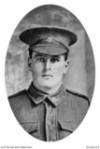
114. O Patterson

Owen PATTERSON (3221)
8 Battalion   DoW 21/4/1917

Owen Patterson is one of the more surprising omissions from the Alberton Shire Soldiers’ Memorial. Also, while his name is included on the Shire of Alberton Roll of Honor he is not marked as ‘killed’. At the same time, his name and death are recorded on the honor roll of Stacey’s Bridge. Overall, there was only limited recognition of the true nature of his sacrifice.

He was born and grew up in Melbourne and when he enlisted he gave his address as care of his sister in South Melbourne. The address of his father, as next-of-kin, was also in Melbourne.

However, he was definitely living and working in the local area when he enlisted. His name is even recorded on the Electoral Roll (1915) as a labourer of Jack River. His first medical (24/7/15) was in Yarram. His enlistment was noted in the local paper – Gippsland Standard and Alberton Shire Representative – on 28/7/15. There are also other references in the same paper to his involvement in local sport, particularly football. He played for the local Devon team. In March 1915 he was on the committee for the Womerah & District Sports.

The last local reference to Owen Patterson appears to be a ‘soldier’s letter’ written by ‘Private J. D. Loriman, formerly of Whitelaw’s Track’ which was published on 24/11/16. In the letter there is a reference to Owen Patterson as one of those locals who ‘came out all right’ from Pozieres.

Private Patterson enlisted on 2/8/15. He was 24 yo, single and he gave his occupation as ‘farm labourer’. His religion was Church of England. He joined as reinforcements for 24 Battalion and left Melbourne 26/11/15. After further training in Egypt he transferred to 8 Battalion on 24/2/16 and left for Europe. His unit disembarked at Marseilles on 31/3/16.

Private Patterson spent 10 days in hospital in December 1916 with bronchitis. He rejoined his unit in mid December.

He died of ‘wounds received in he field’ on 21/4/17. This description of the cause of death suggests that he was wounded on 21/4/17 and died the same day. The witness statements in the Red Cross file provide some additional information. At the time, he was working  in the company quarter master store, assisting with the distribution of rations. He was possibly in the reserve trench at the time he was wounded. He was hit by a shell and he died at a dressing station very shortly after. The dressing station was just yards from where he was hit. He was buried nearby, but recollections of exactly where he was buried were confused and the grave was lost. Shortly after his death, the lieutenant in charge of the QM store was in communication with his father and sister. As indicated earlier, Patterson gave his father as next-of-kin and the address of his sister as his address on enlistment.

The following statement from Pte J A Wheeler 5772 gives the essential details:

I knew him. His name was Owen. He was Q.M’s assistant. He came from Yarram, Gippsland. He was very young [perhaps he had put his age up by a few years on enlistment] pretty dark and about 5 ft 4” in height. He was guiding a ration party coming up with rations at Lagnicourt, and a shell burst behind him, and hit him under his tin hat. It knocked him senseless, and he died at a dressing station near Lagnicourt within an hour or two.

There is no specific detail in the battalion war diary about Private Owen’s death. The battalion was near Lagnicourt. There is a report of 3 men wounded and 1 missing on the day before (20/4/17); and, on the day after (22/4/17), the casualties for a patrol that attacked German positions were 1 dead and 14 wounded. No casualties were recorded for 21/4/17; but the diary does state, Enemy shelling fairly active during the day.

The cable advising the family of his death was dated 11/5/17. No one in the family completed the information for the (National) Roll of Honour. With no grave, Private Patterson’s name was included on the Villers-Bretonneux Memorial.

Personal kit reached his father in early November 1917: 2 Identity Discs, Cap Comforter, Tie, Writing Pad, Card.

Owen Patterson enlisted in Yarram as a young, itinerant farm labourer. At the time he was exhorted to enlist and do his duty, and he was promised, solemnly, that his name and sacrifice would never be forgotten. Unfortunately, there was only ever partial recognition of his story.

Note: Owen Patterson’s personal history has been compromised even more by the fact that his name in the National Archives has been entered, incorrectly, as PETTERSON. Also, the wrong service number (3121 instead of the correct 3221) has been ascribed for the search on the AWM’s First World War Embarkation Rolls.

References

Gippsland Standard and Alberton Shire Representative

National Archives file for PATTERSON Owen 3221 (see note above)
Roll of Honour: Owen Patterson
First World War Embarkation Rolls: Owen Patterson (see note above)
Red Cross Wounded and Missing file: Owen Patterson

113. C J Sweeney

Cornelius James SWEENEY (1449)
15 Battalion   KIA 11/4/1917

Cornelius Sweeney was the brother of Patrick Joseph Sweeney who had been killed in 1915 at Gallipoli (Post 45).  Besides the 2 brothers who were killed, there was another brother- William Henry Sweeney (645) – who survived the War. William was badly wounded, also at Gallipoli. It was described as a ‘bombwound’ and it was obviously severe:  compound fracture skull and left tibia burns and wounds face and left arm. He was repatriated to Australia after medical treatment in the UK and discharged on medical grounds at the end of 1916. In all, this particular family suffered great loss.

The Sweeney family, Irish-Catholic, had been in the local district from the late 1850s or early 1860s. Two brothers – Cornelius and Patrick – both born in Ireland, had moved to the settlement at Alberton after serving their sentences as convicts transported to Van Dieman’s Land. This first generation of the family established themselves as successful farmers in the local district. The success of the second generation of the family was more qualified. One line was definitely successful and, in fact, this success continued through to the third generation. For example, in 1915 this branch of the family had extensive land holdings – approximately 500 acres – of land at Woranga. At the same time, success for the family branch which took in the 3 brothers who enlisted in WW1 was more problematic. Initially, their father – Patrick Sweeney 1855-1932 – was a successful business man in a stock-agency partnership. He was also prominent in local politics. For example, in 1889 he was president of the Yarram branch of the Australian Natives’ Association. In 1901 he was Shire President. He was described as a grazier of Waronga. However, from the early 1890s his fortunes appeared to change. He gave up his partnership in the business. Unlike the other branch of the family, there is no indication that his family held any land  at the time of WW1 and, in fact, the 3 brothers who enlisted simply gave their occupation as ‘labourer’. Admittedly, on one enlistment form, one of them did refer to himself as a ‘dairy farmer’; but, as indicated, there is no evidence that any of them held land and, most likely, they were all working as farm labourers on other properties, possibly even on an uncle’s farm.

Obviously, all 3 brothers were well-known in the district. All had their names recorded on the Shire of Alberton Honor Roll and the 2 who were killed – Patrick Joseph Sweeney (8/8/15) and Cornelius James Sweeney (11/4/17) – had their names included on the Alberton Shire Soldiers’ Memorial. All 3 were also included on the honor roll for the Yarram State School. The father gave Yarram as the location with which his son – Cornelius – was ‘chiefly connected’.

Cornelius Sweeney enlisted on 16/9/14 as one of the original group from Yarram.  He was 35 yo and single. He had been in the Stacey’s Bridge Rifle Club prior to enlistment.

When Dr Rutter carried out the medical examination at Yarram, he wrote on Private Sweeney’s enlistment papers that he was ‘strongly recommended’ with ‘splendid stamina’. Like others from that first group of volunteers, it appears that Private Sweeney enlisted in the belief that he was joining the ‘Light Horse Gippsland’, but in fact he was taken on the strength of 15 Battalion. He left for Egypt on 22/12/14.

Private Sweeney was wounded twice, both times seriously, before he was killed at Bullecourt on 11/4/17. On Gallipoli in July 1915, he suffered a shrapnel wound to the back of his neck and was taken off the peninsula to hospital in Malta. He did not rejoin his battalion until October that year. The battalion moved to France the following year (June 1916) and he was again wounded, 2 months later, with another shrapnel wound to the right hip. His hip was fractured. This time he was hospitalised in England and did not rejoin the battalion until February 1917, some 6 months later. Then 2 months later he was killed in action at the first battle of Bullecourt.

The war diary of 15 Battalion for April 11 is depressing reading. There is a separate ‘narrative of action’ , dated 15/4/17, included in the diary which details the attack on the ‘Hindenburg Line South of Riencourt on morning of 11th. April 1917’.  Tanks were supposed to cut he barbed wire defences. The narrative explains how the tanks could be heard clearly by the enemy as they laboured towards the first stretch of wire. The tanks then failed to reach their objectives and the wire remained intact. Subsequently, the attacking troops, moving forward without the tanks, were cut down on the wire by enfilade machine gun fire. The report details 100 casualties on the first stretch of wire, and the losses on the second stretch were also heavy. Despite the losses, the battalion made it to the second German line and was part of the brigade that managed to seize about 900 yards. However, it proved impossible to hold the ground gained. The Australian troops were subjected to enemy bombing parties and enfilade machine gun fire down the trench and they were effectively cut off from their line, and supplies – particularly bombs and rifle grenades – could not reach them. The report details all the failed attempts to establish communication and supply lines between the troops in the German lines and their own forward lines. As the report grimly noted,

No runners have returned from Front Line and judging by the number of enemy Machine Guns playing in enfilade fire across No Man’s Land it was impossible to get back from captured position.

At round 11.00 in the late morning, the report noted that the men began to fall back to their lines, across the murderous no-man’s-land. There were more casualties. The battalion was relieved that night and moved back to Favreuil, approximately 10K from the front.

The overall casualties for the battalion from the single day’s fighting were severe: ’19 officers and 364 other ranks’. The following brief note from the report gives a stark assessment of the fate of those who took part in the assault and made it through to the German line.

None of the officers who reached objective returned and of the troops who took part in the assault only 52 have returned.

It appears that Private Sweeney made it across the two stretches of wire to the second German trench. He was then wounded by one of the bombs thrown by German bombing parties who were gradually dislodging the Australians from the captured position. He was one of many left behind when the battalion withdrew. There were many prisoners taken, but he was not one of them. The following is a witness statement from the relevant Red Cross file. It was given by Cpl. T McBratney (1973) on 26/2/18.

There was a Sweeney in B. Co. killed on 11th April. I knew him well. He was a 1st. or 2nd. Rft. And his number started 14… He was of medium height and dark. We called him Paddy. He was hit during the German counter attack at Bullecourt about 11 a.m. by a bomb in the stomach. This was in the German positions which we had taken earlier in the morning. I was alongside him when he was hit. Lt. Jones B. Co. (since killed) bandaged him. He had to be left behind in the trench when we retired.

There is no way of knowing when Private Sweeney died from his wounds but, most likely, it was within a short time of being was wounded. Certainly there is no record of him being taken as one the many prisoners. He was listed as missing after the battle and then a court of enquiry in early November (2/11/17), seven months later, determined that he had been killed in action on the same day. The family was advised by cable on 8/11/17. Presumably they had prepared themselves for this news over the intervening months. The fact that he was ‘missing’ was reported in the local paper – Gippsland Standard and Alberton Shire Representative–  as early as 11/5/17.

About a month after receiving formal advice of his son’s death, Private Sweeney’s father – Patrick Sweeney – wrote (8/12/17) to Base Records in Melbourne asking for help in locating and administering the will:

As your Department has informed me some weeks ago of the unfortunate death of my son (C. J. Sweeney) and he has a few belongings (horses, jinker etc) will you kindly do me a favour by letting me know if there is a will and whose duty it is to administer. I consider it is mine but I ask you as a special favour to let me know at your earliest convenience all particulars and you will confer a very great favour on
Yours truly
P. Sweeney
Father of the late C. J. Sweeney

There is no record of the response from Base Records and the father eventually employed the services of B P Johnson, one of the local solicitors, to manage the business of the will. The will left …the whole of my property and effects to my Mother & two sisters.

Surprisingly, there is no record of any personal kit being returned to the family.

There was no grave and Private Sweeney’s name appears on the Villers-Bretonneux memorial.

On Anzac Day 1918, there was a commemoration held at Yarram State School and one of the returned soldiers who was there that day, as a former student, was Trooper W H Sweeney. It was just over one year since his second brother had been killed on active service at Bullecourt and about two and a half years since his first brother had been killed at Gallipoli. Much was made in the speeches that day about the sacrifices made by families, like his, where so many sons had enlisted. As much was made of the idea that the ‘spirit of Anzac’ was ‘self sacrifice’ and  that, as Rev C. J. Walklate put it, … the 25th April three years ago was the beginning of Australian history. Sentiments like these were meant to comfort those families, like this one branch of the Sweeney family, where the losses had been so devastating.

References

Gippsland Standard and Alberton Shire Representative

O’Callaghan G (Comp) 2006, Clonmel to Federation: Guide to people in the Port Albert area 1841-1901, Vol 3, The Alberton Project

National Archives file for SWEENEY Cornelius James 1449
Roll of Honour: Cornelius James Sweeney
First World War Embarkation Rolls: Cornelius James Sweeney
Red Cross Wounded and Missing file: Cornelius James Sweeney

112. H M Raymond

Harold McCheyne RAYMOND (2675)
12 Battalion   KIA 9/4/1917

Harold McCheyne Raymond was born in the Melbourne suburb of Brighton. He attended Melbourne Church of England Grammar School [Melbourne Grammar School] and Geelong College. As a boy and young man, he had no contact with the Shire of Alberton and his father gave Melbourne as the location with which his son was ‘chiefly connected’. Harold Raymond’s name is not recorded on any memorial in the Shire of Alberton. However, there was a very strong indirect connection to the local area because Harold Raymond was the son of Reverend Arthur Rufus Raymond who, between January 1917 and October 1918, was the Church of England minister in Yarram.

As the local Church of England minister over 1917 and 1918, the father was called on to deliver the fateful telegrams informing the next-of-kin of the death of their loved ones. For example, the local paper – Gippsland Standard and Alberton Shire Representative – reported (27/4/17) the following in relation to the death of Gunner John Gellion who was the focus of the last post (Post 111):

The sad news reached Yarram on Wednesday evening of the death of Gunner John T Gellion, killed in action on 3rd April. The Rev. Mr. Raymond, Church of England minister, received a telegram from the Defence Department, asking him to kindly inform his brother, and to convey the sympathy of King and Queen and Commonwealth.

More ironically, the local paper reported (13/4/17) Rev. Raymond playing the same role for the parents of Private Percy David Boddy – Post 109 :

The Rev. Mr. Raymond performed the sad duty on Monday [9/4/17] of breaking the news to Mr. and Mrs. Boddy, Balloong, of the loss in battle of their son Reginald (sic).

The cruel irony was that, most likely, Rev. Raymond’s own son – Harold Raymond – was killed on 9/4/17 (Easter Monday, 1917), the very day he (Rev. Raymond) delivered the telegram to the Boddy family.

When it came the turn of Rev. Raymond himself, a fellow clergyman – Rev Tamagno, the local Presbyterian minister – delivered the telegram. The local paper (2/5/17) reported it thus:

The Rev. F Tamagno on Monday night had the sad duty of breaking the news to the Rev. A. Raymond, Church of England minister, Yarram, of the loss of his son in battle on 10th ultimo. Private H. McC. Raymond enlisted in Queensland, and would have attained his 25th birthday on 21st Inst. … The deepest sympathy will be extended to Mr. and Mrs. Raymond in the loss of their youngest son.

As indicated, Private Raymond enlisted in Brisbane, on 13/7/15. He was 23 yo and single and he gave his occupation as bank clerk. His father, given as next-of-kin, was then the Church of England minister in the town of  Ross in Tasmania. This was 18 months before the father moved to Yarram.

There was a brother – Rev. Charles Hedley Raymond – who was also a Church of England minister, at Parkville, Melbourne. Religion was a significant influence in the young man’s life and the father, on the information form for the (National) Roll of Honour noted that, He was a loyal churchman & a Christian and that, He enlisted in response to a powerful appeal made in his own parish church in Brisbane by the present Bishop of Tasmania, Dr. Hay.

Private Raymond joined as reinforcements for 26 Battalion but he transferred to 12 Battalion in March 1916. He was hospitalised – I. C. T. Feet – in July 1916 and then rejoined his unit on 16/9/16. He was killed 6 months later. There was some doubt over the circumstances of his death. The Roll of Honour has his death as ‘killed in action’ on 9 April 1917 but the official report of death has the date as ‘between 6th /10th April’. There is no record that he was initially listed as ‘missing’. The body was never recovered. His name is recorded on the Villers-Bretonneux Memorial. According to information in the service file, there was also, for a short time at least, a memorial cross erected in the Hermies Hill British Cemetery.

There is a Red Cross report for Private Raymond and there is also a detailed report in the war diary of 12 Battalion for the action at Boursies from 7-10 April 1917. At the time, the Australians were pushing the Germans as they were withdrawing to the Hindenburg Line. The Germans managed to inflict very heavy causalities as they gave up ground. In the 4 days of fighting, the casualties for 12 Battalion were 62 dead, 184 wounded and 10 missing. The fighting was also at close-quarters and brutal. For example, the war diary records that early on Sunday 8/4/17 (Easter Sunday) a party of 6 Germans surrendered to the Australians but then one or more of the group threw a percussion bomb. The diary records that the German prisoners were … immediately killed as a result.

In terms of the Red Cross report, the most reliable witness statement, dated 13/11/17, came, arguably, from Sgt. Huxley (4957). Sgt. Huxley, like Pte. Raymond, was in 12 Platoon, C Company of 12 Battalion:

He was in my platoon. No. 12. and was killed on Easter Monday [9/4/17] morning riddled with machine gun bullets, death was certainly instantaneous. I saw him just after. I saw the burial party going out the same morning. I know he was buried on the field. I do not think there was any proper cross or that  the grave would be registered, though I know the exact spot between [Louveral] and [Boursies] … Our Sgt. Major and several others wrote to his people and have had an acknowledgement. I think they have all possible particulars.

As indicated, word of the death reached the family in Australia at the very start of May 1917. The personal kit – Wallet, Photos. 2, Letters, 2 Discs, Wrist watch & strap (damaged), Wrist strap, Pendant, Photo, Scarf, 3 Handkerchiefs, 3 Testaments, Comb, Purse, Razor, Prayer Book. – arrived in January 1918.

Faced with the death of his son, Rev. Raymond continued to call for enlistments and support for the War. Three months after his son’s death, the local paper reported (11/7/17) his comments at the farewell of an another local, J L Dennison, from Womerah:

Rev. Mr. Raymond said his whole heart went out to the men who fought for the Empire, Home and Country, and referred to the death of his son at the front. Private Dennison was going to do his part. May God go with him and keep him safe, and may he return decorated with a Victoria Cross.

In normal circumstances the reference to winning the Victoria Cross would have seemed odd. Certainly, many local men had received military awards but the possibility of winning the VC was always very remote. However, at that time, 2 VCs had been recently awarded for the very action in which Private Raymond had been killed. One of the recipients was Captain James Ernest Newland, in charge of A Company,12 Battalion. Captain Newland himself had no direct contact with the local area; but he was the brother of the local recruiting sergeant, William Andrew Newland. There was also another Newland brother – Alfred Lindsay Newland – who had been killed in action at the end of 1916. He had also lived and worked in the local district before the War. Overall, the Newland family was well-known locally and, not surprisingly, the award was written up in great detail in the local paper (13/6/17; 21/9/17). It must have also been weighing on the mind of the Rev. Raymond.

As indicated, Rev Raymond left the Shire of Alberton at the end of September 1918. He served less than 2 years. There were many farewells and, on the face of it, he was was well-liked and respected. He was praised, in particular, for his work in improving the finances of the local church: a feat his predecessors had not achieved. People spoke of his genuine interest in, and care for, his parishioners. However, for all the praise, a letter-to-the-editor appeared in the Gippsland Standard and Alberton Shire Representative on 16/10/18 which suggested another side to the shift from Yarram. It was anonymous – just signed ‘Church Goer’ – but the fact that it appeared was significant. Rossiter, the editor, was closely involved with the local Church of England. He had been, and was probably still serving, on the Board of Guardians for the local Church of England and it seems hard to believe that he would have tolerated the following anonymous letter if there was nothing to it. In fact, it is conceivable that Rossiter himself wrote it. The casual or background racism in the letter is reflective of the time.

Sir, – In your issue of Wednesday last I was very pleased to notice an allusion to Rev. A. R. Raymond, and the esteem in which he was held. The wonder is with so many warm friends (as shown in the practical manner described by you) that he got the move on. Surely it must have been a very small minority that was the cause of it. Well, I do not envy them their success, or would like to incur their responsibility, for in my humble opinion Mr. Raymond was one of the best ministers that ever came to Yarram. Possibly he was too evangelistic for them. It is the fashion in these days for some ministers to preach smooth things, so as not to ruffle the feelings of their hearers. Mr. Raymond was not of that sort. This small minority would probably delight in a more fashionable church with a parson to match; something like one in America, of which it was said that an old darkey wished to join. The minister thought it was hardly the correct thing to do. Not wishing to hurt the old chap’s feelings, he told him to go home and pray over it. In a few days the darkey came back. “Well what do you think of it by this time?” asked the preacher. “Well, sir,” replied the darkey, “I prayed and prayed, and da good Lawd, He says to me, Richard, I wouldn’t bother ma head about dat no more. I’ve been trying to get into dat church myself for da last twenty years, and I aint had no luck at all.”

Rev. Raymond had been one of the local clergymen to push for the local Co-Operative Store to give up its licence to sell alcohol as part of the renewed push to promote temperance in WW1. Perhaps that position cost him some support. Perhaps he had pushed too hard for financial contributions from the locals. Whatever the case, it does seem that there was some sort of pressure exerted behind the scenes for his move. In his farewell speeches he certainly gave the impression that he was disappointed to be be moving after such a comparatively short time.

But beyond the local politics of the church, you cannot but wonder – to continue a theme initially presented in Post 26: Soldiers of Christ   that the bigger challenge facing Rev. Raymond was to reconcile, at every Easter that followed, the death of his son for ‘Empire Home and Country’ with the joyous celebration of the resurrection of the Son of God.

References

Gippsland Standard and Alberton Shire Representative

National Archives file for RAYMOND Harold McCheyne 2675
Roll of Honour: Harold McCheyne Raymond
First World War Embarkation Rolls: Harold McCheyne Raymond
Red Cross Wounded and Missing file: Harold McCheyne Raymond

111. J F Gellion

John Farquhar GELLION (846)
4 FAB  KIA 3/4/1917

John Farquhar Gellion was the grandson of one of the first squatters in Gippsland. His grandfather (John Gellion 1811-1884) drove cattle overland from Melbourne to Port Albert in 1844. Gellion’s trip took 6 weeks and was one of the first such cattle drives from Melbourne. At the time, most cattle were coming in to Gippsland from the ‘Sydney side’. John Gellion had been born in Scotland and arrived in Victoria in 1840. ‘One Tree Hill’, the Gippsland station he established, was on the banks of the Albert River. Rev George Cox featured the exploits of the pioneer John Gellion in one of his articles – ‘Notes on Gippsland History’ – in the Gippsland Standard and Alberton Shire Representative on 17/9/15. The article appeared just a couple of months after the grandson had enlisted in the AIF.

The father of John Farquhar Gellion – Farquhar, was the grandmother’s name – was also John Gellion (1852—1892)  and he too was a grazier at West Alberton. Indeed, there were several brothers from the same – the second – generation who were also graziers and farmers in the district.

John Farquhar Gellion – the third generation of the Gellion family in Gippsland – continued the family tradition and variously described himself as farmer or grazier. He held land (128 acres) at Alberton West. Obviously, the name Gellion – the township of Gelliondale was named after the family – was well known throughout the Shire of Alberton.

Not surprisingly, John Farquhar Gellion’s name was included on both the Shire of Alberton Roll of Honor and the Alberton Shire Soldiers’ Memorial. It also appeared on the honor rolls for Stacey’s Bridge, the Yarram Club and the Alberton State School. When his wife – M C Gellion – completed the information for the (National) Roll of Honour, she gave Alberton as the location with which her husband was chiefly connected.

John Gellion was born in Alberton (1888) and grew up in the area. As indicated, he attended the local state school. However, given the family background, it was hardly surprising that, first, he continued his education beyond primary school and, second, that he undertook it at Geelong Grammar. He also attended Hawkesbury Agricultural College. At the time he enlisted he was back in the Shire of Alberton where he was working with his brother, Henry Gellion. The two brothers jointly held the land at Alberton West and, presumably, there was an agreement that John would enlist while Henry stayed behind and managed the property. Henry was given as the initial next-of-kin. John had also been a member of the rifle club at Gelliondale.

John F Gellion was 27yo when he enlisted in July 1915 (8/7/15). He was taken on as reinforcements for 13 Light Horse Regiment. The initial medical was at Yarram on 7/7/15. At the time he was single and, as indicated, he gave his brother, Henry Gellion, as his next-of-kin. His religion was Presbyterian.

Two months later, on 7/9/15, Trooper Gellion married Mary (Molly) Bodman. She was the daughter of William Edward Bodman, one of the largest and most successful graziers in the Shire of Alberton. Bodman’s property was ‘Trenton Valley’ and the family also had a residence (‘Bangalore’) at Toorak in Melbourne. Gellion’s mother had in fact been a Bodman herself — Emily Alice Bodman – but she had remarried – James McKenzie – after John Gellion’s death in 1892. She lived in Melbourne at her residence, ‘Lianos’ at Brighton. Obviously it was a wedding that featured 2 of the most notable families in the Shire and while the ceremony itself was small and celebrated in Melbourne – St. John’s Toorak – there was a detailed report in the local paper – Gippsland Standard and Alberton Shire Representative – on 17/9/15. The reception was held at the bride’s parents’ residence at Toorak. There was a short honeymoon in Ballarat. The report noted that the bridegroom was expected to leave shortly for the War.

In fact, Trooper Gellion left for overseas service on 10/9/15, just 3 days after the wedding.  On the embarkation roll his wife was listed as next-of-kin and her address was given as that of her parents’ Melbourne residence: Bangalore, Toorak.

Trooper Gellion served in Egypt in both the Composite Light Horse Regiment and 13 Light Horse Regiment to March 1916 when he transferred to the artillery (2nd Divisional Ammunition Column) and embarked for France. He reached France in late March 1916 and then in July that year he transferred to 4 Field Artillery Brigade. He was serving in this unit (12 Battery) when he was killed in action on 3/4/17.

Gunner Gellion’s death occurred at the time of the Australian push to the Hindenburg Line over the period late March to early April 1917. Presumably, the death was the result of a German artillery barrage directed at the Australian artillery which was covering the Australian advance.

There is no war diary available for 4 Field Artillery Brigade for the time of Gunner Gellion’s death. The reason for this shortcoming makes for grim reading. The war diary of 4 FAB appears only to start with an entry dated 10 April 1917 at Vaulx, the immediate area where Gellion was killed just one week earlier. This first entry records that on that day (10/4/17) in the afternoon … a high velocity shell about 15cm calibre landed in the Office of Brigade Headquarters. All the officers of the Brigade’s headquarters were killed instantly. The entry also noted … At the same time all records and documents relating to the Brigade were destroyed. Presumably, all previous war diaries were destroyed in this incident.

There was a report of Gunner Gellion’s death in the local paper on 27/4/17, nearly one month after he had been killed. It noted that word of the death was passed to the brother – Henry Gellion – by Rev Raymond, the local Church of England clergyman. There were references to how well known Gunner Gellion was in the district and how he had married just before he left for overseas. It also noted how the young wife had only very recently returned to her mother at Toorak. She had been staying at Trenton Valley for the past several months.

In June 1917 (22/6/17), the local paper published a detailed, first-hand account of the actual death; but, oddly, it was all based on unidentified sources:

A Yarram soldier [unidentified] writing from France, thus refers to the late lamented death of Trooper [sic] John Gellion: – There is bad news to tell this time. Poor old Jack Gellion got a piece of shell in the head and was killed instantly. He was on scout duty, and was putting in his time cleaning the gun. There were no shells falling near at the time, but just by chance a stray one landed a couple of yards away, and he got a big piece of it in the back of his head. We are thankful to know that he did not suffer at all. He would hardly have known there was a shell coming. We went up and saw him decently buried, and are getting a substantial cross made. We have an artist, and a man that is pretty good at carving, in the tent with us, and between them they are going to do it up in a manner that will last. Don’t let this make you any more anxious about us. Another soldier boy [unidentified], writing home, says that Jack Gellion was the best liked in the whole regiment.

It is possible that the information for the story in the local paper came from a cousin, Henry Crawford Bodman (1253) who was also in the artillery.  He enlisted within a fortnight of his cousin and, although seriously wounded in August 1918, he survived the War. The claim is based on a letter from this cousin, Henry C Bodman, written after the War, in 1922. He wrote, from Darriman, seeking information on the location of his cousin’s grave. Specifically, he wanted to know if the body of his cousin … was ever recovered and moved to one of the central cemeteries for soldiers in France. He noted that his cousin – J F Gellion No. 846 of the 12th Battery A.F.A. – … was killed at Vaulx-Vraicourt, France and buried there by myself and friends. In reply, Base Records informed him that the body had been exhumed and re-interred at Vaulx Hill British Cemetery.

The cable advising of the death was dated 20/4/17, just over two weeks after the death. The formal AIF report of death was completed on 10/5/17. Personal kit was returned in March 1918: Letters. Gospel. Air cushion. Photos. Even though the records indicate that the change in the next-of-kin had been noted, the kit was returned to the brother – Henry Gellion – who had been the next-of-kin prior to the wedding.

Incredibly, in addition to Henry Crawford Bodman the cousin referred to above, there were another 3 cousins – David J Gellion (4240), Thomas John Gellion (34999) and Alfred Charles Gellion (38967) –  who served in the artillery. It appears that this branch of the Gellion family had moved out of Gippsland by WW1. Their names do not appear on the Shire of Alberton Roll of Honor and all three gave their address as Toorak, Melbourne on their enlistment forms. It is another example of the complex web of enlistments within a family. In this particular case, of the 5 cousins who served in the artillery, only John Farquhar Gellion was killed.

References

Gippsland Standard and Alberton Shire Representative

O’Callaghan G (Comp) 2006, Clonmel to Federation: Guide to people in the Port Albert area 1841-1901, Vol 1, The Alberton Project

National Archives file for GELLION John Farquhar 846
Roll of Honour: John Farquhar Gellion
First World War Embarkation Rolls: John Farquhar Gellion

110. A H Whitford

Albert Henry WHITFORD (5103)
21 Battalion KIA 20/3/1917

Albert Whitford was born in Won Wron in 1887 and grew up in the Shire of Alberton, attending no less than 4 local state schools: Alberton, Devon North, Won Wron and Yarram. His name is recorded on the honor rolls for all 4 schools. It also appears on the Shire of Alberton Roll of Honor and the Alberton Shire Soldiers’ Memorial. It is also on the separate honor roll for the Devon North District. His mother gave Yarram as the location with which he was ‘chiefly connected’.

The Whitford family name was well known in the district. The father –  John Joseph Whitford Jnr – had been born  in Gippsland (1854). He had been a selector with land at Boodyarn and Won Wron. But he faced significant health problems and had sold his properties just before he died in 1899. His wife, Mary Jane Whitford, retained a house in Yarram and 12 acres at Devon.

There were 10 children in the family. The oldest – Emily, born 1876 – died as a 5 yo from burns she received in a bushfire in 1881. Of the 6 sons, 3 enlisted and the other 2 – Thomas Joseph Whitford and Reginald James Whitford – survived the War.

At the time of his enlistment in January 1916, Albert Whitford gave his occupation as labourer. Presumably, he was working on farms in the local area. He was 28yo and single. He listed his widowed mother – Mary Jane Whitford – as his next-of-kin. She was living in Church Road, Yarram. He gave his religion as Church of England.

The first medical was in Yarram and he was then re-examined in Melbourne 2 days later (24/1/16) when the enlistment was completed. The medical papers indicate that he was missing the second finger on his left hand.

Private Whitford joined 21 Battalion and left Melbourne on 3/7/16. After an additional training in the UK, his group of reinforcements were taken on strength in France in late November (22/11/16). In late January 1917 he was wounded and hospitalised for two weeks. He rejoined the battalion on 7/2/17.

Private Whitford was killed in action on 20/3/17. However there was initial confusion over his fate. He was reported as both ‘wounded’ and ‘missing’. The family received advice in mid April (13/4/17) that he had been wounded. It was the standard form letter that did not provide any details, but reassured the next-of-kin that the case was not serious and that … it is to be assumed that all wounded are progressing satisfactorily. The cable advising the mother that her son had in fact been killed did not reach Australia until mid May (15/5/17) nearly 2 months later.  When, later that same month (May, 1917), the Devon North State School honor roll was unveiled, the name of A H Whitford appeared with a cross, as one of the ‘brave boys who have paid the supreme sacrifice’ (Gippsland Standard and Alberton Shire Representative, 25/5/17). The formal report of death was not completed until 3/9/17.  The body was never recovered and Private Whitford’s name is recorded on the memorial at Villers-Bretonneux.

The war diary for 21 Battalion in mid March 1917 traces the movement of the battalion to the Hindenburg Line in pursuit of the Germans as they staged their tactical withdrawal as part of Operation Alberich.  On March 18, in the early afternoon, the battalion passed through Bapaume and by 11.30 that night they had reached and occupied Vaulx-Vrarcourt, and were only about 10 K from the Hindenburg Line itself. The next day they encountered enemy patrols near Ecoust-St-Mein when they pushed forward another 5 K and then on the 20 March – the day Private Whitford was killed – the battalion came under artillery and machine gun fire from the villages of Ecoust, Longatte and Noreuil. An attack planned for Noreuil on that day ‘failed to develop’. There was enemy shelling all afternoon. The casualties were heavy: 21 killed, 139 wounded and 11 missing. All this fighting was taking place very close to the Hindenburg Line and not far from the village of Bullecourt where the next great tragedy for the AIF was soon to unfold.

Witness statements from the Red Cross file for Private Whitford tell how he was shot near Longatte and buried, with others, near the village. Even though the grave was identified, it was subsequently ‘lost’.

He was in B Co. I knew him in Victoria. I come from the same town, Yarram, Gippsland. He was killed on March 20th, 1917 at Longatte and buried on the right hand side of the road near the village close to a big crater. There are a number of graves there. His grave has a cross on it. I could point out the spot.    Pte. T Paterson 5066

Private Thomas Paterson (5066) enlisted in 21 Battalion round the same time as Private Whitford. Paterson was from a farming family from Darriman and would have grown up with Whitford. He survived the War and returned to Australia in July 1919.

Another witness statement – Cpl D Matheson – provided additional details:

I saw him wounded in the leg at a place called Langote (sic). It happened during an advance. I was told by Pte. W.[?] Smith, 21st Battn. B. Coy 8th Platoon that while he was crawling back endeavouring to get to the dressing station, the Germans turned their Machine guns on to him and killed him. I saw his grave near place of casualty, and it was marked by a cross bearing his number, name and unit.

But this statement did not line up with the one actually given by the same Pte. W Smith:

I am pleased to say that I can give you all the information required as I was close to him when he was killed. I am pleased to say he died without pain as he shot through the heart. I would have seen that he was buried properly only the circumstances did not permit., as it was he was buried after the charge on the filed near some of his mates. There can be no doubt as to his identity as I was in camp with him and his brother Reg for over 12 months.

When she completed the Roll of Honour information, the mother – Mary Whitford – listed 4 cousins of her son who were also were killed in the War. It is a striking illustration of how families, and the wider local community, were affected. Three of the cousins appear on the Soldiers’ Memorial in Yarram: the Sweeney brothers – Patrick and Cornelius- and George Jeffs. The fourth cousin killed – Roy Whitford – grew up in Won Wron but by the time the War started he was farming in Western Australia at Narrogin. There was also a younger brother, Reginald James Whitford, who also enlisted in 21 Battalion within a month of Albert. He reached the rank of corporal, survived the War and returned to Australia in September 1919.

The relevant personal kit – 3 Testaments, Gospel, 3 Military Books, Novel, Razor strop, Housewife, Wristlet watch strap, Writing pad, Mouth organ, Photos. – was returned to the family in early March 1918.

In the Gippsland Standard and Alberton Shire Representative on 20/3/18, the first anniversary of Private Whitford’s death, the following in memoriam appeared:

WHITFORD – In sad and loving memory of my dear son, Pte. A. H. Whitford, killed in action in France on 20th March, 1917, aged 30 years. Sadly missed.

He sleeps not in his native land,
But under foreign skies
Far from those who loved him
In a hero’s grave he lies.
No loved ones stood around him
To bid a fond farewell,
No word of comfort could we give
To him we loved so well.

– Inserted by his sorrowing mother, sisters and brothers.

References

Gippsland Standard and Alberton Shire Representative

O’Callaghan G (Comp) 2006, Clonmel to Federation: Guide to people in the Port Albert area 1841-1901, Vol 3, The Alberton Project

National Archives file for WHITFORD Albert John 5103
Roll of Honour: Albert John Whitford
First World War Embarkation Rolls: Albert John Whitford
Red Cross Wounded and Missing file: Albert John Whitford


109. P D Boddy

Percy David BODDY (4983)
24 Battalion KIA 13/3/17

Percy Boddy was born in Balloong in 1890. He grew up in the Shire of Alberton, attending the state primary schools at Balloong and Woodside. His name is recorded on the honor rolls of both schools.  His name is also recorded on the Shire of Alberton Roll of Honor and the Alberton Shire Soldiers’ Memorial. His father gave Yarram as the location with which his son was ‘chiefly connected’.

When he enlisted in early 1916, Private Boddy gave his father – David Boddy – as next of kin. The father was farming (55 acres) at Balloong. According to the 1915 rate book, Percy Boddy also had a small holding – 5 acres – at Balloong. The son also gave his occupation as farmer and, presumably, he was working with his father.

On his enlistment papers Percy Boddy was 25 yo and single. However, there are papers in his service file which indicate that there was an ‘ex-nuptial’ child, a son. The file shows that after the War this child and the child’s mother both received pensions against Private Boddy’s death on active service. The boy was living with his mother from the early 1920s but there was a period prior to this when he had been in the care of the Neglected Children’s Department in Melbourne. There is no indication in the file that Private Boddy’s parents knew of the child and it is possible that Private Boddy himself never saw his son. In June 1922, it appears the mother thought the medals should go the father (David Boddy) who, in fact, died in 1923.

Private Boddy enlisted in Melbourne on 10/2/16. He joined as reinforcements for the 24 Battalion and left Australia in late July (28/7/16). After further training in England, he reached France in the middle of November (17/11/16) and was finally taken on strength on 10/2/17. He was killed in action on 13/3/17, just over one month later. The father would have been advised by cable in early April (5/4/17) of his son’s death and the formal report of death was completed on 18/4/17. The death was reported in the local paper – Gippsland Standard and Alberton Shire Representative – in April (18/4/17):

Private Percy David Boddy, son of Mr. David Boddy, of Balloong, killed in action in France on 13th March, was well-known in this district as owner of The Barb trotting stallion, and took a great interest in trotting stock. One of his many friends the other day remarked that at Easter 1916, they were only talking together over the war, and Perce was wished good luck across the sea. It proved to be his last Easter. [Presumably, Percy Boddy had gone home on leave for Easter 1916].

The war diary for 24 Battalion indicates that Private Boddy was one of 5 killed and 18 wounded on the day. On the day, the battalion was operating in the area round Grevillers/ Le Barque (near Bapaume), employing patrols to probe the German line as the Germans themselves were systematically falling back to the newly created Hindenburg Line.

The picture below shows the original grave of Private Boddy. Its location was described as ‘between Le Sars and Le Barque 2 3/4 miles s.w. of Bapaume’. In time, the remains were exhumed and re-buried at Warlencourt British Cemetery. The picture also suggests the difficulties associated with retaining the precise identity of those buried in such temporary graves, and it does appear that there was some confusion during the exhumation process. However, in July 1926, the Imperial War Graves Commission determined that Private Boddy 4983 was buried in ‘Plot VIII, Row “D”, Grave 49. Warlencourt British Cemetery’.

In September 1918, one and a half years after his son’s death, the father wrote to Base Records in Melbourne enquiring why he not received any of his son’s kit. The reply from Base Records pointed out that a package containing the personal effects had in fact been sent via ‘registered packet’ in February that year. The father was advised to contact the local Post Office (Woodside). The file does not reveal what subsequently happened; but it does reveal that the inventory of the personal effects, as despatched from the AIF Kit Store in London, showed that the only items returned to Australia were a ‘Testament’ and ‘3 photo proofs’.


References

Gippsland Standard and Alberton Shire Representative

O’Callaghan G (Comp) 2006, Clonmel to Federation: Guide to people in the Port Albert area 1841-1901, Vol 1, The Alberton Project

National Archives file for BODDY Percy David 4983
Roll of Honour: Percy David Boddy
First World War Embarkation Rolls: Percy David Boddy

108. J H Martin

John Herbert MARTIN (4257)
5 Battalion KIA 2/3/17

John Herbert Martin was born at Richmond and grew up in Melbourne (Abbotsford). He attended Melbourne High School and then trained as a teacher. In early 1913, he was appointed as the teacher at Hiawatha. His tenure at this local state school in the Shire of Alberton was only a few months. When he enlisted 2 years later, in August 1915, he was teaching at Warrnambool High School.

J H Martin is recorded on the honor roll for Hiawatha SS, and when this roll was unveiled in November 1917 – commonly, the school honor rolls were created during the War and names added progressively – mention was made of the ‘supreme price’ that he had paid (Gippsland Standard and Alberton Shire Representative, 7/11/17). While he was obviously known in the local area, his name is not included on either the Shire of Alberton Roll of Honor or the Alberton Shire Soldiers’ Memorial. His mother gave Warrnambool as the location with which he was ‘chiefly connected’. Both students and staff at Warrnambool High School placed in memoriams in the local paper – Warrnambool Standard (5/4/17) – when news of his death reached the town. The former teacher was described as a ‘highly respected and beloved teacher’ who ‘did his duty as a teacher faithfully, and died doing just as faithfully his duty as a loyal subject and brave soldier.’

Private Martin enlisted in Melbourne on 3/8/15 and he was taken on reinforcements for 5 Battalion. At the time, he was 24 yo and single. His enlistment form shows that he had had some military experience as an instructor with the cadets and he left Australia with the rank of acting corporal. However, with one exception, all the records in his file indicate that his substantive rank throughout his service was private. The exception was that the inventory for his personal kit, returned after his death, referred to him as Sgt. Martin. Presumably, at some point in his service he reached the rank of acting sergeant.

He gave his father – Richard Martin of Abbotsford – as his next-of-kin. His religion was Presbyterian.

His group of reinforcements left Melbourne on 28/12/15 and, after some additional training in Egypt, reached Marseilles on 4/4/16. He was taken on strength with 5 Battalion on 17/5/16.

He was wounded twice in the second half of 1916. On the first occasion, 25/7/16, he remained on duty but he was hospitalised for nearly a month after the second (6/11/16) – GSW L hand. He rejoined his unit after convalescence on 2/1/17 and was killed in action on 2/3/17.

The war diary for 5 Battalion shows that at Ligny-Thilloy on 2/3/17 there was a German attack on the front line trenches held by the battalion. The raid was repulsed and the German casualties were given as 19 killed and 19 taken prisoner. The casualties for 5 Battalion were 8 killed, 3 wounded and 9 missing. Later that day 5 Battalion was relieved by 7 Battalion.

There is a Red Cross report for Private Martin. Presumably, his parents wrote to the Red Cross seeking more information on the circumstances of his death. The statements in the file indicate that he was shot through the head, possibly by a sniper, while manning his Lewis gun during the German raid. The most detailed statement was provided by J G Leslie on 26/9/17, nearly 7 months after the death.

Re your enquiry about the death of Pte. J. H. Martin No 4257, I was not on the same post that he met his death in, but was just alongside. His friend Pte J. H. Knox 4845 A. Coy 5th Battn was with him and he wrote to Pte Martin’s people explaining his death. Pte Martin was a man about 5 ft 8″ in height and dark. His occupation in civil life was that of a School Teacher. One of the schools he had taught in was down at Warrnambool. He was also fond of motor bikes and shortly before enlisting had been for a trip on his bike through Tasmania. He left Australia as a Sergeant in the 13 Reinforcements of the 5th Battalion. Early in the morning of the 2nd of March we were in the line in front of a village on the Somme, named Thilloy and the Germans came over and while my friend was defending his post with his Lewis gun one of the enemy shot him. The bullet hit him just above the right eye and death was instantaneous. He was buried just where he was killed and a cross was put up to mark his grave. Since then the Military Authorities have fixed up his grave. It is on the right of the main Albert to Bapaume Road just in front of the village. He was a great friend with all the boys and we were all very sorry when he was killed. The Officer that was there at the time collected all his things and sent them home.

The statement describes how Private Martin was buried where he fell. Such ‘isolated’ graves were identified at the time and then after the War the remains were transferred – with every measure of care and reverence in the presence of a Chaplain – to formal cemeteries. Private Martin’s remains were transferred to the Beaulencourt British Cemetery shortly after October 1919.

In February 1918, the family received the following personal kite:

9 Books, Scarf, Balaclava Cap, Pr Mittens, 10 Handkerchiefs, 2 Brushes, Goggles, Pack Playing Cards, Razor, Kit bag handle [?], Fly veil, Metal pencil case, Arabic Book, Chevrons.

References

National Archives file for MARTIN John Herbert 4257
Roll of Honour: John Herbert Martin
First World War Embarkation Rolls: John Herbert Martin
Red Cross Wounded and Missing file: John Herbert Martin

Gippsland Standard and Alberton Shire Representative

Warrnambool Standard

Appleyard, D 1999, Hiawatha: From Pioneers to Pines, Dumbalk South Gippsland

107. A J Godfrey

Albert James GODFREY (417)
1 Tunnelling Coy. DoW 21/2/17

Albert John Godfey was born in Melton in 1884. He came from a very large family of 14 children. His father – Horatio Nelson Godfrey – married Ruth Mansell in 1870 and there was 1 child from this first marriage. After the death of his first wife in 1872, Horatio Godfrey remarried – Fanny Jane Jeffery Curtis – in 1874 and the couple had 13 children over the period 1875 -1895. Albert was the eighth child.

The locations entered for each birth registration reveal that the family moved about a good deal. It appears that they lived in the Alberton district for about 10 years from the late 1880s. The father ran a blacksmith business at the time. Albert was a student at the Alberton State School and his name is included on the school’s honour roll. In fact, records indicate that in 1891 the father was fined for the non-attendance of 3 of his children, Albert was one of them, at the school. There are other records indicating that the father was also involved in other legal disputes – offensive language, assault – in the district at the time. Then in late 1896 or early 1897 the family moved to Western Australia. While most of the family, including the mother, remained in the West, the father returned to Alberton in 1897. In the same year, he died at Alberton aged 53 yo. He was buried in the Alberton cemetery. The local paper – Gippsland Standard and Alberton Shire Representative – reported at the time (28/4/97) that he had recently returned from WA, had been in ill health for several months and that he committed suicide. He killed himself on his 53rd birthday.

Five of the 8 boys in the Godfrey family enlisted in WW1, but only Albert was killed.

Albert Godfrey enlisted in Perth in February 1916 (11/2/16). He gave his mother – Fanny Jane Godfrey, widow – as his next-of-kin and he also gave her address – Morowa, WA – as his own. By that point he had been living in Western Australia for 20 years. When his mother completed the information for the (National) Roll of Honour she gave Sandstone WA as the place with which her son was ‘chiefly connected’. By the time Albert enlisted his link to the Alberton district was tenuous and it is hardly surprising that his name is not included on either the Shire of Alberton Roll of Honor or the Alberton Shire Soldiers’ Memorial. At the same time, the family would definitely have been known in the local area and Albert, and siblings, had attended the local state school where, as indicated, his name was duly acknowledged on its honour roll. From information provided by the mother, Alberton SS was the only school he attended.

When Albert Godfrey enlisted he was single, 31 yo and he gave his occupation as miner. His religion was Church of England.

His unit – Mining Corps, No.1 Company – embarked for overseas, from Sydney, less than 2 weeks later. He would have been one of the last miners recruited, in haste, for the new Mining Corps. The unit reached Marseilles on 5/5/26 and then Hazebrouck on 8/5/16.

The Australian Mining Corps had been formed from late 1915 to support the work of the British engineers and tunnellers on the Somme front. In Europe in mid 1916, the Australian Mining Corps was re-formed into 1-3 Tunnelling Companies and Sapper Albert Godfrey found himself in 1 Tunnelling Company which, in early November 1916, replaced the Canadians at the infamous Hill 60.

The degree of difficulty and danger associated with the work of the tunnellers on the Western Front was extreme. Added to the ever-present everyday risks associated with mining, the war time environment meant that the enemy was also actively engaged in counter operations to locate and destroy the allies’ tunnel system and also endeavoured to mine and blow up the allies’ above ground trench system and other fortifications. There was also the risk that regular above-ground bombardments could also collapse underground works. Much effort went into locating the enemy’s tunnels and mines and, concurrently, preventing them from locating your works, both offensive and defensive. It was acknowledged that the military service of the tunnellers was nerve-wracking and extremely dangerous.

On 26/1/17 Sapper Godfrey was admitted to hospital suffering from ‘suppuration of the gums’ and ‘pyorrhoea’. He spent nearly 2 weeks there before being transferred to the Australian General Base Depot (AGBD) at Etaples on 11/2/17. The AGBD facility was employed to accommodate men coming from England who were still to join their units in France, and also men returning to their units from hospital who were still in need of some short period of convalescence.

On 20/2/17, at the AGBD, Sapper Godfrey shot himself in the face. He was taken immediately to No. 26 General Hospital but died from his wounds early the next day. On the day he died (21/2/17), a court of enquiry was convened at Etaples and determined that:

No. 417 Sapper Godfrey shot himself in the cheek while in an unsound state of mind.

The finding was confirmed by Brigadier-General Thompson on 7/3/17:

I am of the opinion that No. 417 Sapper A. J. Godfrey, 1st Tunnelling Co. A.I.F. committed suicide whilst of unsound mind.

The witness statements taken at the court of enquiry describe what happened. Godfrey had been quartered in a tent with several other men. They had decided to go for a cup of tea – it was 4.45 in the afternoon – and Godfrey had said he would join them but he stayed behind when they left. There was a single shot. People ran to the tent where they saw Godfrey stagger out. There was a rifle on the floor of the tent. Medical assistance was called for. The wound was described as ‘a hole in the roof of his mouth extending into the left cheek.’ Godfrey did not say anything to those there.

The evidence presented at the court of enquiry certainly suggested that Godfrey was not in a sound state of mind at the time.

Sapper A Langmead who was in the tent with Godfrey, and whose rifle Godfrey used to shoot himself, stated:

I had only known Sapper Godfrey since he had come from hospital about a week ago. He seemed very melancholy and sometimes used to sit for half an hour with a vacant stare and then jump up with a start and leave the tent, and return and sit down without saying anything.

Similarly, Driver J Archer, who also shared the tent, testified:

We left him alone in the tent [when the others went for the cup of tea]. I have known him for about a week and thought him strange in his behaviour, and he did not seem right in his mind. He seemed weak and was unable to step over the flap of the tent in entering.

The Company Clerk – Corporal C Coravan – added another dimension to the general picture of mental instability:

He came to me several times and complained of being infested with lice. He was put of the Sick Report and examined by the Medical Officer and found to be clean. I did not think he was quite right in his mind, as he seemed not clear in his ideas and very slow to grasp the meaning of anything he was told.

Finally, there was the evidence of L/Cpl A W Porter AAMC who was the person who dressed Godfrey’s wound at the tent immediately after he had shot himself. Porter had also obviously had contact with him over the ‘supposed’ lice infestation.

His left cheek was severely lacerated and bleeding profusely. I plugged the wound and bandaged it up. I noticed that his right boot was off. He had been attending for lice. He did not appear to be quite sound in his mind.

Clearly, the court of enquiry would have had no difficulty in reaching its finding that Sapper Godfrey shot himself ‘in an unsound state of mind.’

However, there was one other witness statement which did not fit with the general picture  given above. It was prepared by the doctor – Capt. L M Snow – who treated Sapper Godfrey when he was hospitalised with the pyorrhoea. It was dated 2/3/17 so, presumably, was not considered by the court of enquiry, which convened and gave its determination on 21/2/17.

Sapper A. J. Godfrey No. 417 was admitted into my ward on 31/1/17 suffering from Pyorrhoea. He had an upper and lower plate repaired and his teeth attended to.

He was signed up for convalescence camp on Feb. 8th 1917. During his stay in hospital he was most helpful in the ward and showed no signs of any mental trouble.

Interpreting a person’s mental condition with only limited evidence, and across an interval of 100 years, is obviously a fraught exercise. However, taken at face value, this last statement does at least suggest that notwithstanding the possibility of some pre-existing, congenital mental health condition and the very apparent indicators of a serious mental breakdown, it could well have been the specific fear of returning to the front line at Hill 60 that drove Godfrey to suicide. Arguably, he could not face the reality of going back, and as the certainty of returning drew closer his mind unravelled.

The mother, as next-of-kin, was notified of the death within one week. The cable was dated 26/2/17. However it is not clear if the mother was ever informed of the precise circumstances of the death. The Report of Death (Army Form B. 2090A) does indicate ‘Died of Wounds (Self-Inflicted)’. However, the Nominal Roll shows only ‘DOW 22/2/17’ and the entry on the (National) Roll of Honour shows ‘Accidental (Injuries)’ as the cause of death. When the mother was sent the information form to complete for the (National) Roll of Honour she would have read that her son’s death was described as ‘Died of Injuries’. It is also hard to believe that any friend or acquaintance of her son in the AIF would have ever written to give her the true account of how her son had died. At the same time, a family member – identity not given – did request that the Red Cross ‘obtain the fullest details possible of the wounds, death and burial of [A J Godfrey]’. The request was dated 3/10/18. The various statements provided to the Red Cross by the relevant AIF units made it clear that Albert Godfrey had died from self-inflicted wounds. For example, the OC of the hospital where Godfrey was taken wrote:

I beg to inform you that this man was brought into this Hpl. about 5 p. m. on 20-2-17, suffering from a self-inflicted wound of the face, caused by a single bullet. He was in a very bad condition and gradually got worse and died at 4-5 a.m. on 22-7/17. He was buried the following day in the British Military Cemetery at Etaples, according to the rites of the Church of England religion.

There is no record of the information that the Red Cross subsequently provided to the family.

As indicated, Sapper Godfrey was buried in the Etaples Military Cemetery.

The mother wrote in May 1917 (25/5/17) seeking information on her son’s will and effects. There is an urgent tone to the letter:

I wish to make enquiry concerning my sons will and any property he may have had at the time of his death. His name Sapper Albert John Godfrey 417 First Australian Tunnelling Company. He enlisted from Meekatharra West Australia. Died of wounds somewhere in France on 22 February 1917. He sailed from Fremantle on the first of April 1916. If you have no record of the case in your office will you kindly tell me how to go about the business. I am a widow. Please let me know by first mail.

The typically few personal effects arrived in August 1917 (14/8/17):

Identity disc, Leather Purse, Ring, Pencil, Bullet, Match Box Cover, Mirror, Pipe, Leather Belt, Handkerchief.

It is impossible to know what the mother would have made of the single bullet returned with her sons’ belongings. And it seems incredible that it was ever sent.

Clearly, it is not possible to say definitively where the bullet came from or what it meant. However, we do know that Sapper Godfrey did not have his own weapon in the tent – he used Sapper Langmead’s rifle – and that when the tent was searched there was no ammunition found. Langmead also insisted at the court of enquiry that he had not left his weapon loaded and that he had never seen any ammunition in the tent. The only round found was the spent cartridge in the rifle Godfrey had used to shoot himself. One explanation is that Sapper Godfrey had been carrying 2 rounds of ammunition on his person, and that, in a macabre twist, the redundant round was, unwittingly, sent home in his personal kit.

Overall, Albert Godfrey’s was a tragic case but it does at least begin to show the personal horrors and ever-present terror men had to manage, even away from the front lines. The son’s death was also a tragic echo of his father’s fate.

References

O’Callaghan G (Comp) 2006, Clonmel to Federation: Guide to people in the Port Albert area 1841-1901, Vol 2, The Alberton Project

National Archives file for GODFREY Albert John 417
Roll of Honour: Albert John Godfrey
First World War Embarkation Rolls: Albert John Godfrey
Red Cross Wounded and Missing file: Albert John Godfrey

106. J O Mason

James Oliver MASON (2236)
46 Battalion DoW 11/2/17

James Oliver Mason was born at Won Wron in 1898. His family was then living in the Shire of Alberton and it appears the father had been farming in the local area for at least 10 years. The father – William Wallace Mason – had held land at Devon, Bulga, Calignee and Won Wron. He had also worked as a contractor (roadworks) for the local council. However, it appears that there were financial difficulties round the time James was born. There was a mortagee auction of land – 183 acres at Bulga – held by the father in 1896.

By the time James Mason enlisted in 1916, the parents and at least some of the children had moved to Gobur. An older brother – Christopher Mason – was still in Yarram. It appears he ran the local dealership for Dodge cars. Also, another older brother – William Mason – had remained farming in the district at least up until 1915. The children had attended the local state schools. James and another brother who enlisted – Richard – had their names recorded on the honor roll for Tarraville State School. On the information form for the (National) Roll of Honour, the mother recorded that James had also attended the state schools at Yarram and Stradbroke. Significantly, she also gave Yarram as the place with which her son was ‘chiefly connected’. An ‘in memoriam’ published in the Gippsland Standard and Alberton Shire Representative on 28/2/17 remarked how the brother  – Mr. Chris Mason – lived in Yarram. It also praised the enlistment of both James and Richard, and noted of James,

The young hero who has made the supreme sacrifice for his country, was well known in Yarram, as in his boyhood days he attended the local State School.

Notwithstanding the family’s close association with the district and the mother’s explicit identification of Yarram as the place with which her son was ‘chiefly connected’, James Mason’s name is not recorded on either the Shire of Alberton Roll of Honor or the Alberton Shire Soldiers’ Memorial. Similarly, the names of the 2 other brothers who enlisted – Richard Wallace Mason and William Hickman Mason – are not included on the Shire of Alberton Roll of Honor.

James Mason gave his age as 18 yo when he enlisted in March 1916 (7/3/16). Because he was under 21 yo, both parents were required to sign the enlistment form. The age given on the form both parents signed was ’18 yrs 7 mos’. However, when the mother completed the information for the (National) Roll of Honour she specifically noted that when he died (11/2/17) her son was ’18 years 7 months’. Also, the in memoriam referred to earlier, specifically noted that he was only 18 yo when he was killed. The memorial card featured below also has the age as 18 yo. It appears that, with his parents’ support and blessing, James Mason enlisted as a 17 yo. By early 1916, at least according to the AIF authorities, this type of underage enlistment was not supposed to happen.

James Mason gave his occupation as labourer while his mother noted that he was a ‘shearer’. His religion was Church of England and he was single.

Private Mason embarked as reinforcements for 46 Battalion on 16/8/16. There was further training in England until the end of December 1916. Whilst undertaking training, he was charged in November 1916 with being ‘absent without leave’ – in Salisbury – and travelling on the train network without a ticket. He was given 14 days detention. It was a not uncommon story with the Australian troops in training camps in England.

Private Mason reached France just before Christmas, on 22/12/16. In January 1917, he spent a short time in hospital with influenza. Finally, on 7/2/17, he joined 46 Battalion in the field. He was one of 32 men who were taken on strength with the battalion that day.

Just 4 days later (11/2/17) he was wounded – S.W.[shrapnel wound] Chest Penetrating, Right Thigh and Right Leg. He was admitted to a casualty clearing station (South Midland) but died of wounds the same day (11/2/17). 

In February 1917, 1 Anzac Corps held the front near Gueudecourt. The conditions for the troops were particularly severe. Throughout February, there were several attacks on the German lines which were characterised by fierce, close-quarter bombing exchanges, including both rifle and hand grenades. According to its war diary, 46 Battalion relieved 13 Battalion on 4/2/17. On 11-12/2/17 it was involved in a ‘minor operation’ where the objective was to extend its position in Cloudy Trench. Employing both grenadiers firing rifle grenades and bombing parties armed with Mills hand grenades, the plan was to push along and take control of another 200 yards of the trench. Overall, the attack was described as ‘most successful’, but there was the inevitable German counter-attack. The war diary gave the casualties as ‘2 killed & 4 wounded’, at least one of whom, Private Mason, died of his wounds. The Germans lost 5 killed, and 1 was taken prisoner. The relatively light casualties would not have accurately reflected the ferocity of the close-quarter fighting.

Word of their son’s death reached the family in just over a week (19/2/17). He was buried in Dernancourt Communal Cemetery. In late February 1918, one year after his death, the personal kit reached the parents: Letters, Photos, Pocket Books 2, Religious Book, Belt, Handkerchief, Badges, Diary, Coin.

As indicated, there were 2 other brothers who enlisted. Richard, who was 2 years older, enlisted in January 1915. The other brother, William, was 12 years older. He first enlisted in January 1916 but was discharged as medically unfit less than 2 months later. He subsequently re-enlisted in early December 1917.  Both these brothers survived the War.


References

Gippsland Standard and Alberton Shire Representative

O’Callaghan G (Comp) 2006, Clonmel to Federation: Guide to people in the Port Albert area 1841-1901, Vol 2, The Alberton Project

National Archives file for MASON James Oliver 2236
Roll of Honour: James Oliver Mason
First World War Embarkation Rolls: James Oliver Mason


105. The soldiers’ vote denied

In early March 1917 (2/3/17), the Gippsland Standard and Alberton Shire Representative published the mesage that Birdwood had sent to all members of the AIF immediately prior to the first referendum conscription, 4 months earlier. In the letter, included here in full, Birdwood is obviously calling for a Yes vote from the men.

To members of the A.I.F.- As General Officer Commanding the Australian Force, it is not for me to interfere in any political matters or to influence the voting of our men on the coming Referendum.

I know well that in any case all will vote as seems to them necessary in the best interests of Australia and the Great Empire to which we belong, whose freedom has been, and still is, in danger of being turned into slavery by Germany. I feel, however, that I can inform you all of how really essential it is that we should get all the men available to keep these magnificent Australian forces, which are now in the field, and whose name is renowned throughout the Empire, up to their strength.

Every single man would, I am sure, bitterly resent and regret it if we had to reduce a single battalion, battery or company, every one of which has now made history, and established a tradition which we all hope will last as long as the British flag flies over our world-wide Empire. But it is, I think, probable that all ranks do not know as well as I do the absolute necessity of keeping our reinforcements right up to strength, and the present system is not doing this. I feel sure all know the great feelings of regard and pride which I have for every man of this force who has up to now come forward of his own free-will and after great sacrifice.

Many brave men have given their lives for the sake of our Empire and the freedom of the world – lives which have been uselessly sacrificed if we relax our efforts in any way until we have the Germans right down on their knees. Remember, too, boys, that the word freedom does not only mean for ourselves, but what is far more important, freedom for our children and our children’s children. For them, I know no sacrifice can be too great.

In the magnificent manifesto, which our Prime Minister, Mr. Hughes, has sent us, he has fully shown what exemptions there will be when universal service is adopted. It will be seen from this that members of families, some of whom have already come forward, will be fully safeguarded, and no man need fear that there is danger of, we will say, the brother who has been left behind to look after the affairs of the family, being ordered to come out. The shirker, however, will be caught, and made to do his share, instead of staying at home as he has done up to now, not only evading his duties, but getting into soft jobs which we want to see kept for our boys here when they return, or for the representatives of their families who have been left in Australia.

I have nothing more to say, boys, except to point out to you as strongly as I can that the necessity does exist, and I hope that after these two years, during which we have been soldiers together, we know each other well enough to realise that I would not say this without good reason. Having said it, I leave it to you to act according to your conscience, for the good of our King and country, the honour of our people, and the safety of our wives and children.
W. R. Birdwood
Lieut. General G.O.C., A. I F.
October 16th. 1916

The copy of the letter, the paper explained, had been provided by B P Johnson who had obtained it from his brother. [Johnson’s brother was Sergeant Norman C Johnson who had enlisted  – 4 LHR – in August 1914 and who had been repatriated to Australia in April 1916 after having been wounded at Gallipoli.]

The publication of the letter suggests that while the referendum had been defeated, Imperial Loyalists in the local community – like Johnson and Rossiter, the editor – were still steadfastly commited to conscription. Voluntary enlistments had not picked up after the referendum, and, in the minds of people like Johnson and Rossiter, the arguments for conscription remained as valid as at the time of the referendum. The publication of Birdwood’s message to his ‘boys’ reminded everyone of the apparently indisputable logic for conscription. As Rossiter wrote in his introduction to the piece, it was … a powerful appeal for the “Yes” vote. Moreover, the case for conscription was reinforced by the claim that the AIF had in fact voted Yes in the referendum.

Specifically in terms of the soldiers’ vote, the Gippsland Standard and Alberton Shire reported as early as 20/12/16 that the majority had supported conscription. On that occasion, Hughes was reported as stating in federal parliament that … a majority of soldiers of the A.I.F. abroad was substantially in favor of the referendum. When he was pressed for the exact numbers, Hughes declared that he could not divulge them because … the desire of the military authorities in England precluded that [possibility]. The pressure on Hughes to release the precise numbers continued and, finally, at a speech in Bendigo on 27/3/17, he claimed that the number “For” was 72,000 and the number “Against” was 58,000: a majority of 14,000. The numbers were reported in the Gippsland Standard and Alberton Shire on 30/3/17. [The figures given in the Official History were 72,399 Yes and 58,894 No: a majority of 13,505.]

At the end of March 1917, as far as Hughes and his supporters were concerned, the arguments for conscription had always been – and still remained –  beyond dispute; and they had the support of the highest levels of the AIF command. Further, the soldiers themselves voted for conscription by a clear majority. Therefore, the logic ran, the men overseas had been betrayed by the No vote back in Australia.

However, there was a very different version of the story of soldiers’ vote which, at the time, was concealed. Hughes had his way with his version of the truth and the episode reveals just how comprehensively the Government was able to manipulate the narrative of the War.

The alternative version comes, ironically, from the personal diaries of CEW Bean, the Official War Historian. Bean was certainly an advocate of conscription and indeed he did his best to ensure that the soldiers’ vote was Yes. But at the same time, his personal diaries expose the deceit and manipulation that characterised Hughes’ desperate attempt first to win over the soldiers’ vote, and then, when it did not suit him, effectively bury it.

Hughes’ intention was to have the AIF vote held before the vote back in Australia so that the assumed strong Yes from the soldiers would influence the national vote. However, as the vote neared he was informed by his supporters in England, including Murdoch, that the soldiers’ vote was not guaranteed. At this point Bean became involved. He was given the task of contacting Birdwood and encouraging him to make a representation to the soldiers urging them to vote Yes. This is all set out in detail in the following extracts from Bean’s personal diaries. Bean’s role in all this is very apparent. He was most definitely a key participant in the history he came to write. Bean wrote in a form of shorthand but for present purposes, I have written the diary notes in full prose, without changing any of the content.

On Sunday 15 October 1916, Bean wrote in his diary:

Last night [Sa 14/10/16] White told Bazley not to let me go on any account without seeing him.
[CBB White, Brigadier General, General Staff, Australian and New Zealand Army Corps. Working under Birdwood but generally regarded as the real power in the AIF in France at the time]
[AW Bazley, nominal ‘batman’ to Bean but really a colleague]

Hughes had sent a cable to Birdwood from Burnie in Tasmania. It said that the opposition to conscription in Australia was due to the formidable intrigues of the ultra-socialists and the Fenians; and that everything depended on the lead which the vote of our own force in France gave to Australia. He called on Birdwood, with all the earnestness he could put into the cable, to put aside precedent and to use his great influence with the troops to get them to carry conscription by a big majority and give a lead to the people.

White wanted me to see Birdwood and urge him to do a really big thing for the Empire, and take this step. At the moment we both took it that what Hughes wanted was a message to the Australian people.

I hesitated a moment. Perhaps I am weak. I knew that White’s decision, whichever way it was, would have settled me in mine. But I have a very great fear of anyone in Birdwood’s position – a military servant of the State using his influence in a big question at the polls. I should have taken a few minutes to think. I wasn’t sure which way White was. Then he told me he “wants the little man to play the man – and to take a big opportunity of doing a great thing for the Empire.” The loss of this measure would be a terrible smack in the face of the Empire. It would count enormously. It seemed to me that Birdwood might very well tell the Australian people what the military necessity was for reinforcements, as their chief military adviser. It would have enormous effect. White added: “Yes, and get him to point out that every effort that we have made up to the present would go for nothing- would be utterly wasted – if this were lost.” White means, I think, that it would lose us the good name which our energy and public spirit have so far won.

When I got to London I started to search for Birdwood. … After a fair hunt, I heard of Birdie at the Charles Buckleys, where his daughter often stays. Birdie was at Clifton and would not get back till 8.20. I decided to miss the train and stay and see him. Fortunately I found out that the train left at 11.15. [PM]

Birdie, who hated the idea of being made to give evidence at the Dardanelles Commission during the war, had got away quietly to Lincoln and only went to Clifton on his last day.

He came in to the Buckleys with his pretty daughter, the little Harefield nurse, at about 8.45. We had a long talk in Mrs Buckleys sitting room, by ourselves; Mrs Buckley had been exceedingly kind in telephoning all over London for me to find out if he had returned.

Birdie pointed out at once that what Hughes wanted was, clearly, for him [Birdwood] to give a lead to the soldiers. He never hesitated a moment. I too could see at once a reason for this. If the soldiers voted No – that would kill the question, the people at home would never vote Yes if their army here voted No. The Australian vote was to be later, after the result of the A.I.F.’s vote was known. I fancy Hughes had arranged this thinking that the A.I.F would be certain to vote Yes. Anyway, it was no use Birdie sending a message to Australia if the A.I.F. voted No. The thing to do was to get the army to vote Yes.

Birdie told me that he had seen Lloyd George. While he was there Murdoch asked if he might come in. Murdoch wanted Birdwood to send a message to Australia. Lloyd George agreed, too, that B. [Birdwood] should do this, until Birdwood pointed out that if he did, it might be said by opportunists that he was ordering the soldiers how to vote. L. George agreed, and it was decided not to do this; but Murdoch got letters of introduction to Haig and Joffre and started for France to get messages from each of them if possible.

This shows how Ll. George hangs on the Australian attitude – how important he thinks it. Birdwood didn’t hesitate. He got me to sit down and write, to his dictation, a message to the men saying that he wanted them to vote by their consciences and not to influence them in any way. But he added that he probably knew better than they did, the need for reinforcements. He was sure they would not like to see any of the units, with all their traditions and history, broken up. There was a need for men. If the effort of Australia were relaxed now, all the brave lives sacrificed before would have been sacrificed in vain. The Govt has told them what exemptions were to be – they need not fear that the brother left at home to mind the business would be called to enlist; the men it would especially get were the shirkers who were at present filling all the nice fat billets which we wanted to see our men in on their return, or their relations at home.

The poll was to be tomorrow [Mo 16/10/16]. I urged that if possible this [Birdwood’s statement] ought to and could be wired tonight. But the A.I.F Headquarters said it couldn’t. I think it still could. However, Col. Wright said not. So B. asked if the poll could be put off a day or two. Wright, who is under Anderson (who is managing the business of getting the vote taken) said it could. So B. asked them to wire postponing it.

I don’t know one bit the effect of these steps. They are very risky I am sure. I should have tried every way I could to have got the wire across without postponing the poll, but I didn’t put my reasons strongly enough though B. could see that I wanted it.

There it is. I hope it does the business. For I am sure conscription is right.

Bean’s diary entry is striking at many levels. The tone is anecdotal and free-flowing. He places himself at the very centre of the action. He claims close familiarity with the leading political and military figures. He is a confidant and trusted messenger.

The actors seem caught up in the moment of a ‘good idea’ or a ‘desperate plea’ from Hughes and no one is prepared to step back and apply any sort of critical thinking. Bean talks about the unprecedented act of having a military commander intervene in an obviously political situation but there is no evidence of any deep reflection from anyone on just how significant the matter was. The narrative appears to be on the lines of a select group of powerful individuals determining, on the run, that despite the risks something had to be done.

Essentially, all the key characters involved were attempting to influence the soldiers’ vote – despite all the transparently false qualifications Birdwood included in his message –  and Birdwood, acting on Hughes’ request, was using his military status and reputation to intervene directly in a critically important political matter. Moreover, the delay to the voting schedule, so that Birdwood’s message would have the chance to influence the outcome, was obviously intended to manipulate the voting process.

Subsequent entries in Bean’s diary reveal that the political intervention did not achieve the desired outcome. In fact, it probably had the opposite effect. The following entry was dated 21/10/16, immediately after the troops had voted, and it points to an additional strategy which Hughes was keen to employ. Separate from the actual soldiers’ vote on the referendum, Hughes wanted a series of resolutions in favour of conscription passed by public meetings of the soldiers in France.  He intended to use such resolutions to promote the Yes vote back in Australia.

Murdoch tells me that Young (S.A.) O.C. Beale and another have gone across (at his request, by Haig’s leave) to address meetings upon conscription, amongst the men and see if they cannot send some resolution calling on the Australian people to send more men. If the resolution is in favour of conscription, it will be telegraphed to Australia; if against, it will perhaps be telegraphed to Hughes, but he will not publish it. I shall send the results of all these resolutions or none at all, to my papers. Hughes says that Sinn Feiners have sent agents to Australia and that the Irish and I.W.W are against him. I believe the women will carry him through.

Murdoch undoubtedly is a fine strong helper. …

Everybody here exercised [?] about the Referendum. Birdwood’s circular to the troops did little good – rather the reverse. Col. Anderson thinks Hughes is getting as nervous as can be about it. Anything favourable from here will be telegraphed out to give Australia a lead. Anything unfavourable will be suppressed. Sir Newton Moore did not issue Hughes memorandum to his troops at all. Anderson, who is his enemy, hints that this was because Moore would like to see Hughes and Labour out of office as a result of the loss of Referendum, in order that he (Moore) might get some job or position from the Liberal Govt that would follow. But this is absurd.

Anderson is a clever man but a jealous and ambitious one. He has saved a lot of money for Australia, but sometimes his motives are not purely public spirited.

The 2 men that Murdoch had sent to visit the troops in France in an attempt to secure the resolutions in favour of conscription were (Sir) Frederick William Young and Octavius Charles Beale. Young was the South Australian Agent General at the time. He was only 40 yo. Beale was a successful Australian business man living in London at the time. He was much older at 66 yo. Both men were staunch Imperialists. Young was knighted in January 1918 and he was even elected to the UK House of Commons. He effectively lived in England until his death. Beale returned to Australia after the War but he did achieve English honours, including being admitted as ‘freeman of the City of London’ (1918).  Beale was obsessed with the fear of ‘racial decay’.

Anderson, was Brigadier-General Robert Anderson who was Commandant, AIF Administrative Headquarters, London. He was credited with improving efficiencies in the AIF. He was also spoken of as a nationalist, in the sense that he stood up for the AIF’s interests vis a vis the British Army. (Sir) N J Moore was at the time Brigadier-General in charge of all the AIF depots and training centres in Britain. He had been Premier of Western Australia. He was also a very successful business man. Moore was yet another significant Imperialist. He was also elected to the UK House of Commons (1918-23).

Bean’s tone is again anecdotal and once again he places himself in the centre of the politics and intrigue. Once again, people’s motivations are represented as fairly pedestrian. Hughes clearly had no intention of allowing any negative news from the soldiers in France to make it back to Australia. If there was no support for conscription from the troops – either via the vote itself or the passing of various ‘resolutions’ in favour of conscription – then all the related news was to be withheld.

Obviously word was coming in by this point as to how the troops had voted and the intelligence was not encouraging. Bean believed that Birdwood’s message had backfired. A last minute attempt was required to get some sort of resolution in favour of conscription, from at least some of the troops. Hughes was desperate.

There is another diary entry for Sunday 22/10/16. In it, Bean talked about the last minute efforts to get support from key military leaders and the then urgent mission of Beale, Young and one additional, unnamed, agent.  Bean also revealed the apparent failure of the vote amongs the front-line troops.

In London. Lunched with Murdoch at The Times office. He has seen Joffre, Haig and Pollard and each of them has given him an interview. Haig would only make it a message, stating how much France and the allies needed the troops. Birdwood has promised to send a message on the military need for reinforcements. The vote in France has been taken and (up to the present count) the result is a ten per cent majority against conscription. They are accordingly sending to France O. C Beale, Young, and one other, to address public meetings in favour of  [conscription?].

The last diary entry was dated 25/10/16. In it Bean discloses the dismal failure of the efforts of Young to secure a resolution in support of conscription from the troops. Bean also defends his actions in pressing Birdwood to issue his message in support of conscription, but he clealry has reservations about the whole episode.

I can see (though he doesn’t say so) that White thinks I made a mess of my errand to Birdwood. He thinks I ought to have got a message to the people of Australia and not to the troops, and that the message to the troops may be interpreted as an attempt at exercising a dangerous influence and that the putting off of the voting for two days was a dangerous matter. Anderson told White he would not have let him [Birdwood] do it and perhaps I ought to have told him [Birdwood] plainly the dangers I saw in it. But there we are. As White says, I don’t know that Anderson would have found it so easy to stop him [Birdwood].

However, he really did nothing which was not perfectly defensible. He had a perfect right to tell the men his opinion on a point so important – and he had no control whatsoever over the voting. As a fact, I suspect he lost votes rather than gained them.

Bazley tells me that Young, Agent General for South Australia and a very able man, came over as arranged and asked the troops at a public meeting to send a resolution to Australia in favour of conscription. Haig had permitted the meeting provided there were no speeches, except Young’s, and no officers were present. Young put it to them that at present Australia stood first among the Dominions in the eyes of the British nation and that they would lose that regard if the country did not vote for compulsory service. The attitude of the men was quite clear. They said that they did not care whether Australia came first or last in the opinion of the British people. They wanted enough Australians left to maintain Australia’s present character after the war. They did not want so many Australians killed off that the population of immigrants flowing in, should alter the characteristics of the country. They could repopulate it by immigrants but they wanted it populated by Australians. They thought Australia had given enough to the war without forcing those who did not wish to come. They knew what it was like, now, and they were not going to ask others to come into it against their will. Young was going to wait till Sunday, but he went away on Saturday. The 23 and 21 Bns, which he saw, were almost unanimously against him.

They are funny beggars, but they have a lot of sense. It can’t be called a selfish attitude, anyway.

The 2 battalions that Young addressed – 21 and 23 Battalion – appear to have then been in their billets at Steenvorde. Both had recently been in the front lines. It is difficult to identify when Young spoke to the men but the most likely date was Friday 20/10/16. This was also the date that 21 Battalion voted in the referendum. The date for 23 Battalion’s vote is not given in the unit’s war diary but it must have been round the same time. The point is that Young was speaking to the men at the time that they were also voting – or had already voted – in the referendum. Consequently, the arguments they gave for not supporting any resolution that Young proposed were the same ones that shaped their vote. The arguments they gave, as represented by Bean, went to the core of Australia’s national, not imperial, identity. Australia had done enough. Young realised he had failed and went back early to Britain..

Historians generally argue that the overall success of the Yes vote in the AIF came not from those on the Western Front – their vote represented the clear rejection of conscription – but from those on the troopships, in the training camps in the UK  and serving in the Light Horse in Egypt.

The attitude and votes of the soldiers on the Western Front were effectively hidden. Back in Australia, as was evident in its publication in the local paper, Birdwood’s message to the troops continued to be used as a justification for conscription and, after the defeat of the referendum, Hughes was able to represent the vote of the AIF as being in favour of conscription. However, he was not able to use their vote, as he had intended, to influence the vote back in Australia.

Bean’s diary entries reveal Hughes’ determination to control, absolutely, the politics of the conscription vote. They also point to the human frailty, weakness and ordinariness of many of the key actors of the time who, coincidentally, exercised the power of life and death over their fellow countrymen. In Bean’s account, no one emerges with much integrity – or even intelligence – except for the troops themselves: the funny beggars in Bean’s words.

References

Gippsland Standard and Alberton Shire Representative

Bean, CEW 1941, Official History of Australia in the War of 1914-1918, Volume XI – Australia During the War, 7th Edition 1941

Australian Dictionary of Biography

Bean’s diaries

There are digital versions of Bean’s diaries available from the Australian War Memorial website:

AWM 38: Official History, 1914-18 War: Records of CEW Bean, Official History

Item number 3DRL 606/61/1 – October 1916

Item number 3DRL 606/62/1 – October 1916

Item number 3 DRL 606/63/1 – October-November 1916

General histories

Beaumont, J 2013, Broken Nation: Australians in the Great War, Allen & Unwin, Crows Nest NSW. (see PP 243-244)

Connor, J, Stanley, P, Yule, p, 2015, The War At Home, Vol 4 The Centenary History of Australia and the Great War, Oxford University Press, South Melbourne. (see p 113)