Category Archives: Prominent Citizens

180. Farewells in 1918

According to reporting in the local paper, the number of men who received formal farewells in 1918 was 22. Over the same period of time – the whole of 1918 – the number of local men who enlisted was approximately 40. In other words, about one half of those who enlisted in 1918 were given formal farewells from the Shire of Alberton. It is possible that in one or two cases a more private farewell occurred but it was not reported. It was also the case that another small group of men specifically rejected the offer of a formal farewell. More commonly, as noted in previous posts, men enlisted in Yarram, went off to camp but then never returned to the Shire of Alberton before embarking for overseas service. Hence there was no opportunity for a formal farewell.

Previous posts have shown the background complexities associated with enlistment over 1918. There was considerable ongoing pressure for enlistments, particularly after the major German offensive – and spectacular successes – in April-May 1918.

While public recruiting drives continued to be held locally – see Post 167. The search for ‘eligibles’, May 1918 – many of those who came forward at such public demonstrations failed the medical. There was a further drop-out rate amongst even those who did pass the (local) medical. Either they could not obtain parental permission or they failed subsequent medicals or perhaps they were discharged as unsuitable.

There was also the local recognition that, whatever the official recruiters might claim, the number of eligible men left in the district was small. Estimates suggest that by the end of 1918 approximately 800 men with a link to the Shire of Alberton had enlisted. Consequently, however desperate the need for reinforcements, the reality was that the available pool was, by the end of 1918, very limited. At the same time, this reality was often discounted – particularly by those who spoke at farewells – and the calls for enlistments remained right to the end of the War. The denunciation of ‘cold footers’ and ‘shirkers’ also continued to the end.

An indication of how the pressure was maintained to the end comes from the observation that men continued to enlist right through to early November 1918. Indeed, 3 men – James Wentworth Davis, Albert McEvoy and Christian Gregory Olsen – received their railway warrants for travel to Melbourne to complete the enlistment process on the very day of the Armistice, 11/11/18. Equally, as will become apparent, formal farewells were held through to the end of October 1918.

As previously noted, the farewells staged in the small settlements or townships of the Shire – places such as Womerah, Stacey’s Bridge, Lower Bulga, Wonyip – tended to be more community-focused and elaborate than those conducted in Yarram. Invariably in these places, the farewell was incorporated in a social of some kind, there was a very large attendance and the men being farewelled received not just the conventional Shire Medallion and (religious) Card but also some additional remembrance, for example a ‘wristlet watch’ or a ‘gold locket’ or inscribed ’gold medal’. In Yarram, attendance always seemed to be an issue and, as previously noted, A E Paige, the head teacher of the primary school and one of the common speakers, would often bring a party of students from the school to help make up the numbers. The problem with farewells at Yarram was that they were invariably used for recruiting purposes. The farewells were organised by the same group of Imperial Loyalists who were involved in the various iterations of the local recruiting committee and they also backed the Yes vote in the 2 referenda on conscription. Eligibles would hardly attend farewell – or welcome home – events at Yarram and, over time, ordinary locals would, inevitably, become reluctant to attend to be harangued on the need for enlistments. Then, when the numbers attending dropped, the speakers attacked the townsfolk for being indifferent to the War situation and the sacrifice of those being farewelled.

The themes employed by speakers at the farewells, both in Yarram and the outlying centres, remained constant to the end of the War. Loyalty to England and the Empire was ever present. As was the praise of those in the AIF and the conviction that as a fighting force it ranked with the very best. Indeed, for many it had proved itself to be the best fighting unit in the world. Speakers referred to commentary in the newspapers that constantly pushed this claim. Often there were also references to the young man enlisting as representing the very best character and spirit of the original ‘pioneers’ of the district. The pioneers had battled to settle the land and now their descendants were battling to protect what had been created. But by far the most constant theme was the one that had enlistment as a test of character; and this was after 4 years of constant appeals for enlistments, endless recruiting drives and 2 failed referenda on conscription. The essential dichotomy was there throughout the entire period of the War: that while most Australian men proved themselves loyal and brave and enlisted, there was a solid core who refused to acknowledge their responsibility and, no matter what pressure was applied, did not enlist. The sub themes here were that such men were cowardly, they forced mere boys and married men to take their place and do their duty, and they took the jobs of those who had enlisted voluntarily. These men were to be despised. They would forever be outcast because they had never been part of the AIF. Moreover, they must never be able to take either the jobs or the promotions of those who had enlisted.

Often, the various themes and sub themes ran together. For example, Leo Furlong was farewelled from the school at Lower Whitelaw on 21/1/18 and then again at the Womerah Hall on 22/1/18. The farewells were reported in the Gippsland Standard and Alberton Shire Representative on 30/1/18 and 6/2/18. Furlong enlisted as a 21 yo . His family ran a dairy farm. One of the speakers at Womerah was Henry John Alford another local dairy farmer who had take a strong, public pro-conscription position. At the time, his son – Edward J Alford – was serving in the AIF. He would be killed on 14/4/18 (Post 158). Alford started by declaring that at Womerah … practically all the eligible men had enlistedand now married men and boys were going. Accepting that this was the case, in such a small community the locals would have known which ‘eligibles’ had not enlisted. Alford went on to dismiss one of the arguments – it was not Australia’s fight – put up by those who refused to enlist. In the process, Alford not only questioned their reasoning but attacked their base character. These were not real men:

Unfortunately there were men (so called) who refused to take any part in the defence of Australia. They said, “This is England’s quarrel, not ours. If an enemy should land in Australia we would fight.” He would say to those men, “If England goes down Australia is doomed. Only the British navy protects us”. Should an enemy land in Australia there would be no scrub on the hills thick enough to hide those heroes.

Another local farmer who spoke that day – Matthew Thomas – managed to tie together a range of themes:

Mr. Mat Thomas said there were two classes of men who were not taking their part in the war. Those who would like to go, but were afraid, who he felt sorry for, the other class were those who would like to see the enemy win who were traitors, and should be turned out of any position they held. No returned soldier should be looking for work while one of these men held a position.

In May 1918, not long after his son had been killed, H J Alford spoke at another farewell from Womerah. It was reported on 7/6/18. Of the 2 men farewelled that night, William H Clemson was very young. He gave his age as 19 yo but in fact he might have been as young as 16 yo. It was a complicated enlistment and, indeed, he might not have lasted in the AIF, presumably because he was so young. In any case, it must have been Trooper Clemson’s very young age that prompted H J Alford to declare:

It was a shame that young men of more mature years [those not as young as Clemson] should stand back and allow a boy to go to fight for them. If there were any eligible men there that night who could go he appealed to them in God’s name to go at once while yet there was time; if not, how could they face these boys when they came back? They would stand branded all their days as shirker, who in their country’s danger refused to defend her.

Clearly, the stage was set for some form of orchestrated reckoning when the War ended and the men of the AIF returned home. The heroes of the AIF, backed by the general community, would confront and settle the score with the ‘traitors’, ‘cold footers’ and ‘shirkers’.

There was another theme that touched on family sacrifice, or, more pointedly, the father’s sacrifice. As indicated, H J Alford’s son had been killed in April 1918. Another very public Imperial Loyalist, B P Johnson, lost his son in mid May 1918 (Post 164). Men in the public eye, who were in favour of conscription and who advocated ceaselessly for enlistments, promoted the enlistment of their own sons as praiseworthy and proof of their own loyalty. They even loosely cast themselves as modern-day Abrahams, where they, as well as their sons, were making great personal sacrifice. Benjamin Couston was the manager of the Yarram branch of the Bank of Victoria. He had been in Yarram since late 1916. He was pro-conscription and had served on the local Yes committee. He was constantly attacking ‘eligibles’ and claimed he saw them playing football locally. At public farewells, he praised his own sons for enlisting while attacking those … who had no encumbrances but were hanging back and would not enlist. (28/6/18). At the farewell for Private H Brand held in Yarram on 26/6/18, and reported in the Gippsland Standard and Alberton Shire Representative on 28/6/18, Couston once again attacked the eligibles but did so in the context of the personal sacrifice that he, as the patriarch, was called upon to make:

He [Couston] knew of no reason and would acknowledge no reason why eligible men should stay at home. They had no right to do so when their country was calling. The Empire was tottering to its foundations and during no time in history had it been in such deadly peril. … He could not understand eligibles remaining at home. His second son who was only 20 years of age, had just written asking for consent to enlist. One was in camp, and this as his only remaining boy, and he considered whether he ought to sacrifice the manhood of his family for those cold-footers who were remaining in security. There were other people with six or seven eligible sons who had done nothing.

A few weeks later on 10/7/18 it was the turn of Couston’s son – Kenneth Couston, who had enlisted on 1/6/18 as an eighteen-year-old – to be farewelled from Yarram. The farewell was reported in the local paper on 12/7/18. Again the young age of the recruit was noted. In fact, the comments on the day by George Bland – one of the key figures responsible for organising farewells and welcomes – smacked of desperation:

Mr. Geo. Bland said it was another instance of a youth taking a man’s place. So much had been said on that question that it seemed useless to endeavour to persuade men of more mature years to enlist.

When his turn came to speak, Couston declared that – like Abraham – he was prepared to sacrifice everything, in this case for the Empire and the Allies:

Mr. B. Couston said that on behalf of his son he thanked them for their kindly wishes. The present time was not a time when a father could put his feelings into words. He had given all he had – his two sons – for the cause of the Empire; and no father could do more. He would sacrifice everything to advance the cause of the Allies (Applause).

The same sentiment was being expressed as late as October 1918. There was a farewell held at Womerah on 1/10/18 – reported in the Gippsland Standard and Alberton Shire Representative on 9/10/18 – for James Summerfield who had enlisted at the end of May 1918. The father was prepared to commit his son to the ‘fiery furnace of war’. He was reported thus:

Since he was 18 the boy had wanted to go, but he held him back, considering him too young. He was now 20, and going with his full consent. Though he was as anxious as anyone to see early peace declared, but (sic) rather than have an inconclusive peace he would wish to see the war continue and his boy pass into the fiery furnace of war till the beast of Berlin was securely chained. (Applause.)

Wilfred Owen’s poem, The Parable of the Young Man and the Old [below] explored the fateful consequence of the patriotic fervour of such patriarchs.

The penultimate farewell from the Shire of Alberton took place at Won Wron on 28/10/18 and was reported in the local paper on 6/11/18, five days before the Armistice. The event was a social-dance for George ‘Jim’ Clark and the hall was packed. Clark was a 20 yo ‘saw mill hand’ who had enlisted on 2/8/18. As well as being presented with the usual Shire Medallion and Card, Private Clark was also given a certificate in a blackwood frame. The theme referred to that day was the common one of ‘playing the game (of football) as part of a team’.

When attending the school, he had always upheld its traditions and he felt sure that by the stand he had taken, he would uphold the standard already attained by the Australian soldiers. (Applause) … When the opposition [football] team needed a bump “Jim” could give one, and he felt sure now that he is a “member of the team” out for justice and liberty, he will endeavour to give the enemy a good solid bump. He possessed the many fine and sterling qualities of his parents and was certain he would uphold Australia’s good name.

The very last farewells from the Shire of Alberton occurred on the night of 29/10/18 and the morning of 30/10/18. Both events were reported in the local paper on 1/11/18. On the night of 29/10/18 Ernest George Griffiths was farewelled from Stacey’s Bridge. The next morning there was another farewell for him in Yarram. At this second farewell, one other local – Roy William Turnbull was also farewelled, and Sapper A J Martin was welcomed home. Ernest Griffiths was a 21 yo clerk whose family was from Stacey’s Bridge. He had enlisted in August 1918 but, as was pointed out in speeches on the night, he had been trying to enlist since 1916. Roy William Turnbull was only 19 yo. He was a bank clerk from Yarram and he had enlisted in July 1918.

By this point – early November 1918 – there was a growing sense that the fighting had just about finished. Speakers remarked that the news from the front was ‘much brighter’ and it was possible that neither of the men being farewelled would face battle. They were quick to add:

Privates Griffiths and Turnbull had enlisted some time ago, and the fact that they were just about to sail did not detract in any way from the spirit in which they had enlisted.

Specifically in relation to Private Griffiths, the chair of the farewell at Stacey’s Bridge declared that … Private Griffiths was not going to the war because he thought it was nearly over. To his credit he enlisted three years ago, and has tried several times since. This time [18/8/18] he was successful.

The key theme for this last set of farewells saw the return to the legacy of the pioneers. The chair at the Yarram farewell – George Bland – effectively summed up both the Shire’s overall contribution and the ongoing link with the pioneers and their spirit. He declared that the 2 men being farewelled were … grandsons of pioneers of the district, and it was pleasing to see that the grand old spirit which was in the blood of their grandfathers had been inherited by these boys. Almost every district family was represented at the front, and he was proud to say the boys had proved their worth.

The same theme was picked up by B P Johnson. Johnson had returned to his role as key speaker at such events after a period of several months following the death of his son. The sub-theme of racial superiority comes through in all the references to the superior (White and British) ’blood’ of the pioneers.

Mr. B. P. Johnson said in regard to the two boys that were going to the war, they were descendants of old pioneers of the district, and blood tells every time. Their forefathers were men who came out to this country and showed they had true British blood in their veins by the work they had done, and their boys were now going forward to lend their assistance to a cause that was keeping from these shores a fate worse than death.

Johnson of course had been present at the very first farewell of men from the Shire of Alberton at the Alberton Railway Station on 21 September 1914. On the day, there had been much enthusiasm, but that very first farewell had been poorly organised – see Post 11 – and the men nearly did not make it to the station. Johnson, conscious of the second-rate and very amateurish send-off the men were being given, promised to make it up to them with a ’tip-top reception’ when they came back. At that first farewell, all the newly enlisted men were enthusiastic and confident. There was an overabundance of volunteers. The community was totally behind the men. There was no real challenge for any speaker on that occasion. Johnson simply declared:

You are a decent lot, and we are proud of you fellows. You are going to the biggest battle the world has ever seen. It will not be a picnic. You will have a hard time, but we know you will do your duty. I only wish I were a few years younger and I would be amongst you, (Cheers). The Empire is proud of men like you. We know you will come back victorious. We’ll win the fight, even if it takes every man and every shilling we’ve got. We’re fighting for right.

Just over 4 years later, at the end of 1918, farewells had become very different affairs. In the past 4 years, 800 men had enlisted from the Shire and more than 100 had been killed. For at least 3 of the 4 years, recruiting drives had been a constant, draining feature of life for everyone. Two conscription referenda had been defeated. Enlistment targets could not be met and the Government claimed constantly that the nation was failing its soldiers on the front line. In the conservative, rural community of the Shire of Alberton, Imperial Loyalists had not been able to comprehend, or accept, the defeat of the conscription referenda. Principally, they saw the treachery in the City but they also saw evidence of it in their own community, with some not prepared to share the sacrifice. Overall, while formal farewells still acknowledged individual sacrifice, loyalty and selflessness – particularly amongst the very young – they had also become very public demonstrations of division, bitterness, frustration and disillusionment. This was particularly the case for those farewells held in Yarram.

The Parable of the Young Man and the Old

So Abram rose, and clave the wood, and went,
And took the fire with him, and a knife.
And as they sojourned both of them together,
Isaac the first-born spake and said, My Father,
Behold the preparations, fire and iron,
But where the lamb for this burnt-offering?
Then Abram bound the youth with belts and straps,
and builded parapets and trenches there,
And stretchèd forth the knife to slay his son.
When lo! an angel called him out of heaven,
Saying, Lay not thy hand upon the lad,
Neither do anything to him. Behold,
A ram, caught in a thicket by its horns;
Offer the Ram of Pride instead of him.

But the old man would not so, but slew his son,
And half the seed of Europe, one by one.

References

Gippsland Standard and Alberton Shire Representative

167. The search for ‘eligibles’, May 1918

It appears that by the end of 1917, the local recruiting committee for the Shire of Alberton had ceased to operate. As had happened after the failure of the first referendum, the members of the recruiting committee no doubt considered that their efforts, in the face of what they saw as national apathy and opposition, were neither valued nor effective. From the start of 1918, Shire of Alberton council papers indicate that all correspondence from the State Recruiting Committee was being tabled at council meetings, suggesting that the Council itself had taken over responsibility for recruiting. Also, there is no correspondence in the relevant Shire of Alberton archives that deal with the local (Yarram) recruiting committee past early September 1917. On that occasion, there was a letter from the regional recruiting officer, based in Sale, seeking funds to cover the fitting out of a waggon – … of a nature similar to a drovers waggon – that he could use to travel to the more remote ‘back blocks’ so that he could … gain access to eligibles remote from the railway. He was seeking funds from all 23 local recruiting committees in Gippsland. The proposal was that after the trip the waggon would be sold and the money raised would be returned to the committees. The officer – Lt Radclyffe – received the following, rather terse, reply from G Black, Secretary of the Yarram Recruiting Committee. It was dated 6/9/17.

In reply to your letter of the 3rd inst., soliciting a contribution towards a turn out to travel the back blocks, I have to inform you that this Committee has no funds.

From the end of 1917, the only time that the local recruiting committee reprised its role, albeit in a limited way, was in May 1918. This was when the (Victorian) State Recruiting Committee launched a recruiting drive focused on country Victoria. The scheme was referred to as the Itinerary Training Scheme and, over a period of two months, 3 recruiting teams covered the entire state. Each team consisted of approximately 35 AIF soldiers, with an army band of 16 members and a ‘platoon’ of another 15 soldiers – made up of both returned men and those about to embark – as well as a small headquarters staff. Each team also had a Victorian federal politician – J H Lister MHR, J W Leckie MHR and G A Maxwell MHR.

The 3 teams travelled from country town to country town – normally via train – and over a period of between 2 and 4 days, depending on the size of the town, conducted a recruiting drive. There was a standard program for each visit which included some form of civic reception for the AIF members, at least one major concert, several recruiting appeals, a major march/procession though the town and a (Protestant) memorial service as well as a requiem mass organised by the local Catholic priest.

The Itinerary Training Scheme – sometimes referred to as the Itinerary Recruiting Scheme – was specifically targeted at ‘eligibles’ and, in theory, the intention was to identify all the local eligibles and make a personal appeal to each of them. But this was difficult, particularly where the eligibles resided in outlying areas and also, of course, when the eligibles did not want to be contacted. The following extract from the 27/6/18 edition of the Swan Hill Guardian and Lake Boga Advocate highlights some of the challenges. As indicated, J W Leckie was one of the 3 members of federal parliament attached to the recruiting teams.

Mr. J. W. Leckie, M.H.R., who is touring the country with one of the parties under the itinerary training scheme, tells some amusing stories of the experiences of the party.

At a small country town out of Ballarat, members of the party were “beating” the outlying parts for eligibles, when a baker’s cart was seen standing outside a house about 100 yards away. As the party approached, an athletic looking young driver came out of the house, and was about to mount the step, when he saw the “khaki” in the distance, and instantly disappeared. The party was mystified at his quick disappearance, but when the door of the cart was opened he was found crouched among the loaves.

In another instance a couple of soldiers visited a farm house to interview an eligible whose name had been submitted by the recruiting committee. As the soldiers approached the farm house they saw a young fellow bolt into the stables. They searched for him, and eventually he was discovered hiding under a bundle of bran bags in the loft.

Two eligibles were reported in another town to be working in a garage, and the recruiting sergeants paid the garage an unannounced visit. The eligibles, however, got the “tip,” and the sergeants saw them scale a high fence and escape into an adjoining property. They did not return to work until the party left the district.

There were claims in the media at the time that the Itinerary Training Scheme was very successful and up to 500 men were recruited. However, the numerous accounts in country newspapers suggest otherwise. They indicate that while the visit of the AIF party prompted feelings of patriotism in the local community – and certainly the soldiers were well received – the actual number of eligibles who could be persuaded to enlist was very small. As will become obvious, this was certainly the case in relation to Yarram.

The Itinerary Training Scheme came to the Shire of Alberton in mid May 1918. And at this point, the local council appears to have requested that a separate committee be formed to manage the arrangements. This was when the previous recruiting committee was reformed. B P Johnson called a public meeting at the start of May and a committee was set up – it gave itself the title Itinerary Recruiting Committee – with the sole purpose of organising the visit. The key people involved in the committee were B P Johnson, E T Benson, J W Fleming, H C Evans and W F Lakin and, with the single exception of Herbert C Evans, all of these had been involved in the previous local recruiting committees.

The Gippsland Standard and Alberton Shire Representative outlined the agreed program in its edition of 1/5/18. The AIF team was to arrive at Alberton Railway Station on Monday 13/5/18 at 3.00 PM. Jonson’s committee had to organise a fleet of private cars to transport the men to Yarram. The men were to be dropped on the outskirts of town where they were to form up and then march, with the band leading, down Commercial Street to the Shire Hall for a civic reception. The committee had to make sure that the town was decorated with flags and bunting. Businesses were to be closed and the townsfolk were expected to join in. After the civic reception the men were to be taken to their billets – the organisation of billets for all the men was another responsibility of the committee – and then later that evening they were to stage another town parade which immediately preceded the major concert to be put on by them. In the morning of the next day -Tuesday 14/5/18 – there was to be another town march and a special Appeals Parade. The afternoon was set aside for what was termed ‘Personal appeals to eligibles’. Again, the committee was to organise transport for this so that the AIF recruiters could go to the outlying townships. Presumably, the committee – or perhaps the council – also provided names and addresses. That evening there was to be another parade and recruiting rally back in Yarram. On the Wednesday, 15/5/18, the Catholic community was to organise a requiem mass in the morning, and this was to be followed by another parade and appeals. In the afternoon, yet another parade was to herald the 3.00 PM Memorial Service which was to be held at the Showgrounds or, if the weather was bad, in the Shire Hall. That evening there was to be another parade and then the final recruiting rally. On the Thursday – 16/5/18 – the team was to leave from Alberton for Leongatha at 11.45 AM, after they had been transported by private cars from Yarram, and after the final parade set down for 10.30 AM. Obviously, the whole affair required a significant degree of planning and preparation. The so-called Itinerary Recruiting Committee was set up as a short-term working group and it disbanded after the visit of the AIF.
The local paper featured extensive reporting of the events associated with the recruiting drive in Yarram from 13 to 16 May, 1918. The reports appeared in the editions of 15/5/18 and 17/5/18.

The AIF contingent arrived as planned and, having been transported by private cars from Alberton, the men formed up and marched into town, with the AIF band leading. The town’s main street had been extensively decorated with flags and the troop was followed by a large number of townspeople. The men were under the command of a Lieutenant Smith.

The civic reception incorporated afternoon tea and the men were welcomed by the Shire President – Cr T J McGalliard – who hoped that their efforts at recruiting would be successful. McGalliard highlighted what he saw as the dire situation on the Western Front and claimed that the British army was … now far too small an army to stand up against the mighty German hordes. He urged that the struggle had to be maintained until the American troops could make the critical difference. Referring directly to recruiting, he commented proudly on the extent to which the locals had done their duty and enlisted. But he also declared that … every man who was fit and eligible … needed to enlist.

Cr Barlow then expressed gratitude for the size of the crowd at the event and expressed pride in the AIF members who had joined them. He noted that some of them … were going to the front … and he declared that everyone owed ‘a debt of gratitude’ to the returned men also there. Another councillor, Cr O’Connor, expressed anger at the current political situation – he appeared to blame Hughes for not moving quickly enough on second conscription referendum – and frustration over those who refused to enlist:

There were plenty who had good reason for not enlisting, but there were hundreds of thousands of shirkers still in the country, and would be there after the other men had done their duty. They could not be induced to join the colours. They were going to let the other fellow do their work.

B P Johnson also spoke and gave the example of Port Albert where, he claimed, there was not one ‘eligible’ left. He declared that the rest of the district had to copy the example of Port Albert. The claim that every eligible in Port Albert had already enlisted was common at the time.

The officer in command, Lt Smith, thanked everyone for their hospitality. He declared that he was more optimistic than the speakers who had preceded him and was sure that the people of Gippsland would support recruiting. He noted that Gippsland was ‘God’s own country’. He also explained how he had a competition going with the equivalent team then in Echuca. He reassured them that Gippsland was just in front and he declared that he would be able to rely on the local people and … was sure that the citizens of Yarram would be second to none.

That night what was billed as a ‘patriotic concert’ was held in Thompson’s Hall. The local paper described how when the stage curtains were drawn back there was a ‘big display of flags of the Allies’ and seated on the stage were the uniformed men. The AIF Band then struck up the National Anthem.

There was a strong negative tone to all the speeches that night. The way the paper described it, the speakers appeared to vent their frustration over the failure of the 2 conscription referenda and therefore the need to appeal for voluntary enlistments. For Imperial Loyalists, the situation was one of national shame and typical of this sentiment were the opening remarks from the Shire President (McGalliard). He claimed to have received recently 3 letters from relatives who were serving overseas. From one letter he quoted the writer’s belief that … Australia was divided into one lot white, and one lot a dirty, motley yellow. From the second letter he quoted the claim that … Australians did not think as much of their soldiers as the Canadians did, and what was more – it was true. The third letter was from a doctor … who was so disgusted at Australia fighting over petty things instead of considering the sacrifice being made by the boys at the front that he stated “that if it was not for you, mother, I would not come back to Australia again.”

According to the local paper, the most common argument presented that night was the claim that those who had enlisted had been promised, at the time they enlisted, they would be reinforced, yet now that promise was being broken. The chair, in his opening remarks, … emphasised the great need of sending reinforcements to relieve those over there, or they would either have to die or be maimed. The local MP – J McLachlan MLA – one of the invited speakers, declared:

The men who went away had gone with an assured promise, but had not been reinforced to the extent that they ought to be.

Sergeant Perry, a returned soldier and one of the key AIF recruiters there that night, referred back to the very start of the War and declared that:

The one and only thing they [the initial volunteers] were told was that they would be supported. That was the obligation and responsibility placed on those who remained. Not one of them raised any objection to the Government and the pledge that those men would be supported to the last man and and last shilling.

Sergeant Perry went on to labour the point that the lack of reinforcements was having dire effects on the men at the front. He noted that … Those Australians who were fighting in France were becoming physical wrecks for the want of a spell. Some of them had been in the battle since since 1914. He then proceeded to give personal examples of the effects that the lack of reinforcements had. He said he knew of … one boy who was wounded ten times, and on the last occasion had to have an arm and leg amputated. He then made the point that this lad … should have been back 18 months ago. Perry gave statistics on the extent to which casualties had more than decimated battalions. He claimed that of the 1,000 men of 2 Battalion – the unit he left Australia with in October 1914 – only 5 originals remained.

Other themes touched on that night included the bravery and very recent success of the AIF in Europe which had … averted a calamity by driving back the Huns. There was also the usual contempt for those ‘cowards’ who refused to enlist as … the meanest things God ever gave breath. Building on the fear of the ‘enemy within’ and the direct threat posed by Germany – given more credibility at that point by the talk of German raiders off the coast and the claimed activities of local agents and spies – speakers referred to Hughes’ comments about the War being … on our shores, showing that the Germans were at work here. There was also the claim that Australia was an obvious target for Germany acquisition:

This country was most suitable for the enemy with all its great resources, and with a limited population of 5,000,000 the enemy desired this country.

Speakers also criticised those who wanted a ‘negotiated peace’:

Some people were crying out for peace by negotiation, but no man in Yarram could raise his head if they had such a peace. What they wanted was a peace by victory by drawing from all sources of the Empire that man power which they think is available.

On the night, people would have been confused over the question of how many eligibles still remained in the district. The conventional wisdom was that there were very few ‘eligible’ men left in the district. As noted, B P Johnson, for example, was fond of citing Port Albert as an example of a town in the district where there was not one single eligible left. There was also the high number of recorded enlistments from the area. The previous series of posts covering enlistments associated with the Shire of Alberton puts the number of enlistments to the end of 1917 as close to 750. Also, figures from the State Recruiting Committee of Victoria at the end of 1917 revealed that, between January and December 1917, Gippsland had been the country electorate with the highest number of enlistments. The common belief was that country Victoria had done very well with recruiting, Gippsland had been the most successful of all the country regions and that, by contrast, metropolitan Melbourne was the place where all the eligibles resided. This was the gist of comments made at the concert that night by J McLachlan MLA:

In Melbourne there were 20,000 eligible men, who were called upon daily to take the places of their brothers, and there were many eligibles in Gippsland; although Gippsland had done remarkably well.

However this conventional wisdom was turned on its head by comments made by Sergeant Perry who claimed he … knew from official figures that in the subdivision of Yarram there were 839 eligible men and fit to go. On top of that, they had failed to send 65 recruits a year. They had failed badly.

On Perry’s figures, the Shire of Alberton generally, and Yarram specifically, had major concentrations of men who refused to enlist. In fact, on his figures there were more eligibles still in the area than men who had enlisted. Perry’s figures came from a Commonwealth report prepared for the Department of Defence in April 1918. It claimed to show – by subdivision of federal electorates – the ‘Estimated Number of Males between 19 and 44 years at present in Australia’ . It was used, as part of the Itinerary Training Scheme, to highlight just how many eligibles remained. It came with the appeal that … it behoves every individual in the Commonwealth to do his or her best to induce the eligible men to offer their services as early as possible… [letter from State Recruiting Committee of Victoria, 22/4/18]. But the figures were only estimates and, given all the variables involved, vague estimates at that.

Overall, there was certainly no evidence that there were 839 eligibles just in the Yarram subdivision. When the Exemption Court had been held in Yarram in October 1916 – see Post 93 – there were 124 applications for exemption and, based on this figure, it seems reasonable to argue that the number of eligible men who had not enlisted was in the general order of one hundred. Nor is there any evidence that there was an isolated, outlying settlement where there was a concentration of eligibles. Moreover, as has been noted previously, many of these so-called ‘eligibles’ failed medicals when they did try to enlist. The preoccupation with identifying and shaming eligibles meant that under-age and already ‘rejected’ young men were often unfairly targeted. The other complication with country towns was the number of itinerant workers who moved though the district.

In fact, events at the concert that night helped demonstrate the lack of eligibles in the district. At the end of the patriotic concert, after all the exhortations, the call went out and 16 ‘men’ stepped forward. Dr Rutter examined the men afterwards and, immediately, 7 failed the medical. Of the others, some were rejected because they were underage and others must have failed subsequent medicals. In the end, only 4 of the 16 were accepted as genuine recruits; and of the 4 it appears that only 2 – George Clarke from Wonwron and Silvester Callister form Devon North – actually enlisted. Admittedly, eligible men who had no intention of enlisting were not going to attend such a ‘patriotic concert’ and draw attention to themselves but, for all the qualifications, by that point in the War there was not a large pool of eligibles in the Shire of Alberton. At the same time, in the heightened paranoia and patriotism of the time, the quest for eligibles was relentless.

Outside the men who answered the call at the patriotic concert, there were only an additional two or three local men who volunteered in this period of mid May 1918. Even if this additional handful of enlistments was influenced by the presence of the AIF recruiting party in Yarram, it is clear that the overall success of the visit was very limited.

Those attending the concert that night were treated to a full program of popular entertainment. The formula of items had been tried and tested all over country Victoria and the show was designed both to attract the locals and make the soldiers on stage the focus. Newspaper accounts from other towns stressed how much the locals enjoyed having the soldiers in their town and how entertaining the concerts and parades proved. The type of entertainment that featured in Yarram that night was recorded, in detail, by the local paper. For example, after the opening remarks by the Shire President, the paper reported:

The A.I.F. Band then contributed a selection, followed by a chorus “One Man went to Row” by the members of the A.I.F, which was received with loud encores, and they sent out another volley, “Has Anybody here seen Kelly.” The local humorist, Mr. C. E. King-Church, amused the audience with “I had a row with my Wife last night.” The chairman then introduced Private S. Cooke, the hand-cuff king, who gave some clever exhibitions, releasing himself from a straight-jacket, and ropes, chains and hand-cuffs, after being securely (?) fastened by a body of gentlemen from the hall. His feats brought forth rounds of applause. Another selection was rendered by the A.I.F Band.

And interspersed between the calls for recruits, dire warnings about the state of the fighting in France, praise for the men of the AIF and the haranguing of eligibles, there was an ongoing series of popular items. Some of the items would have appeared very exciting, particularly for any children in the audience. There was certainly a martial theme to it all:

Mr. Evans sang “John Bull” in his capable style, and meeting with loud encores favoured the audience with “When the Boys Come Back.” An exhibition of bayonet charging was given by several members of the A.I.F. Mr. King-Church again humorously treated his hearers by singing “Picking Poppies.” Another band selection was rendered by the Military Band.

The other key event that was written up in the local paper (17/5/18) was the memorial service held the day after the concert. It was held – indoors because of the rain – in the afternoon after the Catholic requiem mass had been held in the morning. Returned men were seated on the stage with the clergy. The visiting AIF band provided the music.

The 3 Protestant ministers involved were Rev A R Raymond (Anglican), Rev S Williams (Presbyterian) and Rev C J Walklate (Methodist). Rev Raymond’s son had been killed in action (9/4/17) and Rev Walklate’s brother had also been killed (22/10/17). Rev Williams drew attention to these deaths when in his opening remarks he noted he was … fully conscious that they had on the platform ministers whose family circle had been broken as a result of the war.

During the service, the names of 49 local men who had been killed were read out by Rev Walklate.

The first prayer was for ‘King and Country’ and the focus in the address delivered by Rev Williams was the Empire. As noted previously, many times, Protestantism was the religion of the Empire. Williams tied the deaths of the local men to unquestioning support for Britain and the Empire:

When he read that list of the dead they remembered they were men who stood as soldiers irrespective of creed or denomination to maintain and reserve for Britain the glory of her exalted position, a position that had come by her noble work.

He reminded the audience how they had to … remember their boys as they remember great men and their sons as men who stood to make Britain what she is. These men have handed their life over for the whole world. They were men who had, unflinchingly, answered the call from the ‘mother country’:

When the shadow began to fall on the British Empire, as it crept away and reached to Australia, and the call came from the old mother, the boys in their hearts turned to their parents and said they were going to the war.

Williams set the proud reputation of the Australian soldier within its Imperial context:

Another characteristic in the Australian soldier was that he could take his place alongside the armies of the world. They possessed courage that made them not afraid to take their part. Courage of the kind that General Gordon possessed when he was in the midst of the savage races of Africa. Their courage was shown on Gallipoli, and in France where the men went forth to raid the camps of the enemy at night. In the words of Nelson, who said “We are brothers, we are men, and we conquer to save.” That was the spirit. They were not fighting for the extermination of any race, but liberty, peace and righteousness in all its quarters, to bring about the universal brotherhood of the world.

The focus on Empire was an absolute given in any recruiting campaign. As an example, in early January 1918, when the State Recruiting Committee of Victoria wrote to all the local recruiting committees – at a time when it was trying to re-establish confidence in the voluntary system after the defeat of the second referendum – it made a classic declaration of commitment to the Empire:

It would be superfluous to expatiate on our duty to the Empire because in addition to our being an integral part of the Empire, no sacrifice made by us would be adequate to compensate the Motherland for the assistance and protection she has always unconditionally given.

As indicated, the memorial service – and requiem mass – were intended as set pieces in the overall theatre of the Itinerary Training Scheme and Lieutenant Smith, from the visiting AIF party, gave a short appeal for recruits:

He asked all in this time of grave crisis, when the fate of the Empire hung in the balance to realise their duty.

The AIF band played the popular and moving ‘Dead March’ and the service concluded with the National Anthem.

The Itinerary Training Scheme over April – May 1918 was, in theory at least, designed to boost recruiting by sending out 3 specialist AIF teams to cover all of country Victoria and track down all eligibles. Again, in theory, when these eligibles were confronted with the realities of the present state of the War and their innate sense of patriotic duty was revealed to them, by way of a personal interview with the AIF recruiters, they would enlist.

The actual experiences in the Shire of Alberton in mid May 1918 suggests that the scheme failed. Certainly, estimates of the number of eligibles were overblown, at least in part because many who were seen as eligible had no chance of meeting the medical standard or they were underage and their parents refused to give permission. Moreover, the previous 4 years of recruiting had shown that locals in the Shire of Alberton had enlisted in great numbers and it was definitely not the case that there remained a vast, untapped pool of eligible recruits. Doubtless, there were some genuine eligibles in the local area but, on the face of it, the visit of the contingent from the Itinerary Training Scheme appeared to be out of all proportion to the potential number of recruits. At the same time, the visit by the AIF was a wonderful opportunity for the locals to demonstrate their support for the War effort, their belief in the greatness, newly won, of the AIF itself, their sense of the debt they owed to the soldiers and, of course, their loyalty to the Empire. Moreover in a local community that had – twice – strongly supported the Government’s push for conscription and constantly proclaimed its total support for the War effort, many would have seen the problem with recruiting as not of their making. They were more than happy to participate in the likes of patriotic concerts and support all recruiting appeals, but they hardly felt guilty for the overall situation.

One week after the AIF visit to Yarram, the following letter appeared in the local paper. It was signed by B P Johnson, Chairman and E T Benson, Hon Secretary of the Itinerary Recruiting Campaign Committee:

Sir, – It has been brought under the notice of the committee that a certain gentleman in the town has been accused of supplying names of eligibles to the recruiting officers. This is altogether untrue and in order to remove any misconception, we are directed by the committee to inform the public through your column, that the gentleman gave no information of that kind at all.

There was no further correspondence on the matter and no other related report in the local paper. The claim in the letter is hard to understand. As noted, the very purpose of the whole Itinerary Training Scheme was to identify and then confront all the eligibles in a district. Local recruiting committees were meant to provide names and it was the role of committees such as the one chaired by Johnson to provide the transport so that teams of recruiters could visit the eligibles, even if they resided outside the town limits. Even if the local (Yarram) recruiting committee was no longer actively functioning, its previous work – to the end of 1917 – would have meant that the names of local eligibles were known. Moreover, notices like the one below appeared in virtually every edition of the local paper. Everyone’s attention was focused on the local eligibles. Therefore it seems odd that there were these claims and counter claims over the actions of a single – unnamed – individual in revealing the names of eligibles. Perhaps Johnson and Couston were concerned that just one individual had been singled out as the guilty party. However, overall, the letter merely confuses the larger reality that extraordinary pressure was being applied to force the enlistment of those young men identified as eligibles.

Gippsland Standard and Alberton Shire Representative, 28/6/18 p4.

References

Gippsland Standard and Alberton Shire Representative

Shire of Alberton Archives (viewed  Yarram, May 2013)

File: Correspondence etc of Recruiting Committee. Formed, April 26th 1917 (Box 379)

State Recruiting Committee of Victoria

Circular Memo No. 226, 10/1/18

Circular Memo No. 287, 22/4/18

166. Smoke Social April 25, 1918

The local RSSILA branch held a ‘smoke social’ to coincide with Anzac Day celebrations in April 1918. It was reported in detail in the Gippsland Standard and Alberton Shire Representative on 1 May 1918. It was an all-male affair.

The function was significant for 2 reasons. The first was the singular focus on the issue of repatriation and the second was the apparently eclectic mix of guests, featuring as it did a Victoria Cross recipient who was a pilot in the Royal Australian Flying Corps – F H McNamara – together with a small party of Royal Australian Navy personnel. On the face of it, none of these guests had any association with the Shire of Alberton.

Repatriation

By early 1918, the quest for repatriation had become a national holy grail. Generally, there were 2 broad target groups. There was the increasing number of men being repatriated to Australia for medical discharge, because of wounds, injury or illness. These were men returning to civilian life who were going to face all manner of difficulties. They might face further periods of hospitalisation and treatment. There was the challenge – or impossibility – of securing employment. They would have to live with ongoing disabilities – amputated limbs, blindness, chronic disease – and in general they were still relatively very young. They were to be forced to become reliant on others – on either a temporary or more permanent basis – and in many cases this burden would fall on the parents. If this first group was not ‘looked after’ their position would be dire. The second group of those for whom repatriation had become the national ideal was the much larger core of the AIF itself. These were the men who had ‘answered the call’ and proved themselves heroes. They were to return ‘soon’ and the Nation had to repay the debt owed them. As a minimum, it was totally unacceptable that such men would return to unemployment and hardship. Moreover, they had to be rewarded over those who had refused to enlist.

It is impossible to downplay the strength of the sense that there had to be some sort of national reckoning or settlement for those who had volunteered for the AIF. From April 1915, the Anzacs had been feted as super-humans. Their deeds and character had been celebrated constantly. Their reputation had been used as an integral element in the Government’s narrative of the War. It had been employed in every recruiting campaign and it had served as the essential backdrop in 2 conscription referenda where the basic message was that the heroes of the AIF had to be reinforced. Politically and morally, it was impossible for any government not to commit to repatriation.

But for all the commitment, by early 1918 there was considerable disquiet. It was clear that whatever form repatriation was to take, there was considerable confusion and little evidence that anything was being done. This disquiet was very evident at the Smoke Social held in Yarram in April 1918. As one speaker (G F Sauer) observed:

[Returned] Men had come to him and complained that they had to wait about for weeks before anything was done for them. Their pay was fizzling away and many of them were in want.

Not surprisingly, for many in the Shire of Alberton, the idea of repatriation involved putting the returned soldiers on the land. It was an appealing vision: the hero soldier could be rewarded by being assisted to set himself up as an independent farmer on a modest landholding. The qualities that had made the AIF such a formidable fighting force – toughness, resourcefulness, independence, mateship … – would be the same ones that would ensure success as the soldier transitioned, easily and even naturally, to the life of the farmer. The existing local farming community would welcome them eagerly and support them. It would be their chance to repay the debt. The increased economic activity would create a more prosperous and ever-growing community. Of course, the reality was that there were to be significant problems at every step of the way. The scheme would in time prove to be ruinous for many. Behind the idealism, the scheme was open to exploitation and even victimisation. But that night in Yarram, the dream of land for the returning men was paramount. Thomas Livingston MLA spoke for many:

Gippsland had done splendidly in regard to recruiting, and had perhaps sent more men than any other part of the State. The men were coming back and must have help. He wanted to know the number of men present who wanted land, and would use his best endeavours in Parliament to see they got it.

Later he declared, dramatically:

There was plenty of land about Yarram where the soldier could do well on. They were entitled to it and should get it if they wanted it.

But there were others who were keen to question the commitment of the State Government to the idea of soldier settlement. Councillor Barlow, talking immediately after Livingston, argued that, from his personal experience, the efforts of local councillors to facilitate land acquisitions were routinely blocked by the State Government. On the specific issue of land, he claimed that the very next morning he was going to ride … twenty or thirty miles to inspect land that had been offered the committee for repatriation purposes. But then he aded:

However, his past experience with the [State] Government was that it was bound up so tightly with red tape that many of the labors of local bodies went for nothing. The Government was making a farce of the repatriation problem. Let everyone be up and doing to assist those men who were sent away with so many promises of what was going to be done for them when they came back. There had been a succession of broken promises.

Clearly, the view of local government was that it was all the fault of the State Government. But then the very next speaker – B P Johnson – poured scorn on the commitment of the local council. Firstly, he complained that not enough councillors were present at the function and their absence was typical of people’s indifference to the plight of the returning men. Then he complained about the Shire’s indifference to creating the commemorative record of the men who had enlisted. Admittedly, this issue was not directly concerned with repatriation, but it was, in his mind, indicative of the Shire’s overall indifference to the status and plight of the men. It would certainly have hit raw nerves. It was yet another example of the gulf between what the men had been promised and what they were now experiencing:

As has been said before, there had been a lot of talk, but very little done. He [Johnson] had noticed that in nearly every other place honor rolls were in existence. They should have one to commemorate the men who had gone from the Shire of Alberton. The council had passed a resolution in 1915 to have this done, but so far it had not materialised. … The council should tackle the matter at once, and not only an honor roll, but a book with full particulars of each man who enlisted.

Other speakers that night identified those they saw as the ‘natural’ enemy of the men returning: those who had not ‘answered the call’. Speakers declared that these men – variously described that night as ‘rotters’ and ‘cold footers’ – posed a threat to the ideal of repatriation because they had taken the jobs of the men who enlisted and they would not easily give them up.

Other speakers sensed the indifference and opposition the returning men faced and urged them to ’stick together as a solid body and demand justice’. They needed to become political. Livingston’s advice was reported:

His advice to the Returned Soldiers’ Association was to hang together and vote together. They had the whole political situation in their own hands. They had sacrificed themselves for their country and should force Parliament to redeem its promises. This they could do if they combined together. He hoped to see the majority of seats held in Parliament by returned soldiers. They had fought and bled for their country, so should have the biggest say in the policy of the government.

There were other speakers keen to push an argument about class. Power and privilege could compromise the men’s access to a decent system of repatriation. J W Biggs, a local Catholic with 3 sons in the AIF, spoke on behalf of the Fathers’ League and his sentiments were very clear:

He [Biggs] had three sons at the front and trusted to see them back. As a British subject he appreciated the liberty of living under the flag. There were a lot who talked loyalty in Yarram and then subscribed half-a-crown to a patriotic fund. He endorsed the remarks of sticking together. Let the boys stick together and they would have the fathers solidly behind them. He did not know what might happen to his boys, but he had seen some examples of the injuries sustained and it was appalling. What had the men of wealth done? They went on to platforms and urged the boys to go and fight, while they stayed home and made money, and kept it. This class of man thought very little of other men’s lives as long as it saved their own money. He felt warm on this matter, and had he known as much when his last boy enlisted (he was only eighteen) he would have refused consent until he was twenty-one. He was disgusted the way the returned boys were treated. He hoped those who had promised that evening to do so much for the boys would keep their words and do their duty to the lads. (Applause.)

Finally, there was an immediate insight that night which demonstrated, at least for those there, just how poorly the returning men were being treated. It came in the speech by G F Sauer, late in proceedings. Sauer expressed disappointment that the function, which was obviously for the returned men, had in fact been put on by the men themselves. He believed that this arrangement was the reverse of what should have happened.

In regard to the entertainment that evening, he thought things were topsy-turvy. Instead of the boys giving the social it should have been the people. He trusted next year that the public would give the lads a rousing demonstration, and in the meantime assist in every way to make the lot of the returned men a happy one. (Applause.)

When Livingston, one of the invited guests, heard this, he expressed shock and stated he had been under the ‘misapprehension’ that the community had put on the event for the men. He even offered to pay out of his own pocket.

It is clear that the picture to emerge that night was not an overly positive one. Repatriation – and in particular the call to settle returned men on the land – was certainly both an ideal and an urgent priority – in the community and at every level of government – and there was, apparently, universal commitment to it. However, the lines of division, the political infighting, the threats of recrimination were all coming into focus. Repatriation, as a moral ideal, was about to be hammered into shape as a political compromise. The true worth of the heroes of Anzac had to be tested in the real world. As future posts will show, the situation was going to become ugly and in one of the greatest ironies, where all the advice that night was for the men to stick together and become their own political masters, in the end when the soldier settlement scheme finally became established in the Shire, it would be the ‘old guard’ – the local councillors, existing landholders and other established vested interests – who would have the real power. The heroes would have their repatriation, but only on the terms set by their betters: the generation of Imperial Loyalists who had waved them off.

McNamara, Frank Hubert VC

As indicated, one of the guests that night was Captain Frank Hubert McNamara VC, Australian Flying Corps. He was then 23 yo and while he had seen service in the Middle East he had not been at Gallipoli. In fact, he drew attention to this fact in remarks which he made in praise of those men there that night who had been original Anzacs:

In looking round the hall he [McNamara] felt proud to see so many in khaki, and what thrilled him more was the number of boys with the letter A on their shoulder. That spoke volumes, and he would consider himself an honored man had he that letter on his uniform.

McNamara had been awarded the Victoria Cross in June 1917 for his action in rescuing another downed Australian pilot in March 1917. The downed Australian pilot was in danger of being shot or captured by the Turks when McNamara, himself already seriously wounded, landed and effected a very difficult and dangerous rescue. Subsequently, because of his serious wounds, McNamara had been repatriated to Australia in early 1918 and discharged on medical grounds. However in April 1918, he was appointed ‘Officer Commanding, Air Reconnaissance, South Gippsland’ and it was in that capacity that he attended the smoke social.

The background to McNamara’s appointment involved the German raider, Wolf. In March 1918 the Wolf returned to Germany with the revelation that it had sailed along the east coast of Australia. The captain even claimed to have have used the ship’s own aircraft – it carried a small plane – to fly over Sydney. Moreover, several months earlier, in July 1917, a ship – SS Cumberland – had sunk near the Victoria-NSW border in July 1917 after it hit a mine that had been laid by the German raider. Not surprisingly, the press in Australia whipped up considerable hysteria. To calm matters, Defence decided to mount a series of reconnaissance flights over the south-eastern sea lanes. There were 2 areas of operation: one covering the area round Eden and the other Wilson’s Promontory. For the aerial reconnaissance covering Wilson’s Promontory, Yarram was selected because it had the best location for an airfield. McNamara was appointed the Officer Commanding, and he was supported by radio operators from the RAN and a guard provided by the army. McNamara’s unit operated from 21/4/18 – just a few days before the smoke social on Anzac Day – to 10/5/18. The aircraft in use at Yarram – an FE2b – was damaged on one landing and was out of action for about one week. On the days that flights were not conducted McNamara’s detachment assisted civilian police in following up various reports of enemy activity in the area, e.g. sensational reports of local Germans using wireless to communicate with raiders off the coast. After his time in South Gippsland, McNamara took up duties as a flying instructor at Point Cook.

There must have been some embargo on the reporting of McNamara’s work in Yarram at the time because there is no report in the local paper of his mission. He was identified, but only as a guest, at the smoke social. Moreover, there was only one other reference in the local paper (8/5/18) and this occurred in a speech to students at the local school – Yarram State School – given by a school inspector. McNamara himself had been a state school teacher before enlistment and the inspector (Mr Greenwood) was keen to remind students of the fact:

The Education Department had supplied a big number of soldiers from within its ranks. Captain McNamara, the winner of the Victoria Cross, who was at present in Yarram, was an old school teacher.

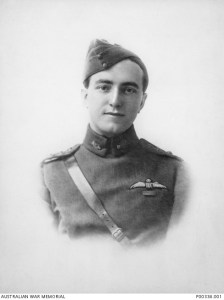
Captain Frank Hubert McNamara VC, courtesy of Australian War Memorial

References

Gippsland Standard and Alberton Shire Representative

Australian Dictionary of Biography, McNamara Frank Hubert (Francis) 1894-1961

Coulthard-Clark, C 1997, McNamara VC: A Hero’s Dilemma, Air Power Studies Centre, RAAF Base Fairbairn ACT

Aviation Heritage Vol 25 No 4, Journal of the Aviation Historical Society of Australia.

Watson, D 2000, ‘In the Shadow of the ‘Wolf’: Enemy Activity and the Internment of a Gippsland Fisheman’, Gippsland Heritage Journal, No. 24 pp. 2-9

For film of the type of plane (FE2b) flown by McNamara see here and here.

161. Anzac Day 1918: For England

This post looks at the celebration of Anzac Day in 1918. At the same time, it also traces the intimate relationship between the celebration of Empire Day and Anzac Day over the course of the War and notes how Anzac Day grew from, and eventually eclipsed, Empire Day.

Post 3 looked at Empire Day (24 May) in the Shire of Alberton in 1914 when celebrations for Empire Day in 1914 were relaxed, even if the spectre of trouble in Ireland – potentially even civil war – was present.

One year later, Australia, as part of the Empire, was at war and Empire Day was celebrated  almost exactly one month after the landing at Gallipoli. The timing inevitably raises questions about how much of the Anzac story was known by that point and how did the very recent events at Gallipoli influence the celebration of Empire Day.

In terms of what was known of the events at Gallipoli by the time of Empire Day 1915, it appears that there was certainly sufficient detail for at least the core of the Anzac story to have been fashioned.

First official word of the landing on Gallipoli came in the Federal Parliament on 29 April, 1915. The Australasian on 1/5/15 reported the PM (Fisher) stating,

Some days ago the Australian War Expeditionary Forces were transferred from Egypt to the Dardanelles. They have since landed, and have been in action on the Gallipoli Peninsula. News reaches us that the action is proceeding satisfactorily.

Fisher quoted the cable message he had received from the (British) Secretary of State for the Colonies. This cable also spoke of the success of the operation and the ‘gallantry’ of the men. Fisher also quoted the response from the Governor-General:

The Government and people of Australia are deeply gratified to learn that their troops won distinction in their first encounters with the enemy. We are confident that they will carry the King’s colours to further victory.

Overall, the first official commentary on Anzac, less than a week after the landing, presented the action as a success and hailed the fighting quality of the AIF. Critically, there was also official confirmation that the Australian troops had proved themselves in battle. The more expansive and laudatory descriptions of the AIF in action at Gallipoli began to appear within a week. For example, Ashmead-Bartlett’s account appeared in The Argus on 8/5/15. Casualty lists began to appear from early May. However it was not until mid to late June that the papers were full of personal accounts by soldiers recovering in hospital in Egypt. Further, Bean’s account did not appear until mid June. It appeared in The Argus on 18/6/15.

In the Shire of Alberton, the basic story was picked up very quickly. The Gippsland Standard and Alberton Shire Representative published Ashmead -Barlett’s account on 12/5/15. The comprehensive account appeared under the headlines: Gallant Australians. Full Story Of Their Fight. Troops Landed In Darkness. Attacked On Seashore. Heroes Of Mons Equalled.

Both nationally and locally, May 1915 saw an increasing flow of information on the Gallipoli campaign. The basis of the Anzac story was established very quickly and universally. The essential features of this story were: the campaign had been a success, even if the notion of ‘success’ had to be increasingly qualified and portrayed in terms broader than military objectives; the AIF had ‘proved itself’ in battle as at least the equal of British troops; the AIF had shown itself to have a distinctly Australian character; Australia’s national identity and the essential character of its people were tied to the AIF; Gallipoli had been a defining moment in Australia’s short history; Australia was robustly and selflessly defending the Empire; and, lastly, it had always been Australia’s manifest destiny to fight for the Empire, and therefore the death and sacrifice of Anzac were inevitable. Critically, Anzac and Empire were intimately linked. The story of Anzac was an extension of the story of Empire.

One way of demonstrating how the Anzac story was so intimately tied to the fundamentals of love for and duty towards the Empire is to look at how, just one month after Gallipoli, the story of Anzac was handled at the Empire Day celebrations in Yarram in 1915. These particular celebrations were directly driven by the local community, in the sense that several prominent locals, despairing that the local council had not taken the initiative to highlight the importance of Empire Day that year, had come together to ensure that due recognition was given. In their planning session – reported in the Gippsland Standard and Alberton Shire Representative on 19/5/15 – they referred to the belief that Empire Day that year had … far greater significance and there were references to the ‘present crisis’ and the fact that this year was … more than an ordinary occasion. The present crisis was both the parlous situation in Europe and, of course, the fighting at Gallipoli. Both events underlined the fundamental link between Australia and the Empire or, more accurately, the seamless whole of the relationship.

The celebrations took place on the evening of Empire Day (Monday, 24/5/15). They were reported in the local paper on 26/5/15 under the bold headline: Monster Public Gathering. At the outset, the local council was again criticised for its lack of patriotic spirit. Post 59 has already looked in detail at this event but it is worth recalling just how strong the commitment to the Empire was.

On the night, there were numerous accounts of the greatness of the Empire. In fact, there were so many speakers lined up that several had to give up their turn because the event was proving too drawn out for all the children there. One stirring speech was made by a visiting Presbyterian minister (Cadwallader Jones) who extolled the 1,000 year Empire:

There was something about the British Empire which appealed to Australians, and in the present crisis a sense of its power and grandeur was felt by all. It sent a thrill of independence through us, and we gloried in the legacy which our forefathers had left us; they who had shed their blood to overcome every hindrance which beset them. The flag that had braved all breezes, and all wars for the past thousand years would still be kept flying, and vindicate our right to the Divine possession. (Applause).

After promising that in the present fighting the allies would … triumph as sure as there is a God in heaven, Cadwallader Jones turned his attention to the very recent events at Gallipoli, praised the great deeds of the AIF – the idea of the Anzacs deeds living forever was already clearly apparent – and located the fighting in terms of a broader Imperial struggle against evil, in this case the corrupt Ottoman Empire. At this point the revision of the status of the Turkish enemy – Abdul – was still some time away. Specifically, Cadwallader Jones condemns the Turkish atrocities against the Armenians, an unresolved issue 100 years on:

We have reason to be proud that our nation is having vengeance on the Turks for those awful Armenian atrocities, and will wipe out the Ottoman Empire. He [Cadwallader Jones] never dreamt that he would live to see the day when the Australians would go forth to avenge that awful wrong. What magnificent deeds they had done in the Gallipoli Peninsula cutting off the enemy and trampling them under feet, though at terrible cost, for we are overwhelmed with grief when we read the casualty list. Though our men are laying down their lives to avenge the wrong we will not forget them, their names will be engraved in the hardest tablet of stone, so that our children, and our children’s children, shall know of the heroism and noble deeds of our men in the cause of justice, ever ready to face death itself. (Applause).

The resolution passed by those gathered that night clearly placed the triumph of Gallipoli within its proper Imperial context. Gallipoli had realised the Nation’s Imperial destiny:

This meeting of citizens of Yarram and district, affirms its confidence in the solidarity of our Empire and the integrity of our cause, and while expressing its unbounded admiration of the gallantry of our representatives at the front, and its deepest sympathy with those bereaved, urges upon (sic) all our people to rise to a realisation of our Empire as exemplified by the conduct of our men upon both land and sea.

Besides the speeches and songs that night, there was plenty of visual reinforcement of the ideals of Empire.

A pretty scene was presented when over thirty Yarram school children marched on to the stage, each carrying Union Jacks. The girls were attired in white frocks, and the boys wore red, white and blue ties. The popular songs “Red, White and Blue” and “Sons of the Sea” were given with considerable vim, the choir and audience taking up the chorus.

Whereas the first Anzac Day was, in effect, celebrated as part of Empire Day, by 1918 Anzac Day was a national day in its own right, even if it did not become a public holiday in all states and territories until the end of the 1920s. Moreover, while Empire Day continued to be celebrated it was obvious that in just 3 years the celebration of Anzac Day had already eclipsed that of Empire Day. However, there was a major qualification to this observation, in that it was definitely not the case that by 1918 the celebration of the Empire had in any way diminished. Rather it was just the case that it made more sense – seemed more natural – to focus on the celebration of the Empire as part of Anzac Day. In effect, Empire Day, even though it continued to run as a separate and distinct celebration until the late 1950s – morphed with Anzac Day, just as Anzac Day had been celebrated as part of Empire Day in 1915.

The shift to Anzac Day is very evident in the local paper. There are very few reports of specific Empire Day activities in the local district for May 1918. The paper reported on 31/5/18 of Empire Day Celebrations held at Stacey’s Bridge. The report was very brief and just noted that a … social evening and dance was held on Empire night to raise funds for the Education Department’s April-May appeal. On 5/6/18 there was a report on the success of fundraising by the local Methodist church for Empire Day. There was also a special service for the Methodist congregation for ‘Empire Sunday’.

The detailed reporting of local celebrations for Anzac Day offered a stark contrast. On 19/5/18, the paper published the full school program for Anzac Day. Two days earlier, the paper had published a report of how the (Federal) Minister of Recruiting had requested state education departments to promote bonfires on Anzac night:

… in addition to any other celebration that might be proposed, the head master of public and private schools be asked to arrange that bonfires be erected in school grounds or selected positions with due regard to safety and in charge of responsible officers, and all to be lit simultaneously at 7.30 on Anzac night. He suggested that patriotic songs be rendered by the children, and in view of the seriousness of the present position [The German Spring Offensive], the ceremony be made as impressive as possible.

The 2 references to the schools serve to remind just how important the (Victorian) Education Department was, not just in establishing the practice and form of Anzac Day but in also fashioning the very story of Anzac. There were obviously other influences – for example, the 1916 publication of The Anzac Book edited by Bean – but the role of the various state education departments was critical. Triolo (2011) covers the role of the Victorian Education Department in great detail. And prior to Gallipoli, the Education Department had fashioned and taught the Empire story. Essentially, the state education departments over the course of WW1 – and before and after it – were highly influential in shaping the attitudes of not just the students but their families and the wider community to the War. These departments through their own publications – in Victoria it was the School Paper – also provided an ongoing commentary, if not narrative, of the War. The account was unmistakably Imperial.

As well as the school preparations for Anzac Day, the local paper gave notice (24/4/18) of what was planned by way of other activities on the day. There was advice that between 12 and 2.00 pm local stores would be closed and that a united (Protestant) church service would be held in Thompson’s Hall. In the afternoon, attention was to shift to the school (Yarram SS) for its program and at the same event a number of district soldiers were to be formally welcomed home. At night, a bonfire had been arranged at Port Albert. Lastly, the local Returned Soldiers’ League was to stage a smoke social in Thompson’s Hall. There was concern that the bonfire at Port Albert was going to keep some returned men from the smoke social in Yarram. The smoke social will be covered separately in a coming post as it revealed yet more division and conflict over the issue of repatriation.

The report covering all the events appeared in the local paper the day after Anzac Day.

The welcome home ceremony was a central component of the prescribed school celebrations for Anzac Day 1918.  On the day there were 12 returned soldiers present and of this number 4 were very recently returned. The welcome home meant that a large crowd of locals also assembled at the school for the ceremony. Having the school as the centre of the celebration obviously raised the status and gravitas of the day. As well, the presence of the returned men helped formalise the solemnity. Their presence also had an obvious impact on the speeches made. The opening remarks made by the head teacher – E A Paige – were full of praise for the Anzacs. Their efforts had not only been comparable to the best of the Empire but had in fact exceeded them.

Mr. E. A Paige, head teacher, extended a cordial welcome to all, and addressing the children impressed upon them the importance of commemorating Anzac Day. It was the day our Australian boys landed at Gallipoli against well-armed enemies. They had read of the charge of the Light Brigade, but what the Australians had done put that feat in the shade, when they landed against such odds on 25th April 1915. He extended a hearty welcome to the returned men, and hoped Anzac Day would be solemnly celebrated every year.

Another speaker that day was the Rev C J Walklate, the local Methodist minister and another leading Imperial Loyalist. Walklate made the claim – commonly being made by this point – that Anzac Day was not just a significant event in Australia’s history it was in fact the beginning of Australian history, which history, at least in his view, was very simplistic:

… the 25th April three years ago was the beginning of Australian history. They had read of the exploits of our explorers, who mapped out the land for civilisation to come and make homes for the present generation. But the tragic landing at Gallipoli eclipsed everything else.

The presentation of Gallipoli as some form of ‘tragedy’ had been well established. Sacrifice had been an essential element of this tragedy and the ideal of sacrifice had been instilled in the Anzacs as young boys at school – just like the school children there on that Anzac Day in 1918 – who had read of the glories of the Empire. The Anzac story was the next inevitable chapter of the Empire story. As Walklate put it,

The spirit our boys displayed [at Anzac], was moulded by reading the doings of other brave men in past years.

Another speaker that day was Inspector Greenwood. He told the students that, On 25th April 1915 Australia leaped into history. He spoke about the … records of the deeds of these brave boys. And he described them in an Australian style as ‘dinkum Anzacs’.

Clearly there was an emerging nationalist focus evident: Australian history only begins with Anzac; the AIF is not just the equal of the British Army its troops are better; Australia has effectively ‘come of age’.

However, just as Empire Day and Anzac Day were intimately connected, the new sense of Australian nationalism was still most definitely contained within the broader commitment to Empire. For clear evidence of this seamless connection consider the song – For England – which was prescribed in the formal school program for the day and was to be was sung by the students. Arguably, it was even more suitable for Empire Day than Anzac Day. Moreover, it had been written by an Australian – James Drummond Burns (1895-1915). Burn’s poem had been set to music by L A Adamson, the headmaster of Wesley College. Burns, a corporal in 21 Battalion, was killed at Gallipoli in September 1915. He was 20 yo at the time. He had been born in Victoria and had been a student of Scotch College. In many ways the young Burns embodied the qualities of the Rev George Cox’s ‘Soldier of Christ’ (Post 26).

The song, For England is reproduced below. Its Imperial sentiment and sentimentality are unmistakable. It was created within the environment of the Victorian elite public school but it was sung on Anzac Day in 1918 in all state schools.

For England

The bugles of England were blowing o’er the sea,
As they had called a thousand years, calling now to me;
They woke me from dreaming in the dawning of the day
The bugles of England – and how could I stay?

The banners of England, unfurled across the sea,
Floating out upon the wind, were beckoning to me;
Storm-rent and battle-torn, smoke stained and grey,
The banners of England – and how could I stay?

O England, I heard the cry of those who died for thee,
Sounding like an organ-voice across the winter sea;
They lived and died for England, and gladly went their way,
England, O England – how could I stay.

There are uncanny similarities here with the comments made above by Rev Cadwallader Jones at the Empire Day celebrations in Yarram on May 24,1915. The poem itself appeared in the school’s paper, The Scotch Collegian in May 1915.

One hundred years on, our own celebrations of Anzac Day do not recognise the Imperial basis for the history of the event – indeed, we celebrate it as a distinctly national and nationally-defining event – but in 1918 its Imperial genesis was fundamental, unmistakable and unchallenged. At the time, Anzac Day was an extension of Empire Day. Over time, it effectively replaced it; but the historical drift from Imperialism to Nationalism took a long period of our history. In another irony, in a post-Brexit world, the UK appears keen to reach back to an earlier version of its relationship with Australia, when it was still its ‘Mother Country’.

References

Gippsland Standard and Alberton Shire Representative
The Australasian
The Argus

Triolo, R 2012, Our Schools and the War, Australian Scholarly Publishing, North Melbourne

For more detail on James Drummond Burns and For England see The Scotch College World War I Commemorative Website


154. The start of the 1918 school year and yet more division

This post continues to explore themes raised in earlier posts, particularly Post 84 and Post 68.

At the start of 1918 there were 2 very significant developments in the provision of schooling in the local community. At the Yarram State School, higher primary grades commenced and, nearby, the new Catholic primary school – St Mary’s – was opened.

The local community had been calling for a higher primary top to the local state primary school – even a separate high school – for several years. Just days after the outbreak of War, the Director of Education (F Tate) visited Yarram (10/8/14) at the invitation of the local school board to consider the provision of higher primary/higher elementary schooling. The basic agreement reached was that continuing classes – to Intermediate level – could be set up in (new) buildings on the existing primary school site, with the local community agreeing to contribute an amount of £350. In theory, the money was to be raised by the local council setting a special levy. But then the reality of the War intervened.

By late 1917, the push for the higher elementary school picked up again after the Victorian Government set aside funds (£2,000) for a higher elementary school in Yarram. Again, the local community was expected to contribute financially. The amount was now £400, over 4 years. This time the money was to be raised by subscriptions, not a special levy via the council. Tate visited Yarram again in January 1918 and by the end of February, 60 students were enrolled. Initially they were accommodated in existing buildings on the site but new buildings, specifically for the higher primary years, were planned in mid 1918 and officially opened in April 1919.

The provision of higher primary or higher elementary schooling was very significant. Students could now pursue formal education beyond the primary level, without having to leave the district. Other neighbouring towns – Sale, Warragul and Leongatha – had already established equivalent, and in some case even more impressive, post primary schooling. The establishment of the higher primary school – on the grounds of the Yarram Primary School – was proof of civic worth and status. When Tate had first visited in August 1914, he was reported – Gippsland Standard and Alberton Shire Representative, 12/8/14 – as stating that he believed that Yarram warranted the higher primary school and that the community could well afford it. He had observed the … substantial appearance of Yarram with its fine hotels and other buildings.

The overall success of the initiative was qualified in one critical way. At the speech night at the end of 1918 – reported in the local paper on 24/12/18 – there was an urgent appeal for a ‘hostel’ to be set up in Yarram to accommodate students from ‘outside parts’ over the school week – Monday to Friday. Such a facility had been established at Leongatha and it was recognised that an equivalent boarding facility was required in Yarram if students from other townships and settlements in the Shire were to be able to take advantage of the improved schooling. In the same speech, it was noted that while there were 42 students from Yarram attending the new higher primary school, there was only an individual student – or in a few cases 2 or 3 students – coming from Balook (3), Wonyip (2), West Alberton (3), Jack River (1), North Devon (1), Womerah (1), Tarraville (1), Lower Bulga (2) and Welshpool (2). Clearly, the benefits of higher primary schooling were largely restricted to those living in Yarram. Families with sufficient finances who were keen for their children to have a complete secondary education – generally with a view to pursuing a degree at Melbourne University – had traditionally sent their children to a boarding school (college) in one of the larger rural towns – e.g., Geelong (Geelong Grammar School), Ballarat (St. Patrick’s College) – or Melbourne. This pattern continued after the extension of primary schooling at Yarram.

The opening of the Catholic primary school – St. Mary’s – for the start of the 1918 school year was a very pressured business. The building had only just been completed and the accommodation for the Sisters of St Joseph – the teaching order to run the school – was only finalised in the week leading up to the opening. The frantic pace was captured in an editorial in the local paper – 1/2/18 – which also praised the determination of Bishop Phelan:

The Catholic community in this district has accomplished a great deal. They built and opened a large brick church – an ornament to the town – built a school, and have now purchased Mr. Brennan’s property for the comfortable housing of the teaching nuns. When Bishop Phelan gets to work things move apace.

Phelan had made it clear to the Catholic community that he expected a Catholic primary school to be established and that it was to serve not just Yarram but the surrounding district, with students, initially at least, boarding at the convent. But Phelan had also made it clear that the school had to come after the new church had been built and after suitable accommodation had been arranged for the nuns. The church, the convent and the school were all to stand as proof of the strength and social status of the local Catholic community in the district.

Interestingly, much was made of the new teaching order of nuns, the Sisters of St. Joseph. From the late 19 C, a French order of nuns – Sisters of Our lady of Sion – at the invitation of Bishop Corbett, had been operating schools in Gippsland – at Sale, Bairnsdale and Warragul. But for the new school at Yarram, Bishop Phelan had been successful in securing ‘local’ nuns. The following appeared in the local paper on 6/2/18. The claim of Scottish ancestry was, presumably, for the benefit of the large Scottish demographic:

With regard to this particular order of teaching sisters, the branch now established at Yarram is purely Australian. The Mother Foundress of this Order, Mother Mary McKillop, is of Scotch descent, and was born in Brunswick St., Fitzroy. So that the sisters of the Oder which she established are for the most part Australians. They have houses, schools, orphanages from West Australia to New Zealand.

Both these significant developments in the provision of local education took place at the start of the fifth year of the War and, as been argued in previous posts, at a time when, in theory, all fundraising was focused on the War effort. The issue is whether either or both of these initiatives attracted any criticism.

In the case of the local state school there was certainly no criticism. The commitment to establish a higher primary top to the primary school at Yarram had been there well before the War. The community had always been strongly behind the proposal. The Victorian Government had placed the proposal on hold because of the War and the local community had, patriotically, accepted this decision. But now, at the start of 1918, the Government had found funds for the proposal to proceed, accepting that the local community also contributed. Further, the local committee appointed to secure the £400 of local contribution was heavily representative of local Imperial Loyalists. Three members of the small committee stood out: A J Rossiter, the editor of the local paper; Rev C J Walklate, the local Methodist clergyman; and A E Paige, the head teacher of the Yarram SS. These 3 high profile figures would have provided an effective ‘guarantee’ of the appropriateness of the fundraising. Additionally, many of the most generous contributors to the public subscription – names were published in the local paper – were also high profile Imperial Loyalists. The lists included people like B P Johnson (£5), T G McKenzie (£10) and Dr Rutter (£10). Importantly, the change from a Shire-imposed rate increase to a voluntary subscription must have also reduced the potential for conflict. Additionally, the change avoided conflict with the Catholic community who could have argued that they were being forced to contribute, through increased rates, to a school system that they would not use, or even – from the perspective of Catholic faith – could not use. The Catholic Church already argued, on the broader scale, that this was the case with State taxation to support state schools. It appears that subscriptions to raise the £400 came overwhelmingly from Anglicans, Methodists and Presbyterians. The records, published in the local paper, are incomplete but it appears that Catholics were under-represented, notwithstanding a large contribution (£5) from Michael O’Callaghan, a Catholic grazier from Jack River.

Overall, there was very strong support for the higher primary schooling at Yarram SS and there was no evidence of any opposition to the fundraising associated with it. The situation in relation to the new Catholic primary school at Yarram was a more complex affair.

Ironically, there was an immediate and very significant positive associated with the opening of the Catholic primary school. The forty or so enrolments in the new school reduced the numbers at the state primary school and this meant that the new higher primary students could be accommodated in the existing facilities at the school. The need to build new classrooms was not immediately pressing.

However, such an immediate benefit hardly compensated for the major fault line which was revealed by the opening of the Catholic primary school.

On the surface at least, there did not appear to be any overt hostility directed at the fundraising associated with the new Catholic school. No one appears to have used the local paper to attack these particular fundraising efforts. Indeed, as noted, editorials at the time were complimentary of the Catholics’ efforts. However, there must have been un-reported opposition to the Catholics’ church and school building projects over the course of the War. Bishop Phelan himself made this point, explicitly, in a talk he gave on the visit of the Apostolic Delegate to Sale in April 1918. His address was reported in the Gippsland Standard and Alberton Shire Representative on 26/4/18. Talking about all the difficulties he had faced in his ambitious building program post March 1915, Phelan noted:

But the greatest difficulty experienced was the wall of prejudice raised by narrow-minded people who endeavored to howl down every movement for raising funds except for Red Cross or Imperial purposes. But the stirling Catholics of Gippsland, like their fighting brothers at the front, did their duty towards all the demands of the Empire, and broke through every barrier that prejudice and bigotry would raise between them and their own field of labour.

He specifically cited the school at Yarram in the same speech; and he used the same emotion-charged language:

Already two convents and two schools, Leongatha and Yarram, have been added to our brave army fighting the battle of Catholic education.

But if fundraising for the Catholic primary school was not a major public concern at the time, there was still considerable controversy associated with its opening.

The new school – with the exception of a brief interlude for an earlier version of St Mary’s primary school, Yarram (1885-1890) – marked the first time that the Catholic community of the Shire of Alberton had withdrawn their children from the local state school(s). Effectively, all the young, local Catholic men who enlisted from 1914 had been educated at the local state school(s). Even though their family background, for the most part, was Irish-Australian, they had been schooled, via the state system, in absolute loyalty to Britain and the Empire. Now, in the fifth year of the War, and with 2 failed referenda on conscription – with much of the ‘blame’ for the failure sheeted home to Catholics – the local Catholics were withdrawing from the state school.

The significance of the opening of the school at that point – the start of 1918 – also needs to be seen in the context of the continuing conflict between Catholic and Protestant over the issue of scripture lessons in state schools. The conflict over scripture ‘readings’ or ‘lessons’ was a constant and while it might seem by our standards, 100 years on, as minor and even trivial, it went to the core of the Protestant – Catholic divide. It was a passionate debate, for while the Protestants argued that any form of state aid to support the independent Catholic sector would be in complete breach of the principles of the ’Free’, ‘Compulsory’ and ‘Secular’ education acts of the 1870s – and only further entrench the Catholic tendency to separation and exclusivity – the Catholic Church argued that any ‘non-dogmatic’ scripture lessons, taught by ‘non-sectarian’ mainstream teachers was nothing but a brazen attempt to incorporate Protestantism in the state school systems and would therefore also be in breach of the same principles. The politics of the day meant that neither side could prevail; but each could antagonise and frustrate the other.

The conflict over scripture lessons was hardly new. For example, for an insight on the complexity and centrality of the issue, consider this account of the 1913 debate – Catholic Educational Claims – held in Melbourne where the proposition was – That the Roman Catholic claims for financial aid from the State treasury toward their denominational schools are not just, and would be destructive of our State system. Speaking for the proposition was Rev J Nicholson, spokesperson for the Scripture Campaign Council, the body representing the Protestant Churches pushing for scripture lessons in state schools. Speaking for the negative was Thomas C Brennan of the recently formed Australian Catholic Federation. The debate was in front of an audience of approximately 1,000 people and while the proceedings were civil it certainly exposed the stark differences between Catholic and Protestant at the time.

The division over the push for scripture lessons in state schools – there were attempts to have referenda on the issue put to the Victorian people – was certainly evident in the Shire of Alberton. In fact, the issue was raised, very publicly, in the lead-up to the opening of the Catholic primary school. In mid September 1917, Bishop Phelan gave a sermon in Yarram. It was reported, in detail, in the local paper on 12/9/17. In brief, Phelan instructed his congregation that in the upcoming state elections they could not vote for any candidate who supported the call for a referendum on the introduction of the scripture lessons in state schools. He saw this referendum as an attempt by the Protestant majority to … crush the Catholic minority.

Phelan must have provided a copy of his sermon to the editor of the local paper because the reporting of the sermon is so detailed. There is an entire section on the Virgin Mary. Citing Luke’s Gospel, Phelan went into great detail outlining the centrality of Mary to Catholic faith, teaching and veneration. The intention behind this specific focus on Mary was to highlight the chasm, between Catholic and Protestant, on the issue of ‘Bible reading’. Phelan pointed out that, irrespective of what the Bible said, Catholic teaching on the role of Mary, and devotion to her, were both anathema to Protestants. He reminded his congregation that up to the very recent past, British monarchs had had to … declare before receiving the crown that “the adoration of the Virgin Mary and the sacrifice of the Mass, as they were used in the Church of Rome are superstitious and idolatrous” . Prior to the Accession Declaration Act of 1910 – in time for the coronation of George V – the wording of the new monarch’s ’declaration’ had been, in part:

… I do believe that in the Sacrament of the Lord’s Supper there is not any Transubstantiation of the elements of bread and wine into the Body and Blood of Christ at or after the consecration thereof by any person whatsoever: and that the invocation or adoration of the Virgin Mary or any other Saint, and the Sacrifice of the Mass, as they are now used in the Church of Rome, are superstitious and idolatrous.

The declaration also denied the authority of the Pope.

In the face of such diametrically opposed positions – based in large part on Bible reading – Phelan argued that the idea of a ‘non-sectarian’ lesson of Bible reading – conducted by mainstream teachers in state schools – was a myth. For him, the idea of a ’non-dogmatic’ Christian faith was a nonsense. For him, there could never be, as it were, a ‘generic’ Christianity. For the Catholic, the Bible was to be read and interpreted through a person’s faith, which itself had been formed by the teaching of the Church. But from the time of the Reformation, Protestantism had had a very different take on the relationship between the Bible and the individual. The Catholic Church saw the bible lessons in state schools, within the promise of ‘non-dogmatic’ and ‘non-sectarian’ scripture readings, as a thinly disguised attempt to proselytise in the name of Protestantism. It would never accept it.

It would be a mistake to see this particular dispute merely in terms of differences in religious dogma between Catholic and Protestant. Other references in Phelan’s sermon that day show how the tension of the difficult history between England and Ireland was ever present. It coloured everything. Speaking of the efforts of the Irish in England from mid 19C to fight for their faith and the provision of Catholic schooling, Phelan made this extended reference:

The men and women who fought for Christian education in the land of the Saxon were the sons and daughters of Ireland driven from the home of their fathers in the middle of last century by a trinity of evils, the awful visitation of Providence, the famine of ’47, the worst landlord system that ever cursed a nation, and a Government whose policy at that crisis can only be described as diabolical. When Lord John Russell was asked for ships to bring food across the Irish Channel to a starving nation he peremptorily refused, declaring that “such a use of Her Majesty’s navy would interfere with the legitimate freights of the shipping industry of Great Britain.” And the London “Times” spoke enthusiastically of the good time coming when “a Catholic would be as rare on the banks of the Shannon as a red Indian on the banks of the Manhattan.”

The not very subtle sub-text was that the persecution of Irish Catholics at the hands of English Protestants was both historical and ongoing.

Not surprisingly, Phelan’s sermon prompted a vigorous response. The first letter appeared one week later (19/9/17). It was from Joseph Nicholson, Superintendent of the Scripture Campaign, the body driving the push for a referendum on the issue of bible reading in state schools. Nicholson was arguably the most high profile advocate for the cause. He had appeared in the 1913 public debate referred to above. Nicholson argued that it was possible to have (scriptural) lessons of ‘absolutely unsectarian character’. He emphasised what he saw as the Catholic Church’s reluctance to have its followers read the Bible:

It is no doubt difficult for a non-Romanist to understand the fears of the Roman Catholic clergy concerning the effect of Bible reading by their people.

Further, he insisted, even if the Catholic clergy were that terrified about their members reading the Bible – by themselves – the lessons in the state school were not to be compulsory:

While we do not share the fears of the Roman Catholic clergy concerning the disasters that are likely to follow from Scripture reading, yet, in our scrupulous desire to protect Roman Catholic children from what they disapprove, we insist on their absolute freedom from Scripture lessons, and make provision for secular studies instead.

This letter was followed by one from Father Stirling which was published on 21/9/17. Stirling made claims about the misrepresentation of the Catholic position but overall his letter read more like an attempt to defuse the situation. This letter was responded to, again by Rev Nichoslosn, who dismissed Fr Sterling’s ‘feeble comments’. The letter was published on 26/9/17. There were more claims of misrepresentation amid pointed claims that … this infallible church is not uniform in its teachings. Nicholson argued that the arrangements for ‘non-sectarian’ bible reading lessons in Victorian state schools for which the Scripture Campaign was advocating, were in place in other education jurisdictions, both in Australia (NSW) and overseas. Nicholson chose to represent the dispute in terms of the rights and responsibilities of the 2 parties, one the minority and the other the majority. As he saw it, the Catholic minority was at fault:

The Roman Catholic opposition to “unsectarian” Scripture lessons is … intensely selfish in seeking to interfere with the Protestant majority that is tenderly considerate of the Romanist minority. We give them safeguarded liberty, but refuse Romanist domination of Protestant liberties.

This particular iteration of the struggle over the teaching of ‘non-sectarian’ or ‘unsectarian’ or ‘non-dogmatic’ scripture lessons disappeared from the local paper by the start of October 1918. However, as we will see, the issue itself certainly did not disappear. Throughout 1918, Catholics continued to block this Protestant proposal. For their part, the Protestants maintained their absolute rejection of any ‘state-aid’ for Catholic schools.

Leaving aside the symbolism of the local Catholic community establishing its own primary school and withdrawing its children from the local state school, at the very time Imperial Loyalists were calling for a single, united and focused War effort – and also at the very time that the community as a whole was trying to extend the range of post-primary state schooling throughout the district – it is clear that Bishop Phelan’s unrelenting focus on Catholic education during WW1 served to heighten division within the broader community. Effectively, he forced the Catholic community in Gippsland as a whole, and not just in the Shire of Alberton, to assert their separate identity and status through education. The problem was that this identity was overlaid with so many religious, cultural, social and political associations that the loyalty of this minority, at that particular time of National crisis, would inevitably be called into question by the Protestant majority. As much as locals wanted to downplay or ignore the division, it was always there. Equally, while their opposition to conscription is routinely presented as the distinctive behaviour of the Catholic minority in WW1, it is clear that considerably more than this single issue was at play. Indeed, as an immediate example of just how complex the issues were, Thomas Brennan – referred to above as the key Catholic spokesperson in the 1913 education debate and also the first president of the Australian Catholic Federation – supported conscription and was an outspoken critic of Mannix on the issue. Bishop Phelan was said to be neutral on the same issue. In short, the Catholic question went well beyond the issue of conscription.

References

Gippsland Standard and Alberton Shire Representative

Synan, T 2003, A Journey in Faith: A History of Catholic Education in Gippsland 1850-1981, David Lovell Publishing, Melbourne

Adams, J 1990, From these Beginnings: History of the Shire of Alberton (Victoria), Alberton Shire Council, Yarram, Victoria

153. The case of Charles William Frederick Allum

Charles William Frederick Allum was convicted at Yarram on 20/9/17 of impersonating a returned soldier. He was ordered to enter into a good behaviour bond of £10 for 12 months and pay the court costs. The police magistrate on the day, Vivian Tanner, was lenient on him and pointed out that he could have been imprisoned for 6 months or fined £100. He was prosecuted for … falsely pretending to be a returned soldier, contrary to para. 45 B (2) of the War Precautions Regulations 1915, made in pursuance of the War Precautions Act, 1915-1916.

The case was reported in detail in the local paper, Gippsland Standard and Alberton Shire Representative, on 21/9/17 and even appeared in The Age (24/9/17). The other source of evidence is the individual ‘Security and intelligence record’ [MP 16/1, 1917/807] from the National Archives of Australia.

At the time of his court appearance, Allum was reported to be only 18 yo. Incredibly, he had been passing himself off as a returned soldier since March 1917. Further, he claimed to have seen service both at Gallipoli and in France.

Allum was from Brunswick but for several months from March 1917 he worked at Yarram, at W C Growse’s store. The evidence presented in court detailed how he had told customers that he was a returned soldier who had been injured in France – shrapnel in his back – but who, after 10 months leave, was to return to camp. It was also claimed in court that he had received gifts from several young ladies in Yarram, on the strength that he was returning to camp. When he was arrested he had on him a letter, undated, which he had written, but not sent, to a Miss F Gibbs at Foster. The letter is barely coherent but he claimed to be in camp (Broadmeadows). The address he gave on the letter was his parents’ address at Brunswick.

As noted in an earlier post (Post 148) the first meeting of the local branch of the Returned Sailors’ and Soldiers’ Imperial League of Australia took place in Yarram in late June 1917 (27/6/17). Allum was working in Yarram at the time and, in terms of the identity he had created for himself, he obviously felt the need to attend the first meeting. However the told those there that he would not join the association because he was heading back to camp. His attendance at his meeting was the beginning of his undoing because he came to the attention of 2 office bearers of the new association: E T Benson and W A Newland. Both these men took it upon themselves to interview him and they questioned him about his service record and the specific details of his regimental number and battalion. In evidence in court, both men stated that his answers were ‘wrong’, in that he gave the wrong colour patches for his unit and the embarkation details were also wrong.

The issue of timing is not clear but there is a report in the intelligence file that states that Allum attended one of the early meetings of the local branch of the RSSILA – the date given is 2/8/17 – at which he was accused by both Benson and Newland of not being a returned soldier. The report notes that he [Allum] … cleared out by early train next morning. Presumably, even though he had left the town, the men went ahead and reported him to the authorities.

The authorities caught up with him in late August (27/8/17) when he was working as a steward on a boat – SS Bulla – at Victoria Dock, Melbourne. When he was challenged, he freely admitted that he had presented himself as a returned soldier when he was in Yarram. He was taken into custody – Victoria Barracks – and eventually returned to Yarram for the court appearance on 20/9/17.

According to the report in the local paper, the authorities, in the person of W P Jones, Intelligence Officer, wanted the court to make an example of the young man:

Mr. Jones asked the P. M. [Police Magistrate, V Tanner] to deal with accused as would act as deterrent to others who may come to a far distant town and pose as returned men.

However, evidence presented in the court made it difficult for the magistrate to come down too hard on on the young offender. Representing the young man in the court was B P Johnson, local barrister. Johnson was – see previous posts – one of the most outspoken Imperial Loyalists of the community.

On behalf of his client, Johnson admitted the wrong doing but he claimed the offending was more the act of a ‘fool’, and that his client had become trapped in his own lies. Importantly, Johnson maintained that his client was … not like a lot of young men – cold footers and traitors. Rather, the young man … was a mere boy, of good parentage, and had tried to enlist seven or eight times, but was turned down owing to a weak chest. He at last succeeded, but his mother would not give her consent. He tried again, and was taken out of camp. He had three brothers at the war. This lad had been pestered so much about enlisting, and having tried so often, he foolishly said he was a returned soldier, and having told a lie stuck to it. He did not so act to get any benefit from it.

The young man then confirmed that he had tried to enlist before he was eighteen and then, when he finally was accepted, his parents would not give permission. He stated that he had a ‘chest complaint’ and that his mother was a chronic invalid. He claimed that the fiction about being a returned soldier came because he ‘was pestered to enlist’ by recruiting sergeants. Cross-examined by Jones, Allum admitted that he had received presents from 3 girls at the time he said he was leaving Yarram to go back to camp.

The lad’s father was also called as a witness and he confirmed that his wife was a ‘chronic invalid’. He added that her condition was the result of a railway accident and that his son had been in the same accident. The father stated that he was prepared to pay the court costs, about £ 3.

The other critical detail that helped the young man’s defence was the fact that during the Great Strike (Post 132) he was said to have worked on the Melbourne wharves as a volunteer ‘National worker’. This would have been after he fled Yarram. This display of patriotic support was specifically cited in the newspaper report as one of the reasons the magistrate was inclined to leniency. The other reasons given were the young age, the admission of guilt and the demonstrated attempt(s) to enlist.

As indicated, there was no fine or imprisonment. The father had to pay costs and there was a good behaviour bond for 12 months.

There are some aspects of this case that are baffling. Most times when young men tried to enlist but were unsuccessful there is some record of the attempt. Commonly, in the National Archives database, there will be a MT 1486/1 (1) with minimal details: name, age, address. Moreover, when a person did enlist and go into camp, but was then discharged – on medical grounds or there was a challenge by a parents on the issue of age – there is inevitably a formal record, as brief as it may be. Allum is not a common name and in fact there are only 13 records in the NA database for this name; and there is no record at all for Charles William Frederik Allum. Nor is there any record of any brothers serving in the AIF, at least under the name of Allum.

Lastly, in the intelligence file there is letter from the parents – Esther Ann Allum and Alex C Allum – giving their permission for their son – Charles William Allum – to join the AIF. It was dated 8/9/17. It must have been supplied after their son had been arrested and was waiting trial. But there is no record of Charles William Allum ever having been accepted in the AIF.

References

Gippsland Standard and Alberton Shire Representative

National Archives file for ALLUM Charles William Frederick ‘Security and intelligence record’ [MP 16/1, 1917/807]


(1) This series consists of records for those individuals who applied to enlist in the Australian Imperial Force, and were either rejected, discharged while still in training, or went on to serve within Australia only [usually as depot troops or camp guards]. The most common reason for rejection is on medical grounds.

152. The Queen Carnival of November 1917 and more division

Yarram and District Hospital, courtesy Public Records Office Victoria: VPRS 12800 P1, H5533

The last post (151. The war against drink 2) looked at division in the local community over the the issue of temperance or, more specifically, the liquor licence held by the Yarram Co-operative Store. It was argued that as bitter as the debate was at the time, the fall-out was effectively contained. This post continues the general theme of division in the community, in the context of WW1, by examining controversies associated with fundraising for the Yarram and District Hospital in late 1917.

The Yarram and District Hospital had opened in October 1914, not long after the start of the War. Its development had been hurried, in part because a bequest of £500 from John Moore, a local grazier who had died in 1911, stipulated that the money could only be given if the hospital was completed in 5 five years from his death. Moore was a local Catholic and he left another £500, this time unconditionally, for the construction of the church (St. Mary’s) at Yarram. The church was opened in February 1916.

There had been a major fundraising event – ‘carnival’ – for the hospital in 1913, but with the advent of the War, state government funding was restricted because of different priorities and local fundraising was similarly affected. However, in late 1917, it was decided to have a major, community-wide, fundraising effort.

The event was described as a ’Queen Carnival’. Essentially, the community was divided into 4 fundraising teams. Each was associated with a ‘queen’. The 4 queens were designated Red Cross, Agriculture, Sports and Charity. Behind each queen there was an organising committee which was backed by particular local stores, businesses, institutions and community groups. The individual committees organised a range of fundraising activities to compete against all other queens. Progressive amounts raised by the separate queens were published regularly and flags flown to show the leading queen and the positions of the other three. The eventual winner – the queen who raised the greatest amount of money – was crowned as the ‘Carnival Queen’ at a special coronation event which was held on 5/12/17. Prior to the formal coronation, as an integral component of the fundraising, a major sports carnival was staged at the Yarram Show Ground on Wednesday 21/11/17. It was a typical sports carnival with competitions in wood chopping, horse/pony events, and foot and bicycle races. There was also a special sports program for school children. The sports carnival itself was preceded by a major procession through Yarram led by the Victorian Police Band which had been secured for the event. Also, on the night of the sports carnival, there was a major concert in Thompson’s Hall in Yarram. Again the Police Band performed and there were acts from Melbourne as well as many local amateur performers. All the details on the procession, sports carnival and concert were written up in the local paper – Gippsland Standard and Alberton Shire Representative – on 23/11/17. Similarly, the write-up of the coronation ceremony appeared on 7/12/17.

Overall, the Queen Carnival was an outstanding success and over £2,000 was raised – an incredible amount for the period – which effectively covered the entire existing debt of the hospital. The degree of planning and organisation, at multiple levels and in many committees, and the strength of the local support were very impressive, and noted as such at the time. However, there were also some significant disputes which arose as the carnival unfolded over November 1917.

One major dispute involved, of all things, a ‘chocolate wheel’, also known at the time as a ’spinning jenny’ or just a ’spinning wheel’. The chocolate wheel had become a favourite at fund raisers. In fact, the Nestle (and Anglo-Swiss Condensed Milk) Company – the chocolate wheels of the day were often referred to as ‘Nestle’s Chocolate Wheels’ – had developed a package which provided the organisers with the wheel itself, the wooden bats, and the chocolates for prizes. At a time when there was ongoing pressure for patriotic fundraising, the chocolate wheel was in great demand. However, there was significant opposition to the use of chocolate wheels.

There was some concern that the commercial providers of chocolate wheels were taking too much of the profits – by inflating the costs of the chocolates used for prizes, boosting overheads etc – but the larger concern was that all such ‘wheels’ promoted gambling. The wheels presented a real dilemma for the churches and the anti-gambling lobby: there was a desperate need for patriotic fundraising; the wheel was a highly profitable and very popular form of fundraising; but the wheel was also a soft introduction to the evil of gambling. Over 1917-1918, there were increasing efforts to limit the use of wheels. Certainly, the authorities tried to keep them well away from school fundraising efforts – schools were a vital focus for patriotic fundraising – and ensure that children had no association whatsoever with them. At the same time, the efforts to restrict the wheels were inconsistent and the regulations commonly ignored. Those opposed to them were commonly dismissed as ‘wowsers’.

In Yarram, the Red Cross Queen featured a Nestle’s chocolate wheel at a jumble sale in early November 1917. It was a great success. Not surprisingly, Red Cross Queen decided to run the same wheel in its booth at the upcoming sports carnival. It was at this point that the trouble started. As some essential background, the sports carnival was organised by a special committee. This committee was separate from the overall committee managing the Queen Carnival and, in fact, maintained that it was in complete control of the sports carnival. Therefore, it claimed that it alone had the say over what activities were to run on the day, and it made it clear that it was not inclined to allow Red Cross Queen to run a chocolate wheel in its booth. Faced with this, Henry George Bodman, threatened that if the chocolate wheel was blocked he would have the Red Cross Queen (Miss Bodman) resign. If that happened then, in effect, one quarter of the fundraising would stop; and to that point Red Cross Queen had been the most successful fund-raiser. Bodman was a very successful grazier who had had a long history of local government service, including a period as Shire President.

The matter came to a head, one week later, at the next meeting of the main planning committee for the Queen Carnival. The meeting was reported in the local paper on 14/11/17. At this meeting it was immediately apparent that there was a further complication because someone had contacted the Attorney-General’s office in Melbourne seeking direction on the legality of the chocolate wheel; and the advice received was that the wheel could not be operated at the sports carnival. Bodman wanted to know who had contacted the Attorney-General, but there was no clear answer to the question. Certainly there were some of this main committee – John Bett, storekeeper and elder of the local Presbyterian Church was clearly one – who were opposed to all wheels and had tried to stop the first chocolate wheel at the jumble sale. A J Rossiter, the editor of the local paper, could have been another suspect. Rossiter claimed to have seen the explicit direction sent by the Chief Commissioner of Police to the local police instructing them to prosecute if the wheel was operated. The meeting became very heated. Bodman claimed that his opponents had acted out of jealousy. Others claimed that the advice from the Attorney-General was only advice and could be ignored. They cited the extensive use of chocolate wheels in Melbourne, even at the MCG. The upshot of the tense meeting was that Bodman announced that, as a matter of principle, he was going to carry through with his threat and the Queen of Red Cross would resign. There were appeals to him not to go ahead with the resignation and some there accused him of being ’unsportsmanlike’. Bodman agreed to a crisis meeting the next night but, in the end, the Red Cross Queen did resign.

The resignation significantly affected the whole carnival. Effectively, from that point, one quarter of the fundraising effort ceased. As Rossiter put it in the local paper on 16/11/17:

Withdrawal of the Queen of Red Cross will mean a loss of several hundred pounds to the hospital, unless generous donors are disposed to apply their efforts to one or other of the queens. The main object should be kept in view.

The resignation also threatened the organisation of the final, all-important coronation spectacle as the final event of the Queen Carnival. In the end, another local lady agreed to step in as the (nominal) Red Cross Queen on the night so that the event could proceed as planned. Another effect of the resignation was that there was no Red Cross Queen presence at the local sports carnival, where all the queens had been allocated a dedicated booth for fundraising.

As well as the resignation of the Red Cross Queen, there was another matter, also linked to the sports carnival, which created still more division in the group running the Queen Carnival. It was, unsurprisingly, over the issue of drink.

The committee in charge of the running the sports carnival agreed to 2 liquor booths – commonly, at other similar sports meetings only one was used – and there was heated debate over this decision. Nor was it just the number of booths because there was as much debate over the siting of the second booth. The sports committee had decided that it would be placed near the entrance and next to one of the queen booths (Red Cross Queen). The debate over the issues was set out in the local paper on 14/11/17. Some moved a motion to overturn the decision to allow the second booth. They argued that one booth was more than enough and there should be no encouragement for additional drinking at the sports carnival. The motion was defeated. At the same time, there was more support for efforts to move the second booth, well away from the entrance and far away from the general public. Speakers at the meeting did not want to see … drunks mixed up with the women and children. A J Rossiter, the editor of the local paper and a member of the general planning committee for the overall Queen Carnival, spoke strongly against the siting of the booth near the entrance … where the language of men would offend the ears of the women and children. In fact, Rossiter used the paper to mount a spirited attack on the decision. He wrote a forceful editorial on the matter on 14/11/17:

If the carnival sports committee remains obdurate in their decision to allow a second publican’s booth to be placed near the main show ground entrance, and alongside a queen’s stall, there will arise a public protest on carnival day. The big hospital effort is only a week away, and those who see the mistake about to be made sincerely hope the sports committee will review their decision. … The environment of a publican’s booth is out of place for women and children, yet to patronise the stalls they will be brought within earshot of at least partly intoxicated men, whose language is never of the choicest, and their personal attire is indecent. Nor will there be any convenience handy. It is easy to foresee the trouble that will arise, and mar the pleasure of people out for the day, if the decision to place the booth allowed is persevered in.

Rossiter maintained the campaign. His next editorial (16/11/17) denied that the protest was driven by teetotallers:

Public feeling is very strong against the second publican’s booth being placed near the entrance to the show ground on carnival day, and yesterday a petition was mentioned. This is not an outcry from teetotallers; men who see no harm in a social glass most emphatically protest against a liquor booth being placed where it will be a nuisance and likely be a medium for bringing disgrace on some sports patrons.

In the end, the sports committee held firm in the face of all the opposition and, on the day, there was no problem. Ironically, by the time of the sports carnival, the Red Cross Queen had resigned and so the Red Cross Queen’s booth, located next to the second liquor booth, was vacant on the day. Additionally, the weather was cool and patronage at both liquor booths was well down. There was only one person arrested for being drunk and disorderly; although there was another report that a man dressed as a woman, and using abusive language, should have been arrested. As members of the sports committee had argued from the start the threat posed by the second liquor booth was exaggerated.

In terms of these examples of disputes and division over the staging of the Queen Carnival in November 1917, it is important to recognise that the individuals and opposing factions all belonged to the core group of Imperial Loyalists who were responsible not just for managing the narrative of the War – in the local paper, from the pulpit, at farewells and welcomes for members of the AIF, in local government sessions, at the local school … – but also for organising recruiting drives, patriotic fundraising, support for Hughes and his ‘Win the War’ party and votes for conscription. Clearly, beyond this common front of support for the War, there were any number of personal rivalries and personality clashes and, of course, significant divisions over attitudes to temperance and gambling and other behaviour.

On the surface, there is nothing to suggest that the 2 controversies covered here – those associated with the 1917 Queen Carnival – were driven by the War itself. They were disputes that could have arisen at any time. Versions of them were evident both before and after the War. However, it is also important to note the War was a constant background feature to all that happened; and it must have exacerbated existing differences and tensions within the local community. There was simply no escape or let up. The constant presence and impact of the War is evident in the following 4 anecdotes taken from the period of the Queen Carnival

The first anecdote concerns Mr George Frederick Sauer. Sauer was a local draper. He was a key member of the sports committee responsible for the sports carnival, and he, personally, attracted a lot of criticism over his support for the second liquor booth. He was a member of the local ANA and was also involved in the staging of farewells and welcomes for local soldiers. At the height of preparations for the Queen Carnival, he learned that Albert Rust, the young man to whom his daughter was engaged, had been killed in France. The matter was reported on 23/11/17:

Deep sympathy was felt for Mr. G. F. Sauer and family when it became known on Wednesday evening [21/11/17] that word had been received of the death at the front of Regimental Sergeant Major A. E. Rust. Mr. Sauer was actively engaged at the carnival when the sad news was conveyed by telegram, and in the being the family was made aware of the sad occurrence. Sergeant-Major Rust was engaged to Miss Sauer, with whom her friends feel keenly the loss that has befallen her. Sergeant-Major was in Mr. Sauer’s employ at the store, and proved a worthy young man, one who, after enlisting, made rapid advancement in his regiment. He is stated to have paid the supreme sacrifice last week.

The second anecdote covers a brief reference to the procession that made its way to the Yarram show ground immediately prior to the start of the sports carnival. The newspaper account (23/11/17) highlighted the number of floats in the procession – one humorously featured a chocolate wheel, with prizes of blocks of wood wrapped as chocolate – and then simply noted that at the very end came … A number of young ladies mounted, leading horses with empty saddles. It was, of course, an attempt at yet another local recruiting drive but, like all others at the time, it proved largely fruitless:

A number of young ladies rode in the arena [of the show ground], leading horses with empty saddles, while Lieutenant Smith, recruiting officer for Gippsland, appealed to the crowd to mount. Only a few saddles were filled, one passing the medical examination. The appeal was almost in vain.

The third anecdote covers one of the actual fundraising activities. Over the course of the Queen Carnival, the various queens ran all manner of fundraising activities: dances, concerts, jumble sales, euchre parties … This particular activity was billed as ‘a social evening in aid of Queen of Agriculture’ and it was held in Thompson’s Hall on 30/11/17. As described in the local paper (28/11/17), the range of interests and tastes to be catered for was somewhat bizarre, particularly given the likely audience, but the speel certainly highlighted the all-pervasive presence of the War:

admission will be by silver coin. Competitions for all will be indulged in. Fruit salad, strawberries and cream, and lolly stalls will be in evidence. Pictures, showing some of the horrors of war, will be screened during the evening. A monster Xmas tree will be held during afternoon and evening , on which prizes will be exhibited.

The last anecdote concerns the staging of the coronation ball. The grand event was reported, in minute detail, in the local paper on 7/12/17. The event itself was closely scripted and the staging was incredibly elaborate. This was the event for which a stand-in for the Red Cross Queen was required. Interestingly, in this locally-crafted very elaborate piece of drama, the characters, setting, plot and themes were all quintessentially English. The first paragraph from the paper’s report of the event gives some impression:

Shortly after 8.30 the curtain rose, and there was presented to public gaze a scene that has no parallel in this district. Thompson’s large hall was crowded, many having been refused admission. In the centre of the stage was a throne, and pillars and appointments were made on an elaborate scale to represent the interior of a royal hall. … The pageant of courtiers, attired in beautiful costumes, have assembled to do honor to the four fair queens, and while waiting their arrival join in harmony. The Lord Chancellor (Mr. B. Couston) [local bank manager, JP, 1916 National referendum Committee, Chair of local Recruiting Committee 1917], in good voice, tenders them advice to receive each queen with honor due. …

In this re-creation of some scene from Tennyson, many references to the current War had been scripted. For example, for the Red Cross Queen (stand-in) the Lord Chancellor’s speech made much of Nurse Cavell … whose heroic self-sacrifice has inspired half the civilised world to nobler thought and action. Similarly he forged a relationship between the Queen of Agriculture and … the glorious immortal heroes of Anzac and Poizieres. The Queen of Sports was obviously linked to all those currently playing … the greater game that men are called to now … serving our glorious Empire so well in the hour of her trial. And so on. By our standards it can appear clumsy – a highly contrived attempt to make links between the War and the glory of English history – but for the audience of the day it would have appeared perfectly appropriate.

Again, the anecdotes simply demonstrate that the War was always there in the background. However, there was one final aspect of the Queen Carnival that definitely did relate, albeit negatively, to the War effort. It was the core issue of patriotic fundraising.

The Queen Carnival was devoted entirely to raising money for the local hospital. It was supported across the entire community and it was very successful; but there was a lingering doubt over the appropriateness of diverting funds away from patriotic fundraising. To that point in the War, fundraising had always served patriotic causes – Belgian relief, the Red Cross, the YMCA, various wounded soldiers’ funds, repatriation funds, the Education Department’s School Patriotic Fund … – but the hospital was a very local cause. On the face of it, the hospital fundraising had nothing to do with the War effort or patriotism. It was local self-interest. All the queens, including Red Cross Queen, were raising money for the hospital.

The War – and fundraising specifically for the War- had been running for more than 3 years. The needs of the new hospital, particularly in a climate of reduced government support, were urgent. It seems that the community, led by its civic leaders, made the conscious decision effectively to place fundraising for the War on hold and focus for a short but intense period on fundraising for a specific local priority. There was no significant public opposition or outcry. At the time, at least 6 of the 10 men on the Board of Management for the hospital – G F Sauer, Rev F Tamagno, J Bett, G E Ruby, Geo Bland and M Cox – were heavily involved in a range of groups and committees dedicated to support for the War effort. They were leading Imperial Loyalists. Doubtless their leadership made it easier for the whole community to accept the legitimacy of the hospital fundraising. At the same time, people were aware that patriotic fundraising would be affected. For example, very early on in the Queen Carnival, the editor – Rossiter – raised the issues in an editorial (9/11/17). The references are somewhat oblique but people would have known the intent. Rossiter was not talking about the fundraising efforts for the Red Cross Queen but rather the various, long-standing Red Cross branches in each of the townships.

Regrettably, but too true, the funds of the district Red Cross branches are languishing for funds, and work on behalf of our brave boys at the front is well nigh suspended. Indeed, some of the branches are in debt, and with the present insistent calls on the purse [the Queen Carnival] there seems to be no prospect of doing anything but hang on till early in the New Year. Patriotic appeals are almost entirely overlooked, yet they should be foremost in every mind.

As soon as the fundraising for the Queen Carnival was over – in the early New Year – letters appeared requesting a re-focus on funds for patriotic causes. The following was written by B P Johnson and appeared on 28/11/17, at the very end of the fundraising period for the Queen Carnival. Johnson was, arguably, the pre-eminent Imperial Loyalist in the community. His son was serving in France – he would be killed in a few months time – and both father and son were keen to spread the word about the efforts of the YMCA. Johnson was also reminding the readers, explicitly, that now that the Queen Carnival was over they had to turn their efforts to (proper) patriotic causes:

The Carnival is over, but we have still to consider the boys at the front. I would remind your readers that the Y.M.C.A. is continuing its good work, and therefore still in want of assistance. In this connection I should like with your permission to quote from a letter I received from my son last week. He says, “I am glad that you are appreciative of the Y.M.C.A.; they are doing grand work over here. In many villages we get into near the line the Y.M.C.A. is the only place where you can procure tobacco. They follow us wherever we go, and set up a counter in some shell-smashed house and give us free tea, cocoa, etc. The boys here know what they have done, and when the war is over they will not be forgotten.”

Finally, there were those who had reluctantly accepted, or chose to ignore, the fundraising for the hospital at the expense of the traditional patriotic causes. Perhaps they agreed, with reservations, that it was necessary to support the hospital. Perhaps they realised that overall community support meant that there was no point taking any sort of public stance against the Queen Carnival. Whatever the motivation, it appears that this group was determined that no further exceptions or lapses would take place. In early 1918, there were moves to organise fundraising to upgrade the community hall at Lower Whitelaw. The proposal was that proceeds from a local sports carnival would go to ‘hall funds’. Immediately, letters appeared in the local press, signed by the likes of ‘Patriot’ and ‘Loyal’, attacking the proposal. For example, ‘Patriot’ (18/1/18) lectured the proponents about their selfish, local focus. Patriot claimed that … We in Australia seem to forget that a war is raging. They reminded the general readers about the real needs of the time, when ‘our boys wounded and maimed are returning’ and when … the people of England are suffering – meatless days, the supply of beef reduced by half, people forced to compulsory rationing, milk supplies shortened to even invalids and children. The call was to put of such ventures until … after we have done with Germany. ‘Loyalty’ (25/1/18) stated,

The Yarram Red Cross, I am sure, could make much better use of the money, in buying comforts to send to the boys who are fighting our battles at the front.

Not surprisingly, the locals of Lower Whitelaw rejected and resented the gratuitous advice, particularly as it came from anonymous corespondents. There was more fierce correspondence. However, the bigger issue seems to have been that while everyone agreed to the Queen Carnival as a one-off interruption to patriotic fundraising, there were those in the local community determined to make sure that it had not set any precedent.

References

Gippsland Standard and Alberton Shire Representative

Adams, J 1990, From these Beginnings: History of the Shire of Alberton (Victoria), Alberton Shire Council, Yarram, Victoria

O’Callaghan G (Comp) 2006, Clonmel to Federation: Guide to people in the Port Albert area 1841-1901, Vols 1-3, The Alberton Project

151. The war against drink 2: the grocer’s licence at the Yarram Co-op Store

The Co-operative Store Yarram, undated. Courtesy Public Records Office Victoria

An earlier post (97. The war against drink) highlighted the significance of the temperance movement in World War One. This post looks in detail at the intense conflict that erupted in the second half of 1917 over the (liquor) licence held by the local co-operative store in Yarram (Yarram Co-operative Store). Specifically, it looks at the extraordinary series of letters in the local paper – Gippsland Standard and Alberton Shire Representative – that ran from July to September 1917.

[At the time, the spelling of licence/license was inconsistent, even within the same text. In this post, ‘licence’ is used throughout.]

The Co-operative Store at Yarram was established in late 1911. It was developed from an existing store owned by James G McKenzie.The original board of directors was – James F Trigg, George Bland, A H Moore, J Langham, J E Chenhall, Richard Moorfield and McKenzie himself. The manager of the store was J O Whyte. The store ran very successfully to the 1920s. From that point on, competition and customers’ bad debts undermined its profitability. It managed to survive, in reduced form, to the early 1960s.

During WW1, the Co-op Store was closely identified with support for the War effort. Several of its employees enlisted. Individual directors were involved in committees that supported recruiting and conscription and the staging of farewells and welcomes for soldiers. The store had a public policy of purchasing war bonds with its profits. It offered its facilities for fund raising, particularly for the Red Cross.

J G McKenzie had held a ‘grocer’s licence’ to sell alcohol in his original store from 1902, and it was transferred to the new Co-op Store in 1911. It was this licence that became a powerful lightning rod for local temperance advocates in the second half of 1917.

To the end of 1916, the temperance movement had enjoyed considerable success. It had become generally accepted – principally through editorial support in newspapers that featured public statements from the Royal Family, leading politicians, generals, admirals and many figures of authority and respectability – that it was necessary to curb drinking to support the War effort. Drink was even described as an enemy as deadly as Germany. Further, the War was proving difficult to win because too much effort was compromised by drink. As Rev Tamagno (Presbyterian) put it in a sermon at Yarram – reported in the Gippsland Standard and Alberton Shire Representative on 26/7/16 – the War had to be won with the ‘enemy [of drink] on our backs’. Beyond the broad appeal to curb (‘hard’) drink, there had been significant checks placed on the sale of alcohol through the introduction of 6 o’clock closing.

The issue of the licence at the Co-op Store in Yarram was first raised, publicly, in an editorial in the Gippsland Standard and Alberton Shire Representative on 12/7/16. The editorial purported to be an even-handed approach to temperance. Whilst it was in general sympathy with the ideals of the temperance movement, particularly at the present time, it argued that temperance advocates were inclined to be too extreme in their demands and, in particular, it felt that their all-out attack on hotels and publicans was unrealistic. Hotels, the editorial argued, were important institutions in the local community. They served an important social function and generated wealth for the town. They were legitimate businesses. Further, 6 o’clock closing was about to have a serious negative impact on their profitability. Against this background, the editorial took aim at the grocer’s licence. First it emphasised the need for a more ‘temperate’ approach:

Where the Temperance Party fail is in their extreme measures, which could not be swallowed whole by people who are alive to the injustice that would be done. Besides, extreme measures rarely meet with success. All are agreed as to the evils inseparable from strong drink, and but a small percentage is against reform, but it must not be too drastic.

Then it championed the local hotels over the licence held by the local grocer:

The cry of the Temperance Party is “down with the publican,” while little is said about the grocer’s licence, where business is done in a comparative wholesome way. We claim if the business hours of the publican are to be further curtailed [6 o’clock closing] they should at least have the whole of the retailing of liquor, and that no further grocers’ licences should issue. A grocer’s licence is after all but an auxiliary, while a publican depends wholly on the one article. His is a one-line business, while the grocer has a means of livelihood without selling grog, whether by the bottle or by the gallon. This is a point that should be advocated by the Temperance Party. If they will but proceed in a “temperate” way, and be content with a partial gain, the rest may well be left to the next, or following generations.

In the very next edition of the paper (14/7/16) there was a letter-to-the-editor signed by ‘Reform’ which agreed that priority should be given to the hotels and that ‘the absolute abolition of grocers’ licences’ would be an ‘easy win’ for the temperance reformers. The letter also highlighted another key conviction of those opposed to the grocer’s licence:

If the grocer’s licence goes by the way, the quantity of home consumed liquor will diminish greatly. The convenience of adding the liquor order to the grocery order, and the privacy of same helps the grocer’s licence. Many regular buyers at the store will not personally order or carry away bottled stuff from the hotel, hence it is apparent that if the grocery liquor trade were shut down the home consumption must diminish.

The argument that the removal of grocers’ licences was the key to the reduction of consumption of alcohol within the home was to become critical in the debate.

While to this point the material in the local paper referred only to the general provision of grocers’ licences, there was little doubt that the specific target was the licence held by the Co-operative Store in Yarram. This was made abundantly clear in another editorial published on 18/7/16:

The liquor licence held by the Yarram Co-operative Store was condemned by the local Rechabite Tent some little time ago, since some of the Order are employed in the store, who doubtless never touch nor handle, much less taste the liquor. The crusade against the licence continues, and last week one of the directors, Mr. Geo. Bland, resigned. We hear that in the Methodist pulpit, both at Yarram and North Devon, Mr. Bland’s action was commended, and the holding of a liquor licence by any store was caustically condemned. It is time the Government abolished all grocers’ licences, and allowed hotels the whole and sole benefit to be derived from the trade.

Clearly, for a range of reasons – both economic and moral – the grocer’s licence attached to the Yarram Co-operative Store was an issue in the local politics of the Shire of Alberton – or more particularly, Yarram – even before the fierce debate and division of the second half of 1917.

To give some perspective on the particular licence held by the Co-operative Store, at the licensing court, which sat in Yarram on 6/12/16 and was reported in the local paper on 8/12/16, the following hotels had their licences renewed: Carrajung Hotel, Commercial Hotel Yarram, Commercial Hotel Tarraville, Commercial Hotel Woodside, Hopetoun Hotel Gelliondale, Port Albert Hotel, Ship Inn Hotel Port Albert, Victoria Hotel Alberton, Yarram Hotel and Yarram Club Hotel. In addition to the 10 hotels, there was a wine licence for B Morris of Darriman and, of course, the grocer’s licence for the ‘Yarram and District Co-operative Store’.

The event that triggered the intense debate over the Co-op Store’s grocer’s licence in mid 1917 was the death of Thomas Callender Christie on 30/6/17.

The account of his death was published in the local paper on 4/7/17. Christie was described as a … labouring man who lived a solitary life. He was 55 yo. He worked, off an on, for a local grazier, F E Hobson. As an example of just how involved the life of a ‘local’ farm worker could be, when the estate was settled – reported on 9/1/18 – the ‘Curator of Estates of Deceased Persons’ sold off Christie’s 2-roomed house which was situated at Wonwron on 1 acre of land and included fruit trees. Christie was an example of a local ‘landed labourer’: he worked for local farmers and graziers but he also held a small parcel of land in his own right.

The finding of the deputy coroner was that Christie … died on 30th day of June, 1917, at Wonwron, from want of food and exposure as the result of a drinking bout.

Hobson, Christie’s employer, described how Christie went on ‘periodical sprees’ and related how he [Christie] had told him … on one or two occasions he would like to die drunk. The last time Hobson saw Christie was nearly a week before his death. Hobson said he … appeared to be muddled with drink … and he was… only partly dressed. At the time, Christie was drinking gin and whisky and Hobson noted that he usually drank the gin neat. Hobson was alarmed that Christie did not appear to be eating and so he cooked some sausages for him. He stated that Christie ate the food and drank some tea. A few days later, Hobson asked J H O’Connor who was going to visit his parents – they lived near Christie at Wonwron – if he would check on Christie. It was O’Connor who found Christie dead and notified the police. The police noted that the death was the result of drinking. The officer described how Christie … was clad only in a shirt. It was the middle of Winter. He also noted that … The body was hooked up by the shirt he was wearing to a hook in the fireplace.

Christie’s death, reported in detail in the local paper, was obviously tragic and confronting. It was a stark example, if one was needed, of the inherent danger of drink.

Rev Walklate (Methodist) made Christie’s death the focus for his sermon about 3 weeks later. The sermon was reported in detail, in the Gippsland Standard and Alberton Shire Representative on 20/7/17. The telling headline for the piece was – The Co-operative Store Grocer’s Licence. Condemned From The Pulpit.

Walklate began his sermon lamenting the general lack of commitment to true Christianity. Then he turned to what it meant to be a true Christian businessman. He posed the rhetorical question: What [as a Christian] is my business life? and then answered it,

Does God come first? True to God in business, then after a business transaction my client should go away feeling, well, that is how Jesus Christ does business.

The focus on the Christian business man was his entree to the store’s licence. In his mind at least, the two were incompatible and Christie’s death presented the chance to prove the incompatibility:

Last week we read of a man named Christie. who drank himself to death: not in a hotel – that is against the law – but in a hut, upon liquor bought at the Co-operative Store.

Walklate’s charge was clear: how could true Christian business men – the manager, shareholders and directors of the Co-op Store – have sold liquor to someone who drank himself to death?

To labour the point about the need to see the person of Christ as a vital figure in the way business was conducted, Walklate offered an unusual – if not bizarre – image. He asked his congregation to imagine a sign painted over the Co-op Store – Jesus Christ & Co., licensed to sell wine and spirits. The presumption was that it was inconceivable. Later, he again placed Christ, literally, at the centre of the trade in alcohol:

If Jesus Christ were to stand at the counter for one day where liquor was handed out, and owners and shareholders of licences could see the face of the Lord, how long would they continue in the business?

For Walklate, the Christian business man had a definite responsibility: Christian teaching and values had to shape his conduct. By the end of the sermon, Walklate had called out all those associated with the operation of the Co-op Store’s grocer’s licence. They were not true Christians at all but, rather, as he put it, … of the race of Judas Iscariot.

In the next edition of the paper (25/7/17) there was another letter from the anonymous ‘Reform’ [see above] who congratulated Walklate as … a clergyman who has the courage to enunciate his beliefs and opinions on such vital public questions as liquor control.

The anonymous correspondent was convinced that … the abolition of the grocers’ licences is the keystone of temperance reform. Get the grocer’s licence cut out and the battle is half won.

‘Reform’ also claimed, specifically in relation to the Co-op Store at Yarram, that the real level of drink sales was hidden in the balance sheet and, more generally, it was … a well known fact that some purchases of liquor in stores hide their purchase under the guise of other goods.

Finally, ‘reformed’ returned to the editor’s earlier claim that it was only fair that licences be restricted, exclusively, to hotels.

To this point, all the reports in the local paper – both letters and editorials – had favoured the push to remove the grocer’s licence from the Co-op Store. This changed dramatically when Richard Moorfield, one of the original directors of the Co-op Store chose to respond.

Moorfield and Walklate had much in common, including the status of both civic leaders and high profile Imperial Loyalists. Both had supported recruitment campaigns and the 1916 Conscription Referendum and both were involved in soldiers’ farewells and welcomes. But there was also a history of conflict between them. For example, during the campaign for the 1916 Referendum, the two had clashed at an anti-conscription meeting held by Senator Blakey. Both had attended the meeting to attack Blakey’s position, but Moorfield had taken the matter one step further. At the end of the meeting, he proposed a motion to the effect that those present at the meeting in fact supported conscription. Walklate had intervened and argued that Moorfield was going too far. The intensity of the clash between the 2 men was remarked on by those there. Presumably, even then, the tension over the licence was affecting relations between them.

In his letter, published in the local paper on 27/7/17, Moorfield launched a spirited defence of the Co-op Store and a strong personal attack on what he described as the clergyman’s ‘vindictive diatribe’.

Moorfield did not dispute that Christie had purchased the liquor at the Co-op Store. But he argued that Christie could and would have purchased the drink from any one of numerous other locations, and he claimed that it was unfounded to single out the Co-op Store as the effective cause of Christie’s death:

Will the Rev. Mr. Walklate affirm that the unfortunate man Mr. Christie would have abstained from liquor had the grocer’s licence been extinct? He knows full well that drink can be procured in the township at various places. Why does “the vilest abomination of that hellish traffic” belong to the Co-op Store in particular?

Moorfield’s criticism then became far more personal. He attacked Walklate as a ‘rabid teetotaler’ who was keen to force his views on everyone, including …thousands of respectable ladies and gentlemen [who] consume wine and spirits as a beverage or stimulant, yet hate intoxication or excessive drinking.

Moorfield was Presbyterian – Rev. Walklate was the local Methodist clergyman – and he certainly had no illusion about the potential ‘evil’ of drink, but he went to considerable length to distance himself from the Walklate’s approach:

I deplore excessive drinking and very much of its social influence, just as much as the Rev. Mr. Walklate does, but I don’t approve of his methods to combat the evil. I have come to the conclusion that many of the rabid teetotalers do more harm than good by their extravagant language and charges against respectable people.

Moorfield even quoted scripture to prove the Church’s approach to drink was not one of total abstinence. He also employed scripture to advise Rev Walklate to step back from passing judgement on other people’s morality. This was clearly criticism of Walklate as a minister of religion.

Lastly, Moorfield could not resist playing with the contrived image that Walklate had set in his letter, where Christ was portrayed as the licensed purveyor of wine and spirits at the Yarram Co-op Store. In such a fanciful situation, Moorfield opined, at least customers would be assured of the quality of the liquor, the sales would be conducted on the ‘very best lines’ and there would be a ‘roaring trade’.

By now, if Rossiter, the editor of the paper, had hoped to stir controversy he had succeeded.

Walklate responded to Moorfield in the next edition (3/8/170. The issue of Christie’s death was receding as Walklate now began to highlight what he saw as the real problem: the appearance of ‘respectability’ that the Co-op Store was able to bestow on the liquor trade. As Walklate stated, grocers’ licences were ‘vile’ … because their hypocritical respectability is an inducement for people to drink. They are vile because they foster drinking in the home. They are vile because women are encouraged to deception and secret drinking.

Walklate’s preoccupation with the apparent duplicity of women prompted him even to suggest that it was their innate ’snobbery’ that sat behind the grocer’s licence. He argued that the … Grocer’s licence is vile because it fosters snobbery. The licensed grocer’s wife or shareholder’s wife seeks to move to a so called higher social level than the hotelkeepers wife. As Walklate saw things, the hapless grocer was driven by his status-seeking wife.

Walklate also started making accusations about the inner workings of the store itself. He suggested that the profits from the sale of alcohol were deliberately hidden in the store’s accounting practices. He also suggested that some employees of the store had had their lives ruined and families broken up because of drink, presumably from their association with the sale of liquor at the store. The further claim was that these employees had then been dismissed … to keep the store “decent and decorous.”

Not surprisingly, Rev Walklate felt the need to challenge Moorfield’s use of scripture. He even suggested Moorfield was not a true Christian:

Use of Scripture is not confined to Christians. If I remember correctly, our Lord ere he commenced his ministry met a gentleman who quoted Scripture to make wrong look right.

As for his own more informed use of scripture, Walklate observed that ‘drunkards’ would never … inherit the Kingdom of God.

Walklate was very keen to deny any association between the historical Christ and any tolerance for the consumption of liquor. In his view, Christ, and the early Church in general, had no involvement with or tolerance of alcohol.

Walklate finished by returning to his main argument that … Christian people have been lulled to unrighteousness by the grocer’s licence and its so called respectability.

For Walklate and his supporters, hotels were ‘evil’ and ‘unrighteous’ places. But this was a given in the community. Everyone knew the dangers of hotels. The Co-op Store, on the other hand, was an even more dangerous proposition because its ‘evil’ trade was concealed by a veneer of respectability. If the licence could be removed it would represent a profound victory for temperance.

Matters became very personal in the next exchange from Moorfield on 8/8/17.

Moorfield claimed that he had not entered the debate in his capacity as a director of the store. He claimed not to have set himself up as a ‘mouthpiece’ for anybody. At the same time, he strongly defended the reputation and name of the store and its employees. The claims from Walklate about questionable practices and behaviour, associated with the sale of liquor in the store, had clearly rankled him.

To the best of my knowledge, since the store was taken over from Mr. James McKenzie, over five years ago, no director has partaken of liquor within the store at any time. The manager, Mr. Whyte, strictly forbids the slightest indulgence in drinking. The employees are a respectable body of servants who know and obey the rules of the store. Should an employee be guilty of drinking in the store during working hours, he, or she, would be liable to instant dismissal. The manager is not responsible for the actions of its servants outside working hours, but all who know them, either in the store or out of it, will pronounce them a credit to the town of Yarram.

The irony was that such declarations served to support Walklate’s claim that the very ’respectability’ of the store enhanced its trade in liquor.

Moorfield dismissed Walklate’s claims about the early Church’s commitment to temperance.

He questioned yet again why Walklate refused to tackle the liquor trade at the hotels and focused exclusively on the Co-op Store. He wondered aloud why … he [Walklate] avoids saying one word against the Club or hotels, thereby showing his bitter animosity towards the store “in particular.”

The reference to the (Yarram) Club was critical. As already indicated, the Yarram Club – a private club in Yarram since the 1890s – held its own liquor licence. Yet it had not attracted any attention at all from Walklate.

Moorfield decided that he needed to address this inconsistency. He claimed that he had the ‘painful duty’ to expose the reasons behind this ‘glaring inconsistency’. Moorfield then announced that Rev Walklate was himself a member of the (licensed) Yarram Club.

It is rumored about (but rumor is not sufficient for me), and I have it from an undoubted source, that the Rev. C. J. Walklate joined the Yarram Club, wherein the “hellish traffic” is carried on, and where drink is sold to members only to be drunk on the premises; that the rev. gentleman was duly balloted for, and made a member of the Club.

Moorfield finished his letter with a curt,

The public awaits his reply.

Walklate had challenged the ‘hypocritical respectability’ of the Co-op Store, now he was being called out as a hypocrite himself over his membership of another licensed premises.

Walklate’s lengthy rely on 15/8/17 claimed that Moorfield was twisting and distorting his (Walklate’s) arguments; and that he was being personally attacked and held to ridicule. As for his membership of the Yarram Club, Walklate denied ever having been a member and claimed, again, that Moorfield had deliberately misrepresented the situation. His version was:

I was proposed as a member of the club and successfully balloted, but hearing it challenged as inconsistent with my rechabite principles I personally interviewed the Grand See of the Rechabites in Melbourne, and was told that the Council would hold it as inconsistent with the I.O.R. principles. Desiring to be consistent, I wrote my proposer and the president of the club and asked permission to withdraw my nomination. They kindly let the matter drop, and thus I never was a member. Should the Rechabites ever permit me I shall gladly join the club for, as a man and a Christian minister I ever seek the right to be found in all places (worthy or worthless) as a man among men.

Walklate returned to the claim that the Co-op Store was morally responsible for Christie’s death. He also now claimed that the sale of alcohol was the ‘backbone’ of the ‘grocery department’ and this was the reason the store was so reluctant to give up the licence.

In his ongoing attempt to remove Christ and the early church from any association with alcohol, Walklate persisted with his claim that ‘wine’ from the scriptures was not intoxicating:

Mr. Moorfield knows that he cannot show from scripture that Biblical wine made by our Lord and advised by Paul was intoxicating. He has no ground for dragging in such instances as though they were intoxicating wines. Raspberry vinegar might have been called “wine” in those days. Any fruit steeped in water was a wine.

Moorfield waited a full week before he replied on 22/8/17. The language in his response was particularly strong. He accused Walklate of showing … his maliciousness and malignant disposition against the Co-op., its employees, and a large section of the public who do business under its licence.

Further, he claimed that Walklate’s instruction from the pulpit was so harsh and extreme – driven by his obsession with temperance – that it drove his congregation way:

From his pulpit … he attacked the Christians of his church, or any others, who professed to be followers of their Master, by using harsh and uncalled for language against them, which I have pointed out in this debate.

And he noted … no wonder the churches – in which such doctrines are preached – are becoming empty.

Clearly, Moorfield was directly attacking Walklate’s worth as a minister of religion. He also attacked his ambivalence towards the question of the licence at the Yarram Club and claimed that his obvious – and ongoing – desire to be a member, set against others’ interpretation of Rechabite principles, showed that ‘his mind is very fickle’ and ‘under outside control’. As far as Moorfield was concerned, Walklate was not even his own man.

Further, to accentuate Walklate’s supposed limitations as a clergyman, Moorfield ridiculed his references to ‘raspberry vinegar’ and other forms of non-alcoholic wine at the time of Christ. He even listed 14 specific references to scripture which he maintained showed that, in fact, biblical wine was intoxicating, and early church leaders recommended its use in moderation while explicitly condemning drunkenness. The clear imputation was that he, a layman, was a more informed scholar of scripture than this particular clergyman.

Rev Walklate’s last letter on the matter came on 29/8/17. He opened his letter by claiming that he had been subjected to a … personal and abusive attack by Mr. Moorfield. He accused Moorfield of ‘brow-beating and abuse’ and of twisting ‘my words into insults’. He wrote that Moorfield had violated the ‘law of courtesy in debate’ and, most pointedly, had poured out ‘contemptible abuse on my ministry.’ Walklate claimed that it was generally recognised that Moorfield’s attack had been so extreme that even shareholders and customers of the Co-op Store had approached him and apologised for the way he had been treated.

Overall, the letter was considerably shorter. Walklate still maintained that the store bore moral responsibility for Christie’s death. He still wanted a thorough investigation of the store’s licence. He wanted to know the ‘drink totals of each year’, and how many employees had been dismissed over drink-related problems. He was still suggesting that ‘liquor’ was … being charged as soap, vinegar, grocery or drapery.

He also still wanted to persist with the seemingly fanciful position that … Our Lord’s and Paul’s wine have no connection with intoxication of today.

Oddly, it was only in the last paragraph of his final letter that Walklate explicitly referred to the War and the call for temperance:

Now His Majesty King George, the late Lord Kitchener, Prime Minister Lloyd George, and a gallant host of leaders have banished intoxicants entirely from their households, and have asked loyal citizens to do the same during the war. Surely the Co-op. management can show a spirit of loyalty to the Empire and give a lead to this district by banishing liquor from the store.

It seems strange that he did not employ this patriotic argument earlier, and with more force. Perhaps he used it, at the very end, to claim back some form of authoritative respectability in a debate he believed he had lost.

For his part, Moorfield’s last letter came on 5/9/17. He had no intention of apologising or backing down. He wrote that Walklate was ‘ruffled’, principally because he had been caught out with his membership of the Yarram Club. He then summarised all the charges made against the Co-op Store by Walklate, from moral responsibility for Christie’s death, through the promotion of drinking in the home and the promotion of drinking among women, to the alleged practice of recording alcohol sales as other items. He rejected them all, vigorously:

I repel with indignant and redoubled force and vigor the defamatory accusations which have been cowardly and spitefully levelled at the Co-operative Store, its management, and its shareholders.

He specifically accused Walklate and his backers of an orchestrated campaign:

This outcry from a small section of violent reactionists has gone far enough, and now we say “hands off the Co-operative Store and mind your own business.” Already, if I am not mistaken, the Rev. Mr. Walklate has gone perilously near a precipice. We had peace for over five years in connection with the Co-op., until this conspiracy – by a small circle of “chosen people” – was hatched. This particular section evidently put their heads together to damn the Co-op. Yet, after all their contemptible work and “hypocritical respectability,” the store is rapidly progressing.

He employed religious imagery to damn them:

These I say, “superior” scavengers of society, searching the dust bins in other people’s places for scraps of filth to throw at the community again and again from their housetops, with malignant spite under pre-arranged conspiracies. I say, these are the kind of Pharisees who ran rampant in the days of ignorance. Have their posterity, I ask, reached Yarram and district in the year of Our Lord 1917? If so, I have every confidence that the intelligence of this community will drive them out.

He finished with a passage for Walklate:

Not that which goeth into the mouth defileth a man, but that which cometh out of the mouth – this defileth a man. (Matthew 15, 11.)

The final word on the debate in the local paper over the grocer’s licence at the Yarram Co-operative Store came on 14/9/17. It was a letter from James Bland – a dairy farmer from Alberton – and it was in support of Walklate. He reassured readers that people were not leaving Rev Walklate’s congregation and that there was a lot of support generally for his position, not just from his ‘own people’ but also from ‘most of the other churches’. Interestingly, he took aim at all non-hotel licences, the Yarram Club included:

I feel that grocers’, club and wine licences are an unnecessary evil; that they do encourage secret drinking in the home no sane man would deny. I venture to say that not one half of the drink sold by grocers would be consumed in the homes if there were no grocers’ licences.

Bland finished his letter with a fairly mild rebuke of Moorfield:

If Mr. Moorfield is going to try to get into heaven on his good works alone I think he will have to put up a better argument to Peter for a pass than he has for the grocer’s licence.

On one level, the foregoing account stands as a case-study of the intense social conflict precipitated by the attempts of temperance advocates to impose their views on the wider community. Such advocates saw temperance as proof of moral strength and religious purity. They also believed that they had a duty to promote temperance in the wider community and even impose it on, by definition, weaker individuals or souls. Opposed to such ‘reformers’ there were others who, recognising the risks and even ‘evils’ associated with alcohol, were not prepared to compromise individual rights, set themselves up as the moral arbiters of others, curb or prohibit existing social behaviours and pastimes or even deny legitimate business practices. This, essentially, was the conflict that played out in Yarram in the middle of 1917.

But this level of analysis misses much of the historical complexity associated with what happened in Yarram at that time. Specifically, it does not place the events within the context of the War.

As argued previously, the early stages of the War saw a very close connection between temperance and support for the War. Temperance was advanced as an essential war-time goal and it was promoted, vigorously, at every level – the Empire, the Nation, the AIF and the local community. Specifically, in the Shire of Alberton there was an almost seamless connect between the call for temperance and support for the War. The local Imperial Loyalists of the Shire strongly supported both causes. Importantly, this group largely featured leading members of the local Protestant congregations, including their clergymen, as well as groups such as the local Rechabites. This demographic was naturally inclined to support temperance.

However, by the middle of 1917, after 3 years of the War, when the focus of temperance reform shifted to a very specific local cause – the abolition of the grocer’s licence at the Yarram Co-op Store – the previous unity was fractured. As noted, both Walklate and Moorfield belonged to the leading group of Imperial Loyalists yet, ultimately, the issue of temperance caused them to fall out spectacularly, with considerable bitterness. It seemed that the cause of temperance had, in fact, divided the civic leaders and the core block of Imperial Loyalists.

Yet it also appears that the division and fall out were contained. Effectively, while there was no longer any common position on temperance, this tension was not allowed to undermine the stability of the group of Imperial Loyalists or their support for the War, and within a few months the same group was actively promoting the Yes vote in the second referendum.

There appear to have been 3 critical factors at play that prevented a more profound social and civic rupture. The first was that the public conflict was limited to just 2 people: Walklate and Moorfield. No other public figures became involved. It was as if there was agreement that the debate would be limited to just two spokespeople. Even Rossiter, the editor of the paper and another key Imperial Loyalist, who definitely had strong opinions on the matter, withdrew from the debate once it had been taken up by Moorfield and Walklate.

The second factor was the apparent agreement to keep the various Protestant congregations at arms length. Even though Moorfield was Presbyterian and Walklate Methodist, the debate did not become one that pitted Methodist against Presbyterian. This was a critical point because the temperance movement was definitely not limited to the Methodist congregation. Many Presbyterians were temperance backers, including Rev Tamagno the minister who had chaired the local ‘6 o’clock movement’.  Similarly, Rev George Cox the previous Church of England minister had been a strong temperance advocate. In fact, he had been the Head Ruler of the local Rechabite Tent. The Rechabites drew their number from all the Protestant churches. It appears that there was tacit agreement not to allow the debate to develop into a conflict between or within Protestant congregations. Moorfield was scathing in his attacks on Walklate but he never explicitly attacked him as a Methodist clergyman.

The third factor, already mentioned, was that Walklate did not employ the argument that temperance was vital to the War effort. He only introduced it at the very end of the debate and, as argued, then he appeared to employ it merely to claw back some credibility for his position. One explanation for Walklate’s behaviour is that he knew full well that in the block of Imperial Loyalists to which he belonged, there were others – possibly many others – who, like Moorfield, did not share his strong views on temperance and he was reluctant to use the cause of the War lest he create major divisions within the group. Rossiter, the editor of the local paper, was another example. He had in fact started the debate about the Co-op Store and its licence but he also warned temperance advocates about being over zealous. In one sense Walklate’s reluctance to create too much conflict with his peers was similar to his willingness to ignore the licence for the Yarram Club and focus exclusively on that for the Co-op Store. It appears that Walklate made political decisions about how best to pursue the cause of temperance and at the same time hold together the group of civic leaders, to which he belonged, who were committed to pursuing the War and supporting the Empire.

Even though local politics contained the fall-out from the bitter debate over temperance, it was abundantly clear that the issue of temperance was yet another major fault line running through the community. Arguably, while there was a major Catholic – Protestant divide in the community – over theology, religious history, education, perceived level of support for the War …. , the division within the Protestant churches on the issue of temperance was also very profound.

References

Gippsland Standard and Alberton Shire Representative

Adams, J 1990, From these Beginnings: History of the Shire of Alberton (Victoria), Alberton Shire Council, Yarram, Victoria

150. The second conscription referendum (Dec 20, 1917)

In its Christmas Day edition (Tuesday 25/12/17), the Gippsland Standard and Alberton Shire Representative featured only limited coverage of the second conscription referendum, held just a few days earlier on Thursday 20/12/17. It limited the coverage to a breakdown of the vote and a short, local anecdote.

The voting returns, to that point, showed that whereas the No vote had succeeded in Victoria, the Yes vote in the Yarram poll had come in at 67% which was essentially the figure achieved in the first referendum. Both the Shire of Alberton, and Gippsland, retained their status as amongst the strongest supporters of conscription. The anecdote that the paper made a point of including was clearly intended to stand as an editorial comment on the failure of the referendum:

An incident worthy of notice occurred at the Yarram polling booth on Thursday. A lady voter, Mrs. Hamilton, second eldest daughter of Mr. and Mrs. Wm. Bland, was borne in on a stretcher, having only a few days previously undergone an operation for appendicitis. It will be remembered that Mrs. Hamilton lost her husband at Gallipoli, and with true Anzac spirit, at all events was determined to have revenge in an effort to send “more men.’” Unfortunately the Commonwealth has decided that our boys at the front shall not be relieved.

Essentially, the anecdote was intended to serve as a lesson in moral failure. Once again, beyond all expectation, understanding and exhortation, the Australian Nation had suffered a moral failure.

For the local Imperial Loyalists, the conviction that there was a lack of moral integrity abroad had been expressed regularly in the months leading to the second referendum. The constant claim was that people refused to accept their obligations in terms of the War effort. Three years of War had compromised their sense of responsibility and their inherent selfishness had come to the fore. At a poorly attended welcome home for a soldier (F J Card) in late September 1917, B P Johnson was reported – Gippsland Standard and Alberton Shire Representative, 3/101/7 – as stating:

The war had been on three years and some people had got tired of saying good-bye, or wish (sic) a welcome to the men returning or to say “thank you, old chap.” It showed a tremendous want of feeling or thought. It seemed to be the same all over Australia. They heard people say Australia had done enough. The 320,000 gone had made a name throughout the world. Those men deserved credit. Other men would not go, nor even give those returning a shake of the hand. He felt very strongly about it. They did not realise the protection they had from the British Empire, and did not care how the boys felt.

While the vote in the Shire of Alberton in the 2 referenda was substantially the same, the second referendum was characterised by a far more visible level of division and antagonism within the community. Such discord was set to worsen in 1918. Its most obvious manifestation would take the form of increasingly bitter sectarianism.

Anti-conscription meetings

Reports in the local press indicate that there were 3 public anti-conscription meetings in the shire in the lead up to the referendum. The first of these was held in Port Albert, on the reserve, in the afternoon of Sunday 2/12/17. The key speaker was Mr McGowan, an ALP candidate for St Kilda in the recent state election. Substantially, this meeting was similar to the single anti-conscription meeting held during the first referendum (Post 91): the speaker was someone from outside the local district, there was no indication that any locals were involved in running or even setting up the meeting, and the reception was overtly hostile.

There were about 100 present at the meeting and they had come to disrupt it. The report in the local paper (5/12/17) noted:

In anticipation of some fun, a number of visitors went to Port Albert on Sunday afternoon, to hear Messrs McGowan and Taylor, billed to speak on the reserve on Anti-Conscription. Mr. McGowan was heckled from first to last.

That afternoon, over the abuse and hectoring, McGowan attempted to argue that the Government could not be trusted on the issue of the number of reinforcements required. He maintained the Government was not able to give an accurate number of how many ‘eligible’ men there were nor how many reinforcements were required. Further, it had given conflicting figures. McGowan cited his version of the numbers to prove that compared to others – Canada and the US – Australia had done more than its share. McGowan also pressed the issue of the lack of support for returned soldiers. He told the crowd that invalided soldiers’ pensions were being reduced, those returning could not find work, and their dependents were facing hardship. McGowan actually proposed a collection for returned soldiers but the crowd voted it down.

The next night (3/12/17) McGowan spoke in the Mechanics’ Hall in Yarram. It was a full house.  In the previous week, he had spoken at both Wonthaggi and Leongatha. The report in the press indicated that McGowan received a better hearing at this meeting but there was no indication at all of any support for his position.

McGowan was critical of the wording of the referendum – Are you in favour of the proposal of the Commonwealth Government for reinforcing the Australian Imperial Force overseas? – as manifestly biased in favour the Yes vote. He argued that some Nationalists – William Irvine was the most prominent – were directly advocating the introduction of conscription by legislation and Hughes’ pledge to introduce it only through a referendum was therefore compromised. He also claimed that the vote of married men had been bought at the expense of young, single men who did not even have the vote. He accused the Hughes Government of using wild claims about the IWW and Sinn Fein to create division in society.

At the meeting, McGowan shared the stage with 3 returned soldiers. The advertisement for the meeting had declared that these men would present … the views of the Returned Soldiers’ Anti-Conscription League of Australia. The criticism of the men was that the Government had not looked after the men who returned from the War either wounded, suffering from illness or medically disabled in some way. It was a critical issue. More and more men were returning home and, while welcomed as heroes, they faced all manner of problems. Moreover, the casualty rates were increasing. The second half of 1917 had been a disaster for the AIF and the level of casualties from September had been one of the very reasons Hughes had decided on the referendum. However, the clear implication was that the Government had not provided adequate care and support for those men returning and therefore had no moral right to compulsorily send even more. McGowan’s claim that Australia must do much more for her returned men and their dependents was met with applause.

J R Boucher, one the soldiers present, claimed:

In this country the returned men were promised this and that; brass bands played – but not for them. He referred to a returned soldier, named Divett, whose pension, he said, had been reduced to 15/- a week – a man pronounced by the doctors to be incurable.

One of the other soldiers there introduced the issues of class and wealth:

Returned soldier W Taylor stated he was a committeeman of the Returned Soldiers’ “No” Conscription League, 1500 strong, and every man of them has heard shots fired. He contended that while soldiers offered their lives, wealth should lend money free of interest instead of pocketing 4 1/2 per cent.

McGowan and the soldiers also argued that the unions were not disloyal, working people’s conditions and wages had been reduced and, following the Great Strike, unionists had been persecuted and discriminated against. All this while the promises of jobs for the returning men were not being honoured.

The report of the meeting in the paper makes it clear that the soldiers on the stage were challenged and hectored and the fact that none of them were local returned men would not have helped their cause. However, the issue of repatriation was a key one and, as already noted – Post 148 – it was already creating tension in the local community. There was real concern over the issue. Indeed, at the meeting that night a collection for returned men in need was organised on the spot, and it raised £6.

The meeting at Yarram would have been a difficult one for McGowan and the returned men, but at least they got a hearing. As mentioned, McGowan had spoken the previous week at Wonthaggi, a mining town. His reception there had been very different from the one at Yarram. According to the report in the local paper at Wonthaggi – Powlett Express and Victorian State Coalfields Advertiser, 30/11/17 – the meeting was a clear success for McGowan, and at the end of the meeting the following motion was passed unanimously:

That we the citizens of Wonthaggi will endeavour to do all that lays in our power to secure a No vote on December 20 .

The report also notes that McGowan again stressed the lack of Government support for returned men. Given the more like-minded audience he also made more of the threat conscription posed to Australian unionism and the conditions and employment of Australian workers generally. He also argued that in the UK where the union movement had actively supported the government, working conditions had declined. He pushed the claim that conscription, by its very nature, was an attack on the working class and the union movement.

There was a third anti-conscription meeting held on Tuesday 11/12/17. It was reported, briefly, in the Gippsland Standard and Alberton Shire Representative on Friday 14/12/17. This particular meeting was originally scheduled for the day before (Monday 10/12/17) and a large crowd turned up but there were no speakers and no indication of what had happened to them and why the meeting did not proceed. Once again, there was no mention of local people involved in the planning of the meeting. It was, apparently, a completely ‘outside’ affair. The crowd broke up with no one knowing what was going on. The paper (14/12/17) even suggested that the cancellation that night and the rescheduling the next day were part of a ploy to keep the Yes people away, particularly those from Alberton and Port Albert. The disruption of meetings, on both sides, was certainly commonplace. Indeed the same edition of the local paper reported on how local men were even going to Melbourne to break up meetings:

Returned soldiers in the metropolitan area, on the affirmative side, have adopted tactics to break up “anti” meetings. They speak for a while as “No” men, and receive the applause of the audience, but when they make known their true views the air is rent with boo-hoos, and the order of the meeting is gone. Sergeant Newland, of Yarram, was one of these speakers at St. Kilda the other evening, gained his purpose in creating disorder, and was lost in the crowd outside.

The third Yarram anti-conscription meeting did go ahead the next night. It was held in Thompson’s Hall and did not finish until 11.00 pm. Once again, there was a large crowd. The key speaker was Mr Guido Barrachi. The chair was occupied by another returned soldier but, again, he was not a local. Apologies were given for the cancellation of the meeting the day before. Bad roads were given as the reason.

As indicated there was little detail in the local press about the second Yarram meeting. However we do know something about Barrachi and we also know that earlier that day Barrachi and another key anti-conscriptionist, the Rev Frederick Sinclair, had addressed a meeting at Mirboo North. That particular meeting was a very rowdy affair and … at times it looked as if serious trouble would brew. (The Argus, 12/12/17). Part of the problem at Mirboo North was the statement by Sinclair that he wanted to talk to the young people, not the ‘bald headed’ ones.

Both Rev Sinclair and Guido Barrachi were avowed socialists. Not long before he appeared in Yarram, Barrachi had given a lecture on ’Socialism as an Economic System’ as part of a series of free public lectures chaired by Archbishop Mannix. Barrachi was a law student from Melbourne University. He was very involved in the anti-conscription movement and appeared at many meetings. For example, in the week after his appearances in Gippsland he was in Geelong where he appeared at street corner meetings with Vida Goldstein. Baracchi would eventually be prosecuted under the War Precautions Act – both Sinclair and McGowan were also prosecuted – and imprisoned for 3 months.

There was no report on the detail of what was said at the meeting in Yarram, but Barrachi’s opposition to conscription, from a socialist perspective, would have been, arguably, the most strident anti-War sentiment the people of Yarram ever heard. As an example of his position, in July 1917 he had clashed with the board of Melbourne University for publishing the following in the university’s student publication:

The war, whatever the jingoes and junkers may tell us, is not primarily our affair. Essentially it is a European war, fought by the Allies against Germany to maintain the balance of European power. And Australia is not Europe. This is the true explanation of our recruiting figures; the exact index of the nation’s war interest. Nevertheless, through a connection with the British Empire, on the whole rather tragic, the Commonwealth is deeply involved in the European cataclysm, and the event is for us, and for the rest of the world, well nigh as significant as the fall of Lucifer. (Labor Call, 19/7/17)

Pro-conscription meetings

There were 2 major pro-conscriptions meetings in Yarram in the lead up to the referendum. Both were reported extensively in the Gippsland Standard and Alberton Shire Representative. The first was held on Saturday 7/12/17 in the Shire Hall and reported on 12/12/17. The second was held on Thursday 13/12/17 and reported on 19/12/17. Both meetings were advertised in advance, attracted large, supportive audiences, involved outside speakers as well as prominent local backers of conscription and both passed, overwhelmingly, resolutions in favour of the Yes vote.

The first meeting was chaired by the Shire President – Cr McGalliard – and proceedings opened with the National Anthem, “God Bless Our Splendid Men”, “Rule Britannia” and ‘other patriotic airs’. At the end of the meeting the following resolution was passed:

That we, the citizens of Yarram and district, express our determination to wholeheartedly support the Government in adequately reinforcing the men at the front, and to that end pledge ourselves to work for a huge “Yes’ majority.

In opening the meeting, the Shire President praised Hughes for honouring his commitment not to introduce conscription without a referendum. He also noted that Australia was the only place where conscription had not simply been legislated for, as many wished. However, he continued, the stakes were much higher now than in 1916. Critically, Russia had effectively left the War. The threat from Germany was greater than ever. McGalliard also warned that if the referendum was defeated, Hughes, to honour his pledge, would resign and the nation would be thrown into chaos. Finally, he appealed to the Catholic voters. Italy and Belgium, 2 of the strongest Catholic countries in Europe, were fighting with the allies. People had to put the issue of sectarianism aside and face the greater threat of Germany.

Cr. Embling (Herbert Arthur Embling, Mayor of Prahran) as the invited speaker, took the high moral ground, reminding everyone that Australia had pledged support to the last man and last shilling. Further, the setbacks in Europe – Russia was out of the War and Italy had been badly set back – justified conscription. Without reinforcements the Australian divisions would continue to reduce in number. The UK had stood by Australia, even buying the wool and wheat it had no hope of transporting back to England. It proved the UK stood by Australia. There was also praise for the UK unions and workers who were totally behind their government.

B P Johnson, in introducing the motion of support for conscription, spent time attacking the claims made by McGowan at the earlier anti-conscription meeting. He also claimed that the local returned soldiers would not support the claims made at that meeting by the soldiers on the platform with McGowan. Johnson was keen to remind everyone of the last referendum:

Yarram gave a magnificent “Yes” vote at the last referendum, and it was to be hoped that a bigger majority would be given this time. (Applause)

Rev Cyril John Walklate began by detailing his own unsuccessful attempts to enlist. He declared that he would never hide behind either his marriage or his calling as a clergyman. He recounted how he had only recently been rejected on medical grounds. Further, in a barely disguised attack on Fr Sterling, he claimed that if he had been able to enlist as a chaplain he would have insisted on serving the men in the front line and not by taking the role of chaplain on a troopship. This public attempt to belittle Fr Sterling’s efforts as a chaplain was to continue through at least 1918.

Walklate disputed all the figures that the antis had cited in their claims that Australia had done enough. In his mind, the arguments about numbers and ‘share’ was a false one. The real issue was loyalty to the Empire. What he wanted was equality of sacrifice from families, not colonies. Given his audience, he had no compunction in stating that not only had conscription been introduced in the UK but .. the labor of the working man had also been conscripted as well (Applause). His claim – ironically, one of the key fears of the Australian labour movement – was in line with the overall argument about shared sacrifice.

Walklate tended to make the most extreme claims in these public meetings. He made a range of claims about Germans, including that … the children were fed scientifically on raw meat. Further, if … a woman happened to get in front of a military officer in Germany she was thrown aside, and should her husband interfere he would be slashed with the sword.

Walklate also referred to the recent death of his brother at the front: Captain Harold Vernon Walklate, 14 B kia 22/10/17.

Finally, as reported, Rev Walklate gave a somewhat convoluted reason to explain why so many soldiers had voted no in the 1916 referendum.

At the last referendum tens of thousands of soldiers voted no because they had never seen the firing line.

The general consensus amongst historians is that in 1916 the troops in training in the UK and on the troopships tended to vote Yes, precisely because they had not experienced the western front.

It was also somewhat odd that Walklate laboured the number of desertions from the AIF – principally in Australia, prior to embarkation – at the meeting. He was trying to argue that the figure of total enlistments used by those opposing conscription, had to be adjusted to take into account the 67,000 men who had deserted. While this made some sense from a statistical perspective, the audience could hardly have warmed to such a claim. Certainly, it did not fit with the popular image of the AIF.

The second Yes meeting saw many of the same claims repeated. G H Wise, the local federal member and the guest speaker, again hailed Hughes as an honourable person who had determined to keep his word and not introduce conscription without a referendum. This was despite all those, including some in Hughes’ government, who argued that the Government should use its numbers and legislate for conscription. But where Hughes was honourable, Wise claimed that those opposing him were not. They were insincere and blindly following the (ALP) party line:

He knew from his own knowledge that those men’s speeches are not sincere, and that they are only spoken from order and not from the heart. (Applause.)

Wise also stressed that the current situation was dire, far worse than in 1916: The position is blacker today than it has been since the war started. He noted that Russia was effectively out of the War, Italy was struggling and … Roumania is down and out.

In a stretch of logic, Wise argued that the reinforcements were not required because of the casualty levels but to give the men at the front a rest.

Again there was the contrast to the labour movement in the UK. In Britain labour stood behind the Government but in Australia the ALP … are the only ones not standing behind their Government. And there was the rhetorical question on what would happen if the referendum was lost and Hughes, to honour his word, resigned. He warned of the chaos to follow.

The first local speaker that night was W G Pope. He presented the motion to be put to the meeting:

That this meeting of the citizens of Yarram and district pledges itself to support the Government in this national crisis, and to use very effort to secure an overwhelming majority for “Yes” in the coming referendum.

Pope warned how real the threat of the German conquest of Australia was. Then he launched into an idiosyncratic claim that those enlisting only stood a 1 in 20 chance of being killed. It is difficult to know what those in the audience would have made of it, particularly as there was no equivalent figure for the odds of being wounded, having your health ruined or being left disabled for the rest of your life. Many would have found his claim inappropriate or misleading and certainly counter-productive:

Life Insurance companies say that they may safely insure men going to the front at a premium of 5 per cent above that of civilians. That means that after a careful investigation of all the figures, the added risk of men being killed at the war is 1 in 20, and about 80 per cent. may be expected to return.

On the question of death rates, Pope felt compelled to argue that, ultimately, it didn’t matter. What mattered was not the degree of sacrifice but the integrity of the sacrifice:

If Australia gave her last man and her last shilling she would not have done too much.

The motion, which was of course passed overwhelmingly, was seconded by Rev C J Walklate. He obviously knew he was speaking to the converted:

The thing that stood out in his [Walklate’s] mind was that the “Yes” platform is a statement of facts, and the anti platform a concoction of lies. (Loud Applause.)

Extraordinarily, Walklate justified one of the key arguments employed by those opposed to conscription: the threat it posed to the maintenance of the White Australia Policy. As far as Walklate was concerned, even the risk of undermining this policy was not enough to break the sacred promise to the men at the front:

If we are going to deplete Australia, and colored labor comes here, is that any reason why we should break our promise and leave the soldiers there to die?

He finished with an analogy about married men and bolting horses. Again, it could not have meant much to the audience, particularly given that under the conscription proposal married men were to be protected:

If a team of horses bolted up the road, and a man’s life were in danger, and married men looked on and said because they were married men they could not risk their lives to save that man, what would you call them? (A voice: Cowards.)

Essentially, the 2 pro-conscription meetings held at Yarram were set pieces. Their key purpose was to demonstrate the strength of support for the Yes vote in the local community. The arguments put forward for the second vote were the ones that had been promoted at other public meetings – farewells, welcomes, recruiting drives, religious memorial services – for most of 1917.

In addition to the large, formal meetings held at Yarram, there were at least 2 public meetings held in local townships. One was at Hiawatha (Fairview) on Friday 14/12/17 and the other at Binginwarri on Monday 17/12/17.

The meeting at Hiawatha was reported in the Gippsland Standard and Alberton Shire Representative on 19/12/17. It was addressed by speakers for the Yes vote: Rev Walklate and E T Benson, the secretary of the local branch of the Returned Sailors’ and Soldiers’ Imperial League of Australia. The report noted that it was the first ever public meeting on the issue of conscription held at Hiawatha. The meeting was peaceful. There were some interjections but overall … the meeting was very orderly and no doubt educational. While there was no formal motion of support for the Yes vote, the audience closed the meeting with God Save the King. Overall, it was uneventful. In fact, the key point raised in the report was the delight that the car load of speakers had been able to mange the drive, at night, to Hiawatha. It was cited as proof that Hiawatha was not as isolated as some locals believed.

The meeting at Binginwarri was very different. It was reported in the edition of 19/12/17.

The report suggested that the speakers knew there was gong to to be trouble. It noted how fortunate it was that Senior Constable McLeod accompanied the speakers that night. It was again a pro-conscription meeting and the first 2 speakers – W G Pope and B P Johnson – ‘got a good hearing’. However when Rev Walklate spoke ‘at length’ the mood changed significantly.

Walklate attacked the views of Dr Mannix and claimed that in fact other Catholic clergy supported conscription. Walklate then stressed that Mannix’s opposition to conscription was because he, as an Irishman, blamed the British for Ireland’s problems.

Presumably, the Catholics in the audience did not appreciate being lectured by a local Protestant minister on either the nature of the Catholic position on conscription or the political situation in Ireland and its relevance to them as Irish-Australians. Perhaps Walklate had been determined to provoke a response.

The meeting became very lively. The report noted that people got up and walked out and eggs started flying. At the meeting’s end, a tense stand-off followed outside the hall – it was near midnight – and as the car of speakers left it was pelted with eggs:

As they moved off the party were pelted, obviously intended for Mr. Walklate, whose strong utterances aroused the ire of “No” voters.

Walklate himself was convinced that he was being singled out because of his views on conscription. In an editorial in the local paper on 12/12/17 there was a claim by Walklate that, in an earlier incident, his dog had been shot – not fatally – because of his outspoken comments in favour of conscription. However, the editorial noted… but it is more than likely that his canine was amongst a flock of sheep and got a charge of shot.

The report of the trouble at Binginwarri is the only substantive report in the local paper of sectarian conflict as a feature of the referendum. However, previous posts have tracked the significant divisions – cultural, religious and political – between the Protestant and Catholic communities in the Shire of Alberton. Conscription brought the division to a head but it itself was only one aspect of a very complex picture. Moreover, there had been real efforts to moderate the divisions and strive for a common approach to support the War effort, at least to the end of 1917. Following the defeat of the second referendum, sectarianism became far more public in the community.

There was one additional source of tension for the local Catholic community in the political landscape that existed post the 1916 referendum. In late September 1917 the Hughes Government passed its so-called ‘Bachelor Tax’. Essentially, single men who had not enlisted were hit with a levy. It was specifically intended to promote enlistments and raise money for the repatriation of those who had served in the AIF. However, the Catholic Church took great exception to the law and saw it as an attack on its priesthood and male religious orders. Celibacy was a central plank of the religious life and therefore, unlike other religions where the clergy could marry, the Catholic Church argued that it was being singled out.

Catholic opposition to the legislation was significant. One outspoken critic was Bishop Phelan of Gippsland. At a function in Maffra in mid November 1917, Bishop Phelan not only condemned the ‘bachelor tax’ but directed his congregation to … Refuse to contribute to every patriotic appeal when that appeal is in the interests of the Government which framed this iniquitous law. This was all reported in the Gippsland Standard and Alberton Shire Representative on 23/11/17, in the lead up to the referendum. For patriots and Imperial Loyalists this was further proof that Catholic support for the War was, at best, highly qualified and compromised. For Catholics, the legislation was further proof that the Hughes Government was targeting them. Importantly, even though the point was not made specifically, the following directive from Bishop Phelan, in the context of the impending vote on conscription, could have been interpreted as a more general call to withdraw all support for the Government:

To the Catholics of Gippsland I say, follow the example of your pastor, to very demand made on you for Red Cross, Repatriation Fund etc, say: – We have to pay a bachelor tax for our priests, and as long as that law remains unrepealed we refuse to help the Federal Government. The Win-the-War Party may then see that their ill-considered action has helped to dry up a source which was the glory of Australia, namely the tens of thousands contributed by voluntary offerings.

The farmers’ vote

The tone of formal appeals to farmers to vote Yes in the referendum became almost hysterical. The editorial in the local paper on 30/11/17 featured a detailed appeal from the Reinforcements Referendum Council. It began:

The farmers’ vote will be the decisive one on December 20th. If the farmers unite and work to secure a “Yes” vote the Commonwealth Government’s scheme will be carried. If they hang back, if they are indifferent as to the result, if they lack enthusiasm, and if they accept the view that one vote more or less does not matter, the the referendum will be defeated.

The language sharpened considerably as the appeal continued:

If the farmers, who have responded so generously to the call of Empire, and who have aided so liberally the cause of the democracy, fail to exert the whole of their strength on this occasion, they will be acting as traitors to their relatives and friends in the trenches. They will be acting, moreover, as enemies of their country.

In this particular appeal the true enemy was the IWW which had caused so much damage in the recent industrial unrest and which played with the incredulity of the working class:

The memory of the great hold-up in August and September is still fresh in the minds of every man on the land. The I.W.W. play upon the credulity of the big mass of the working class, and they used the deluded workers as an instrument to crush and despoil the farmer.

The formal appeal to the farmers from Hughes was published in the local paper on 14/12/17. In it, Hughes gave the IWW and Sinn Fein as the 2 forces behind the No vote. He depicted the IWW as the natural and historical enemy of the farmer. He warned the farmers:

If you by your vote defeat the Government’s proposals, then you hand over the reins of government to extremists, the I.W.W. and the Sinn Fein. That is the responsibility that rests upon you.

Most of Hughes’ appeal sought to counter the claim that conscription would deny the farmers workers. Clearly, for Hughes the constant claims and counter claims over numbers in the referendum debate was having a negative effect. He stressed that the number of 7,000 men per month was the maximum that would ever be required under the conscription proposals. However, in the same equation that sought to reassure the farmers that there would be no labour shortage, Hughes stated that of those soldiers returning to Australia – those repatriated and discharged on medical grounds – 50% would take up their former occupations and another 25% would be fit for ‘light work’. In other words, the low target of 7,000 per month was in part based on the assumption that 75% of those members of the AIF being repatriated would slot back into the workforce. This claim would not have matched the actual experience of farmers in the Shire of Alberton, or other farming areas. They saw with their own eyes that many of those returning would never work again. Moreover, statistical claims about labour availability meant very little if the direct experiences of farmers confirmed that there was a labour shortage. If anything, statistical arguments tended to confirm the weakness of Hughes’ position.

The returned soldiers’ vote

As indicated earlier, returned soldiers were present at anti-conscription meetings in Yarram, and they claimed to be members of the Returned Soldiers’ Anti-Conscription League of Australia. But these men were dismissed as ‘outsiders’.

The official position of the local branch of the RSSILA was published in the local paper on 30/11/17.

Mr. W. A. Newland, hon. secretary of the Yarram sub-branch of the Returned Soldiers’ Association (sic), has received the following letter from headquarters, which is deeply interested in the reinforcement referendum campaign.

The position was:

That knowing the urgent need for reinforcing our comrades at the front, this committee of the Victorian branch of the R.S.S.I.L.A. urgently appeals to our members and to the public to vote in favour of the proposals to be submitted on the 20th Dec. next.

The position of the local paper

The final editorial published in the local paper on 19/12/17, the day before the referendum was also very telling on the issue of statistics. A J Rossiter, who signed the particular editorial, noted

Much twisting of figures has been perpetrated by the “Antis” in an endeavour to make it seem that there are ample men and that Australia has done enough.

He then attempted to debunk some of the claims. However, the reality was that by that point. figures did not mean a great deal, either to those who believed that Australia had done enough and the cost had just become too great or to those who believed that, ultimately, no sacrifice was too great.

Rossiter wanted to claim the high moral ground:

To-morrow Australia will decide whether reinforcements are to be sent to our brave men in the firing line. We cannot conceive that any right-thinking man will have been so influenced by anti clap-trap to record “No” at the polling booth – tantamount to signing the death warrant of thousands of our boys in the trenches.

As indicated, the vote in the Shire of Alberton was overwhelmingly in favour of conscription. The Shire had not been affected by the ‘clap-trap’ of the ‘Antis’; and its moral compass and unswerving loyalty to the Empire remained true. It could start 1918 confident that it was one of the few places in Australia that had remained ‘loyal’.

References

Gippsland Standard and Alberton Shire Representative

Australian Dictionary of Biography

Adams, J 1990, From these Beginnings: History of the Shire of Alberton (Victoria), Alberton Shire Council, Yarram, Victoria

148. Returned Sailors’ and Soldiers’ Imperial League (of Australia), local branch

The local branch of the Returned Sailors’ and Soldiers’ Imperial League (of Australia)  – RSSILA – was formed in Yarram at a meeting on 22/6/17. The meeting was reported in detail in the Gippsland Standard and Alberton Shire Representative on 27/6/17.

By that point in 1917, the estimate was that approximately 30 local men had returned from the fighting. At the meeting there were 10 present and a further 5 apologies. Of the 10 who were present that night, half (5) were not from the local area. They were returned soldiers who had come to the Shire of Alberton after their discharge.  Presumably they had come seeking work, given the acute (farm) labour shortage in the area. The presence of these early ‘outsiders’ was to be a pointer to all the other returned service men who would come to the Shire after the War when the soldier settlement scheme commenced. This movement of ex-service men into the district would have further implications for the very notion of ‘local’.

Importantly, with several significant exceptions, the group of men who formed the local branch of RSSILA were younger and from a different socio-economic profile than the members of the existing committees that had supported the War effort from 1914. This ‘new guard’ was a generation separate from the ‘old guard’ and, as has been shown previously, they were predominantly from the rural working class, with also a concentration of sons from family farms. The old guard, on the other hand, represented the social and economic elite of the community. The generation and class differences were at least in part responsible for the tension that was to arise between the 2 groups. It was a tension that was to continue well after the War.

There were 3 significant exceptions to this observation, and all 3 people involved were elected to key leadership positions in the local RSSILA branch. Dr Rutter was older than most – 35 yo – when he enlisted in May 1915 and he was married. His professional status as one of the local doctors was also atypical and more in line with the old guard. He was elected at the inaugural meeting as president. William Newland was also older – 34 yo when he enlisted in August 1914 – and also married. Further he had fought for several years in the Boer War. Additionally, he had been the local recruiting sergeant and had worked closely with many of the old guard. Newland was elected as secretary. The third exception, elected as treasurer and vice president, was Eric Thomas Benson. Benson was to become the most public spokesperson for the newly formed branch. It was Benson who had convened the inaugural meeting. Yet he was an outsider. He had been born at Warrnambool and enlisted from there. He had been repatriated to Australia from Gallipoli at the end of 1915 and discharged on medical grounds – ‘neurasthenia’ and ‘shell concussion’ – in May 1916. His service record notes that he was cited for ‘conspicuous gallantry’ on Gallipoli. He arrived in Yarram in late 1916 as the bank manager for the State Savings Bank and remained in the district until the early 1920s. He had worked as a (bank) clerk prior to enlistment. Presumably his war service had helped with his promotion in the bank. Benson had enlisted at 21 yo and was nearly 15 years younger than both Rutter and Newland and much closer in age to the generation of returning men. Even though he was, relatively young, his occupation – bank manager – naturally aligned him with the old guard. Yet, initially at least, Benson was the most outspoken critic of the old guard.

At the first meeting, Newland gave the rationale for the RSSILA. He was reported as stating:

There was a lot of men coming back who would not be in as sound a position as when they went, and no other association existed that had the welfare of the soldiers at heart, although many people had individually.

Newland’s focus was clearly on those who had been wounded or were suffering other disabilities or sickness and who had been discharged on medical grounds.

Benson’s comments on the other hand appeared to look beyond the immediate concern for those medically discharged. He was flagging the broader issue of repatriation for all. This was now a major issue, and the idea – and even ideal – of the soldiers settling on the land was gaining much attention:

There were a lot of men coming back, and it was the duty of those who had returned to help them, and see that they got a fair deal. Repatriation was receiving attention from the State and Federal Governments, and when the scheme had been completed and a man applied for land the local branch of the league could help him.

Both Newland and Benson were asserting that it was the primary, if not exclusive, right – and responsibility – of the returned soldiers to care for and represent themselves, assisted by both Government and the broader community.

Newland was also reported as making the following defence of the league’s activities:

Mr Newland strongly condemned any idea that the league was going to to foster idleness. Members were supposed to help themselves, and if they could not do so they would be assisted by the league.

Presumably, this sort of reassurance was required in a community that had a strong history of self-help and reliance, as well as an entrenched fear of organised labour and unionism. There could be no suggestion that help was going to those undeserving of it or that the league could be a front for union or socialist agitation.

Immediately after the local branch was established, either Newland or Benson – or both – began to appear as speakers at the functions organised by the Soldiers’ Farewell and Welcome Committee. In the report of the farewell for Privates Dennison and Jones published in the local paper on 11/7/17, about 3 weeks after the local branch was formed, Rev. Tamagno was reported as praising the new body. He also used the development as an opportunity to continue his criticism of the local community over its general lack of support for the War effort.

Referring to the Returned Sailors’ and Soldiers’ Association, he [Tamagno] said he was pleased to see representatives [Newland and Benson] present. The value of such an association was recognised, because of the hundreds and hundreds who have returned and are returning to this land. It seemed to him that not enough was being done for these men in our midst, so the men had to do it themselves. It showed the dilateriness and absolute neglect of district residents in not recognising the worth of these fellows. He asked the children [school children from Yarram SS attending the farewell] when they grew up, to do their part for the men who, voluntarily, fought for them and their country.

Later at the same gathering, a soldier was welcomed home and this time Sergeant Newland spoke. The criticism of the ‘gentlemen’ who had farewelled the local soldiers was very evident:

Sergeant Newland spoke on behalf of the local branch of the Returned Sailors’ and Soldiers’ League (sic). He remembered when the first send off was given to men from Yarram and district, a few gentlemen spoke about the brave soldiers, and said what would be done for them when they returned. But what had been done? He offended a man yesterday because he told him there was too much talk and not enough doing. There is a lot to be done for the men, and there would be trouble if it is not done. They had formed a league to battle for their interests, and apologised to none. Organisation was needed, and he felt sure of the help and sympathy of all in the district.

There was an even more striking example of the antipathy between the old and new guard. It occurred at a farewell to 3 local men in early October. The function was of course organised by the Soldiers’ Farewell and Welcome Committee. On the day, Councillor Barlow was in the chair. Benson’s comments were direct and accusatory in tone and, presumably, Barlow himself  – see Post 147 – was the target:

Mr. Benson, of the local branch of the Returned Soldiers’ League (sic), said it had been determined to have a representative of the league present at these gatherings. They recognised the call for men was never greater and he was glad to see lads going forward to take the places of others in the trenches. This district had done wonderfully well, seeing that over 800 had gone, but the sacrifice should be more equal. There were those who stayed at home, hiding behind mother and father. There were some in families of men who take a leading part in public meetings remaining at home. He wished the boys a safe return.

The fault lines were clear: the new guard was accusing the old of not honoring commitments to the men who volunteered; and, worse, it was calling into question the very patriotic integrity of its members. And sitting behind such claims was the conviction that the only genuine voice for the returning soldiers resided with the RSSILA.

Notwithstanding such thinly veiled antagonism between the 2 bodies – the Soldiers’ Farewell and Welcome Committee and the local branch of the RSSILA – they continued to work together. It appears that the issue of repatriation was greater than their dispute. In late July 1917, they held a joint meeting to discuss a common approach to repatriation. This joint meeting  took place on 9/8/17 and was reported in the local paper on 10/8/17. Once again Benson’s comments, as reported in the local paper on 1/8/17, were very pointed:

Mr. Benson said that in Yarram they had a good organisation for sending off the local lads with a cheery good-bye, and also in welcoming home the returned men, but unfortunately the good work stopped there.

The discussion that followed looked at models – the most favoured one was that of the local recruiting committee – for the creation of a committee to promote repatriation in the local community. The meeting agreed to send a joint deputation to the Shire Council … urging immediate action in the formation of a local committee to deal with repatriation of district soldiers.

For its part, Council recognised the need for an organised approach to repatriation but it wanted more details on what the Federal program was to involve. Council was also reluctant to delegate its powers. Interestingly, it had not had difficulty in delegating power to the local recruiting committee. It appears however that by this point – late 1917 – Council appreciated that repatriation was to involve some form of a land settlement scheme and it was certainly reluctant to hand over local powers in the area of land management.

As events turned out, the local repatriation committee was not formed until April 1918, and by that point the very public animosity between the various groups had dissipated. The initial tension between the old and new guard had been accommodated, principally, it appears, through the efforts of Benson. Effectively, Benson shifted in his local politics to align himself more with the old guard. However, even if the public dispute had softened, major underlying tensions continued. They would continue through to at least the 1920s.

In summary, it is clear that by the end of 1917 the politics surrounding the repatriation of the AIF was definitely starting to divide the local community.Traditionally, as we have seen throughout this blog, the old guard of the district had promoted recruitment, organised farewells and welcomes, issued shire medallions, supported the Yes vote in the conscription referenda, promoted anti-German sentiment and the exposure of German sympathisers, supported fund-raising and other activities, put on special commemorative and memorial services, and some of them had even supported temperance as part of the overall War effort. One of their constant complaints was the rest of the community, or at least many in the local community, did not share their sense of Imperial Loyalty and commitment to the War effort. From late 1917 there was another voice and another source of division. The new guard were younger and from a different class background. They had no traditional place in the local politics of the community. Some of them were literally ‘outsiders’ who were new to the district. Many were recovering from serious wounds and poor health. Most faced uncertain futures in terms of employment and a ‘normal’ life. However, they held the status of returned Anzacs and they shared an exclusive sense of ‘mateship’. Unlike their elders who spoke about the War, they had had direct, first-hand and terrible experience of it. They demanded the right to be heard.

In part, people at the time would have experienced the division as a clash over narratives. From 1914, the old guard, made up of the community’s elders and senior citizens – its political elite – had emphasised the narrative of loyalty, duty and sacrifice. But their narrative was largely symbolic. They spoke from the position of authority and respectability and their direct, personal involvement was limited. From the end of 1917 there was a new group with a new narrative. This narrative was based on their direct and traumatic experiences at the War. Many carried their wounds – ‘badges of honour’ – to prove it. The central themes of the new narrative were suffering, fairness and recompense. The real issue from that point was how the different narratives could co-exist. As will become clear, the particular outcome in the Shire of Alberton was shaped by the dynamic of local politics.

References

Gippsland Standard and Alberton Shire Representative