Category Archives: Religion & Community

27. ‘The lions of the evening – the men in khaki’: farewells to mid 1915

An earlier post (11) covered the farewell in September 1914 of the first large group of recruits, approximately 50, from the Shire of Alberton. Other posts have pointed out that many more volunteers left the Shire individually and without any sort of formal farewell. Judging by newspaper reports, it appears that after the September 1914 farewell from the Alberton Railway Station there were only 2 additional formal farewells through to May 1915. Both of these farewells came at the end of 1914 and they are the subject of this post.

The 2 farewells came about when recruits were given final leave to return home and bid farewell to their families before being sent overseas. Given this, it was inevitable that the men involved were ‘locals’ in the sense that they had strong, long-standing and on-going association with the district. They were coming ‘home’ before being sent overseas. Other men who had enlisted from the Shire but who had had only passing or limited association with it, as well as those whose association with the Shire had been in the past, would hardly return for such farewells.

One of the farewells was held in the small community of Stacey’s Bridge and the other in Yarram, the most populous and chief town of the Shire. The one at Stacey’s Bridge was more a relaxed, community celebration whereas the one at Yarram was a more stylised and formal farewell. This difference between more community-focused farewells in the smaller townships and settlements of the Shire, as opposed to the more formal farewells conducted at Yarram, was to continue throughout the War.

The farewell at Stacey’s Bridge on Wednesday 4 November 1914 was written up in both local papers – the Gippsland Standard and Alberton Shire Representative and the South Gippsland Chronicleon 6 November 1914. Both accounts mentioned that word of 4 men coming home for a final farewell was received with only a few days warning and that preparations, not just for the farewell but also for an appropriate ‘souvenir’, had to be organised very quickly. On the night there was a ‘three-fold programme’. First there was a (roller) skating carnival, with prizes for ‘best dressed’ and ‘best skater’. This was followed by the actual farewell presentation ceremony for the 3 local lads who were home on final leave from Broadmeadows before leaving for overseas. Finally, there was a dance social for everyone.

It was a very hot night but nonetheless the skaters, bathed in perspiration, managed to keep up a lively performance, many of them in fancy dress. The four local lads acknowledged that night were: Jack Cantwell (21yo), Aloysius Cotter (19yo), Patrick Sexton (19yo) and Jack Babington (20yo). The last of these – Jack Babington – had not managed to get leave but his presentation gift was accepted by his father and he was certainly acknowledged in the speeches. For their ‘souvenir’ gifts, the men had been given the choice of a ‘gold locket’ or field glasses. After the presentation ceremony the assembled crowd sang a verse each from Rule Britannia and the National Anthem. The dancing that followed ran well into the small hours.

The speech making that night emphasised pride in the fact that ‘boys’ from Stacey’s Bridge had joined the AIF. According to the Gippsland Standard and Alberton Shire Representative : It was a credit to the Stacey’s Bridge district that four young fellows had volunteered, and they might well feel proud of them. The same paper noted the young age of the volunteers – only 18 or 19 years of age – and remarked that people remembered them as local school boys. There was also praise for their parents .. who did not raise the slightest obstacle to their sons’ desire to go to fight. All of them had been members of the Stacey’s Bridge Rifle Club. Overall, those there noted the young locals were … – straight, honorable young fellows, who were determined to fight for their homes, their relatives and their friends.

At the same time, there was a level of naiveté evident in comments made that night. People were not even convinced the boys would have to fight. Mr Robert Lee was quoted as hoping … they would not have to fight, but if they had to, he felt sure they would give a very good account of themselves. He wished them a pleasant trip and no fighting. The reality, as already indicated (Post 23), was that the death rate in this first group of volunteers from the Shire would be 1 in 3. Of this group, it would be Patrick Sexton. He managed to make it right through to April 1918 before he was killed. On that night of farewell from Stacey’s Bridge, the last night he spent with his family, his sister (Margaret Sexton)  took out the prize for the best dressed skater.

Those who spoke that night at Stacey’s Bridge were all local farmers. There were patriotic sentiments expressed and notions of duty stressed, but the overwhelming sense was that of pride in, and best wishes for, the local boys who had grown up known to everyone and were now off to war, not that people at that point had had any first-hand experience of what the War meant.

The only other major farewell to locals, up to May 1915, took place one month later at Yarram on the night of 9 December. According to the detailed article in the Gippsland Standard and Alberton Shire Representative of 11December 1914, the 7 men farewelled were: Sergeant Newlands (sic), and Privates Harry Bett, W. Sweeney, P. Sweeney, W. O. Sutton, H. Coulthard, and J. Babington. Obviously, this time Jack Babington was able to get his leave. In the detailed account of the same event published in the South Gippsland Chronicle – also on 11 December 1914 – the names of the men themselves were not included. The only reference made was to Sergeant Newlands (sic) who responded to the toast. One consequence of not including the names – and it must have upset the families at the time that the names were not recorded – is that it is not possible to identify precisely who the men were. The definites were (Sgt) William Andrew Newland (34yo), who had spent 4 years in the light horse in South Africa, Henry Drysdale Bett (19yo), Patrick Joseph Sweeney (28yo), William Owen Sutton (19yo) and John Sutherland Babington (20yo). The W. Sweeney was either William Henry Sweeney (28yo) or William Patrick Sweeney (21yo). It was probably William Henry Sweeney, the brother of Patrick Joseph Sweeney, but it is not definite because the other William (Patrick) was also a local who could well have returned for a farewell. He was most likely a cousin of the Sweeney brothers. The problem with the name H. Coulthard is that there was no H Coulthard who had enlisted. It must have been either Eric Osborne Coulthard (20yo) or Samuel Francis Coulthard (31yo) who were most likely cousins.

In terms of the war service of this group of 9 men (5 definites and 4 possibles) only one – Patrick Sweeney – was killed in action (August 1915); but only 2 of the other 8 managed to serve the entire period of the War. The most common experience was that they were discharged early after being wounded. For example, Sgt Newland, wounded at Gallipoli, was back in the Shire by August 1915. Subsequently, he became the local recruiting sergeant.

The farewell at Yarram was a very formal affair and once again it was put together with little notice. The organisers even managed to place an ad for the event in the Gippsland Standard and Alberton Shire Representative on the day it was held. The ad noted that it was to be a Farewell to Our Soldiers, that there would be Speeches by Prominent Residents, and that admission would be by a small donation at the door to defray expense of refreshments.

Both local papers reported the event in detail on 11 November 1914.

The Gippsland Standard and Alberton Shire Representative set the scene under its heading: Our Soldier Boys. FAREWELL. PRESENTATION OF SOUVENIRS. MONSTER GATHERING IN THE MECHANICS ‘ HALL.

Short as was the notice – about 24 hours – the Mechanics’ Hall on Wednesday evening was crowded to its utmost capacity by a gathering of local and district residents, met to honor the young men who were, perhaps, giving their lives for their country. It was an enthusiastic assemblage, an air of patriotism being imparted by the flags representing England, Australia, Belgium and Russia. While on the stage sat the lions of the evening – the men in khaki.

Occasions such as this in the early days of the War served the dual purpose of recognising the sacrifice of the individuals who had volunteered and providing a platform for declarations of patriotic loyalty. The latter function was very evident that night in Yarram. There were 6 designated speakers. As has been noted earlier, the speech making at such functions in Yarram was dominated by the class of proprietors, managers and professionals.  It was this group that, effectively, had taken responsibility for articulating the narrative of the War on behalf of the Shire. The local papers disseminated – and also augmented – the narrative. Admittedly, there were 2 local graziers who spoke that night but one of them was Neils John Christensen who spoke as the then Shire President and the other, Arthur Hugh Mooore, had very little to say beyond wishing the men a safe return. The key speakers were Rev. George Cox, Fr. Patrick Francis Sterling, George Frederick Sauer, draper from Yarram and also the President of the local Australian Natives’ Association branch and Ben Percival Johnson, solicitor of Yarram.

Rev. Cox was keen to emphasise religious justification for the War, arguing that Germany was, effectively, no longer a Christian nation. The account from the Gippsland Standard and Alberton Shire Representative noted:

The Rev. Cox was called upon first. He did not know if this form of gathering was unique in Yarram, or had been held in connection with the South African war. To many it was an unusual experience to have a number of citizens going from amongst them in the name of God and the Empire, to fight in the greatest battle in history. It was fitting, he thought, that the church should be first to speak, because he believed the war was a religious one fundamentally. He realised that it was a war of Christianity against a philosophy born of hell. … These young men were going to fight in the name of God. May He give them His sheltering care, and may they be instruments for His glory.

The fact that Fr. Sterling was called upon to offer a speech reflected the common support, at that time, across all Christian denominations for the Nation’s and the Empire’s commitment to the War. Sterling had been born in Nenagh, Tipperary. He would have left his audience in no doubt about his patriotism. The paper wrote:

He had a letter from his old Irish mother the other day, whom he had never heard swear, but she was hot when she wrote that letter. She said, speaking of the sinking of the Emden, “I notice your country has sent the poor devils to hell.” (laughter). He echoed those sentiments, and hoped the young men from this district would send many a German to heaven. (Loud Applause)

On the face of it, Sterling’s reported hope that the locals would be despatching Germans to heaven does not appear to match his mother’s sentiments and, not surprisingly, the version in the South Gippsland Chronicle is a better fit:

He had lately had a letter from his mother in Ireland and she had said, commenting on the Emden, “I see some of your people have blown some of the devils to hell.” (Laughter) He had never known his mother to swear before. (Laughter). He hoped the Yarram soldiers would send many of the Germans to hell. (Loud laughter and cheers)

Whether the German dead were heading for heaven nor hell there was clearly popular support for killing them. Given the comments of both Cox and Stirling it is worth reflecting on just how difficult it would have been at the time for any clergyman to question either the justification or conduct of the War.

Sauer, as President of the local ANA, laboured the idea that Australians could always be relied on now, just as they had been in the Boer War – they were there when wanted every time – and that they were natural fighters: The fighting blood in our veins came from the old stock, and they would find that Australian boys at the front would keep their end up with the best troops in the world. (Applause).

Johnson, the local solicitor, had the task of presenting the souvenir to each soldier – a wristlet watch . He was keen to stress their youth:

He preferred to call them boys; he had known some of them as toddlers. Some had attended the local state school, and other schools in the district and now they were about to depart to fight in the greatest war the world had ever known.

Johnson pressed the common themes of the Empire – they were going to fight alongside their kinsmen, the British of Canada – the sacrifices being made by the men, and their families – particularly their mothers and wives and sweethearts – and the confidence that everyone had in their fighting abilities. Johnson also touched on another of his favourite themes: the belief that very few people, even including the people in the UK, really understood the seriousness of the situation unfolding in Europe. People needed to wake up to the enormity of the danger they faced.

The musical items presented that night – and there were very many – were as patriotic as the speeches. The following list is compiled from the account in the Gippsland Standard and Alberton Shire Representative : The Veteran’s Song, Sons of the South, Harlequenade, The Soldier’s Pardon (recital), (It’s a Long Way to)Tipperary, Flight of Ages, John Bull (repeated), Bianca, (It’s)The Navy, The Englishman, The Sergeant of the Line, Jonathon Jones, Home sweet Home. The South Gippsland Chronicle added to the list: Trooper Johnnie Ludlow. All told, and with lively audience participation, the items must have stretched for at least one hour.

The morning after the farewell there was another short send-off immediately before a scheduled meeting of the Shire Council. It was attended by about forty people. There was a toast to ‘The King’ and those there sang one verse of the National Anthem. Speeches were short but there was mention of how the men from the ‘back blocks of Gippsland’ were going to hold their own and show the British soldiers how good they were. Everyone wished them a safe return home and, again, some even hoped they would not have to face battle. Events were concluded with one last toast. In the words of the Gippsland Standard and Alberton Shire Representative:

Glasses were charged, and the health of the soldier boys drunk, musically honoured with “Jolly Good Fellows” and “Tipperary.” Good-byes, bugle calls, and they were soon off to Alberton, to catch the train.

There were no further organised farewells in the district until May 1915 when one of the local doctors, John H Rutter joined the army medical corps. Then, after Gallipoli, the rate of farewells increased dramatically and the whole process of farewelling the locals who had enlisted became more organised and, over time, more directed to the process of recruiting.

References

Gippsland Standard and Alberton Shire Representative

South Gippsland Chronicle
26. Soldiers of Christ

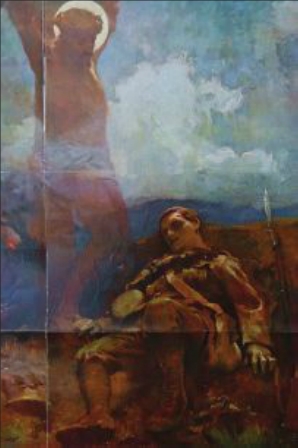
James_Clark_-_The_Great_Sacrifice

The Great Sacrifice, by James Clark [Public domain], via Wikimedia Commons

ed 2 church window

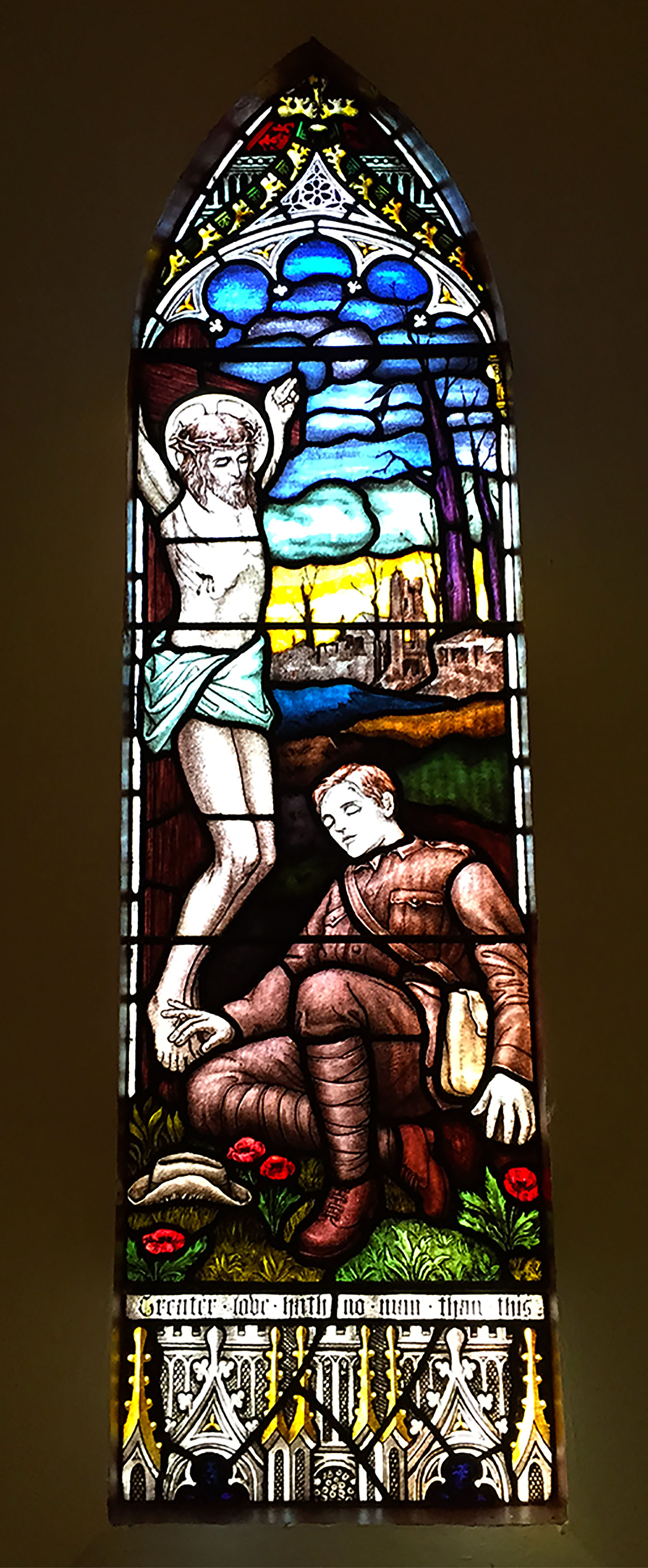
Detail of stained glass window by William Montgomery in St. Martin’s Chapel, based on The Great Sacrifice. Photo courtesy of Saint George’s Anglican Church, Malvern (Victoria).

In December 1914, just before Christmas, a commemorative print of the painting – The Great Sacrifice – by James Clark (1858-1943) was issued in the (British) illustrated weekly publication, The Graphic. The print had an immediate appeal and became one of the key religious images of WW1. It was picked up and adapted across the Empire. For example, the basic image appears in the stained glass window in St. George’s Anglican Church at Malvern (Victoria). In this particular work a distinctly Australian slouch hat has been included.

Some idea of how influential the poster was and just how quickly it was pressed in to service across the Empire comes from the following article which appeared in the Gippsland Standard and Alberton Shire Representative on 8 January 1915.

Special services in connection with the Empire’s Day of Intercession concerning the war were held in the Anglican churches throughout the district on Sunday last. At Yarram the pulpit was flanked with the Union Jack draped round a copy of the new painting by James Clark, entitled “The Great Sacrifice,” depicting the Saviour on the Cross, at the foot of which lies a dead soldier, in the uniform of the present-day British infantry, whose hands rests on the Saviour’s feet, as though seeking to identify himself with the “Great Sacrifice.”

Reverend Cox (Church of England, Yarram) was still employing the image of The Great Sacrifice in a sermon that was reported in detail in the paper in May 1915 (7/5/15). It is difficult for us, 100 years on, to appreciate just how influential the idea of the British or Australian soldier as a ‘soldier of Christ’ was at the time. In a far more religious Australian society and at a point in the War well before the AIF had established its own more secular ideology that represented sacrifice as an expression of ‘mateship’, it was seen as natural that religious leaders like Cox explained such sacrifice in war in terms of religious teaching. Cox stressed in this particular sermon:

“Greater love hath no man than this that a man lay down his life for his friends.”

He was definitely not talking about secular notions of ‘mateship’ but about Christian love and duty.

For Cox, the soldier lying dead at the foot of the cross, his hand touching the foot of the crucified Christ, was at one with the Lord who had sacrificed His Life for the sins of the world and the One who would rise triumphant over death. In his death, fighting the just war, the soldier had also won his eternal life with the Saviour. The soldier’s individual sacrifice was an expression of The Great Sacrifice.

On this particular occasion Cox was also keen to emphasise that Christ Himself identified with the dead soldier. Referring to the text quoted and the actual picture of The Great Sacrifice, Cox told his congregation: I want by means of this text, illustrated by the picture, to show you Christ suffering, bleeding, dying, thereby identifying Himself with suffering humanity. For Cox, Christ in His compassion was taking the soldier to Himself. We might find all the imagery overdone – perhaps uncomfortable and even unfathomable – but for religious congregations of the time, the sermon would have been easily understood; and later in the War as death became so common, parents, families and whole communities could take consolation in such religious teaching. As tragic as the death of a soldier fighting overseas was in the bitter world of everyday reality, there was higher purpose to all the suffering and Christ would take to himself those who died in His name. These were profoundly powerful religious beliefs.

Such a religious perspective on the thousands of Australian deaths that, in early 1915, were still to come was based on several key beliefs. The first was that God was on the side of the Allies: it was a just war against an enemy that had turned its back on Christian principles and conducted war in a barbaric manner. The second belief was that there had to be both a moral and martial campaign against Germany. The War called for religious renewal because for the Christian believer it did not make any sense to see the War simply in terms of competing armies. There had to be a higher, more divine purpose to all the suffering and horror. True Christians had to turn again to God in prayer and commit to leading upright lives. The third belief was that those on the front line facing the enemy were acting selflessly to protect those at home, and their sacrifice would be recognised by God. Therefore they were under His protection. However, the significant qualification here was that the individual soldier, exercising his free will, had to stay true to his religion and live a decent life as a soldier. He could not allow himself to be corrupted, or even seduced, by the evil that war inevitably spawned. War could destroy innocence and the young and impressionable had to be both warned and protected.

All these beliefs could be seen in the sermon Reverend Cox delivered that day in May 1915. He reminded his congregation of the suffering of those in Belgium and he then added the outrages inflicted on those in Poland, alluding to the sexual predations of the German army on the women and girls of that nation. Continuing the theme of German perfidy, he turned to the treatment of British prisoners of war: We read almost daily of the treatment meted out to British prisoners in Germany of their being fed on stuff that we would scorn to give to our pigs, of their being insulted, cruelly treated and murdered in cold blood. He even gave an example of the brutality of German colonising methods, citing an incident from 1897 when a leading German colonial officer ridiculed British attempts to deal ‘fairly’ with the Massai and proceeded to shoot dead any native who challenged – even in the most moderate and reasonable way – German authority. Germans were ruthless tyrants and Cox warned his congregation that because Australia had pledged such strong support for the Empire against Germany, and had already done everything possible to exasperate the enemy, they could expect no mercy if ever Germany overcame Britain; and therefore God must always be their last refuge: If ever the enemy gets a foothold we will have to look to God for help. So for Cox, prayer – and the attendant recognition of God’s supremacy above everything – was the primary line of defence: Prayer – earnest, believing prayer. Why do I put this first? Because we are fighting not against flesh and blood, but against the powers of evil. Therefore no other weapon will avail. But as Cox saw it, people were not turning to God in this hour of national crisis and the power of prayer was not being realised. As Cox, lamenting the size of congregations, noted … it seems as though prayer has lost much of its meaning nowadays.

Faced with this indifference, Reverend Cox believed strong action was required to force people to wake to the national crisis at hand. Sacrifices had to be made and, again, football was high on his list. He declared:

And what do we see? Many a man who ought to be on the battlefield, fighting for the sufferings and honor of womanhood staying home to play football, and women and girls flocking to watch them play. I have no quarrel with football. I have played the game, I like the game, but under present conditions! no, certainly not.

The local football competition in the Shire would be wound up several months later, under the relentless pressure from patriots. Cox was also keen to push the cause of temperance and hoped that many more would follow the lead of King George V who had only recently pledged to abstain for the duration of the War. There was also a passing shot at trade unionists undermining the war effort by holding up ships with war supplies.

For the young men who could enlist, Cox had the simple message that they should: Go, because your country needs you. Go, above all, because Christ needs you. As such ‘soldiers of Christ’, they needed encouragement and direction and therefore Rev. Cox was keen that young man enlisting had access to the Scriptures:

There is one object for which I would ask. The men who are going to the front are going to face death – they know it – they volunteer with that in mind, and at such times men are prepared to receive divine truth. There is then a unique opportunity presented to us of helping them. The British and Foreign Bible Society undertakes that every man who cares to have it receives a copy of the Scriptures. This requires funds, and I will gladly forward any contributions for that purpose handed to me.

The sermons of Reverend Cox were repeated from countless pulpits across the nation. Protestant churches tended to have a sharper focus on Imperial duty but the Catholic clergy definitely preached for the War. There was a collective sense of turning to God in the hour of need. God Himself was enlisted in the cause. The AIF was charged with doing God’s work to overthrow evil. And death in war was seen as an expression of Christian sacrifice.

However, the AIF – idealised as some sort of righteous army of God, with its individual members, as soldiers of Christ – could easily fall short of religious benchmarks. It was inevitable that the pressured creation of the AIF would concentrate the very anti-social behaviours – drunkenness, gambling, ‘filthy’ and blasphemous language, disrespect for proper authority, larrikinism .. – that religious leaders had railed against for years. Certainly in the early months of the War, the image of the AIF was not as wholesome as the sermons suggested.The following account is taken from The Argus of 21 December 1914. It covered one of the riots in Melbourne by soldiers from Broadmeadows. The headlines read: SOLDIERS ATTACK CHINESE. TUMULT IN THE CITY. ORGY OF WINDOW BREAKING. POLICE USE THEIR BATONS. SEVERAL ARRESTS MADE.

Little Bourke street, the scene of many a conflict, probably never witnessed such a serious disturbance as that which occurred last evening in consequence of certain members of the Expeditionary Forces acting on a desire to wreck the place. From Swanston street to Russell street hardly a window which was not sheltered remains whole, and during the conflict, which in this quarter lasted for more than an hour, many extraordinary scenes were witnessed.

The article claimed that the trouble began when a story circulated that a soldier had been treated roughly on the previous night by a Chinese shop owner. The story eventually had the soldier involved dying from his injuries in the Melbourne Hospital. There was no such death, nor possibly even any injury, but as the paper pointed out, … the indignity of having been kicked by a Chinese evidently rankled so bitterly that the story became magnified… .

The paper suggested that the attack on Chinese business along Little Bourke Street was an organised affair:

About half-past 6 o’clock last evening a number of soldiers assembled in Little Bourke street , and shortly afterwards a brick hurtled through the plate-glass window in Wallach’s furniture shop. The crowd then dispersed, but returned to the same place about an hour later, and there were then indications that the disturbance was more or less organised. Several men carried bandages and Red Cross outfits to salve the wounds of those who might come into conflict with the police, and the bugle call to assemble brought hundreds of men to the lane. The soldiers by this time had reached a state of extreme anger, and talked openly of running all the Chinese out of Little Bourke street at the point of the bayonet. It was stated on all sides that 7,000 men had broken camp, and were marching from Broadmeadows to avenge their comrade’s death.

The picture that the paper gives of the men’s sense of military discipline was not encouraging:

Major MacInerney, provost marshal, was on the scene shortly after the disturbance became general, and many of the men obeyed his command to fall in and march away. Every time, however, that a missile found its objective, the men would break their ranks and cheer vociferously. On one occasion, when being marched away from a side lane, the soldiers came upon a heap of stones and bricks which almost seemed to have been placed there for some fell purpose. On seeing them, joy filled their hearts, and they instantly broke their ranks, and made a dash for Little Bourke street, where hostilities were resumed.

It appeared that the larrikin defence of the White Australia Policy proved far stronger than military discipline.

The episode in Little Bourke Street was not the only such ‘riot’. The most serious one was the ‘strike’ at the Liverpool camp in NSW in February 1916.

Historians -e.g., Stanley, P (2010) – have written extensively of the struggle military authorities faced with the new volunteer army – made up primarily from the working class – that was the AIF. In time, however, some of the very qualities that proved so intractable at the beginning -for example, attitudes towards military authority – would come to be extolled as the distinguishing strengths of the AIF.

The larrikin soldier of the early AIF hardly appears compatible with the idealised image of the soldier of Christ, but the more important observation is that both realities were at play, in obviously complex and often contradictory ways.

References

Gippsland Standard and Alberton Shire Representative

The Argus

Stanley, P 2010, Bad Characters: Sex, Crime, Mutiny, Murder and the Australian Imperial Force, Pier 9 (Murdoch Books Australia), NSW.

For more on The Great Sacrifice see this entry in Wikipedia

For more on the stained glass window in St George’s Anglican Church, Malvern see this entry on the collection of Stained Glass in the Church.

POSTSCRIPT
The attached image of a memorial card based on ‘The Great Sacrifice’ was kindly supplied by the Stratford and District Historical Society. It comes from a photograph album kept by a family in memory of their son, and it shows just how common the imagery of ‘The Great Sacrifice’ was in WW1.

25. The Belgian Narrative. Part 2: The Shire responds

A previous post (15. The Belgian Narrative. Part 1: to the end of September 1914) looked at the development of the Belgian Narrative in the opening months of the War. This narrative placed Germany as the unprincipled aggressor prepared to crush any nation that stood in its way, and Belgium as the heroic but doomed small nation upholding its rights as an independent state. In the same narrative, Britain and the Empire, as defenders of Belgium’s neutrality, were drawn, reluctantly, into war in Europe against the military tyrant. Belgium’s heroic and fierce resistance had slowed the German plans for the conquest of France and brought precious time for the Allies. The resistance of the Belgians also brought out all the latent savagery and barbarism of the German nation and the world press was full of stories of German outrages and atrocities against the civilian population.

The Belgian Narrative summarised the origins of the War in essential elements for patriotic Australians – the resolute Empire, the beastly Hun and the heroic Belgians – and through to the end of April 1915 it dominated Australian reporting of the War.

This post examines how the story of Belgium was presented in the Shire of Alberton and what the locals did by way of support for the cause.

Post 15 concluded with an advertisement for a Handkerchief Afternoon Tea to be held in Yarram on 7 October 1914, with the proceeds to go towards Belgian relief. Admission to the fund raiser was by handkerchiefs for wounded soldiers. The following is an account, taken from the South Gippsland Chronicle of 9 October 1914, of this particular fund raiser. The headline was Patriotic Garden Fete.

The residence of Mr. and Mrs. J. W. Fleming, of Yarram, presented a very pretty appearance Wednesday evening last, when a garden fete was held to collect money and kind for the Red Cross Society. … The residence and grounds were adorned with flags and bunting, emblematic of the British Dominions and allied forces. … A large number of the residents of Yarram and district were present and all expressed themselves freely of the splendid work of the host and hostess. … Refreshments of a very sumptuous nature were provided. Withal, the visitors were attended to in a right royal fashion, and all enjoyed themselves immensely.
As a means of collecting funds games were carried on and charges made. Croquet, putting and rifle shooting were all well patronised, and the competitions were interesting and keen. …
Altogether, gifts of 363 handkerchiefs, 36 tea-bags and 5 bandages were received, which is very commendable. The Hostess (Mrs. J. W. Fleming) requests us specially to make mention of W. G. Growse, of handkerchiefs, tea-bags and bandages. For all other donors thanks are also tendered.
The amount collected per medium of the various games amounted to £2 10s. … This amount will, we understand, be given to the Belgian Fund.

James Weir Fleming was a ‘manager’ of Yarram. He was an executive member of the local branch of the People’s Party (Liberal), a member of the board of management for the local Presbyterian Church and he would in time become a member of the local Recruiting Committee. William Charles Growse was a local merchant who ran one of the main emporiums (Growse’s Leading Stores) in Yarram.

The newspaper account of the fundraiser suggests an almost surreal disconnect between faraway Yarram and the suffering in Belgium. At the same time, there was an ongoing attempt by the local press to drive home just how dire the true situation in Belgium was and how Germany was such a ruthless enemy. In an editorial at Christmas that year, the Gippsland Standard and Alberton Shire Representative (Wednesday, 23/12/1914) claimed:

For fifteen years past the cult of brutality has been preached as the German spirit in the army, on political platforms and in the University. Brutality with the German nation has become a disease; all virtue has clean gone at the will of a military despot, who has demoralised his people with the one thought of gaining power by brute force.

Germany was held totally responsible for the War, the cause of which was … Germany’s attempted self-aggrandisement at the expense of her more peaceful neighbours. In the process of ruthless conquest, she had turned her back on Christian principles, as shown so forcefully in her invasion of Belgium:

The guiding principle of “do unto others as you would that they should do to you” has had no place in the hearts of the German leaders, otherwise the peace-loving Belgians would not have had their neutrality violated, because they resisted the depredations of a burglar nation. They were ruthlessly murdered – men, women and children. What is Christmas for the brave little Belgian nation today? A desolate country, with the pall of death spread over their fair land, for daring to intercept the march of a foe intent on battle.

By the end of February 1915, support for Belgium had shifted away from the occasional fete to a more sustained and organised contribution scheme. It was run under the slogan of Bread for the Belgians. The local paper, the Gippsland Standard and Alberton Shire Representative, was one of the the driving forces for the campaign. In the edition of Friday 26 February 1915 there was an article under the headline Bread for the Belgians. Appeal to Gippsland. It started by setting a grim scene,

In Brussels over 200,000 people every day wait in the snow for their bread. In Liege, where for 6 months the bravery of a small nation altered the whole complexion of the greatest war in history, 30,000 old men, women, children and cripples daily line up to get their half pound of bread and litre of soup, which alone enables them to live. Babies and children are barely kept alive for want of milk.

The paper reminded its readers of the debt owed to the Belgians – We in Australia have been asked to help these most deserving people, to whom we owe our liberty today – and listed in detail all contributions, both in cash and kind, that had been received. The paper called for the setting up of a committee to manage the appeal.

In the same edition, the editor had organised for a letter from the Reverend F Tamagno (Presbyterian) to appear in support of the contribution scheme. The Rev Tamagno would become another key player in the local Recruiting Committee. The letter itself stands as something of a classic account of the Belgian Narrative.

I am sure that the appeal to loyal Australians, from Belgium, will be generously responded to. Surely the faintest hearted Australian can now see that little heroic Belgium gave Britain and France time to gather their forces together and meet the nation of “kultur”. There is no doubt that had Belgium assented to Germany’s diabolic demand, to march through her country unmolested, then France would have been the awful sufferer, and most probably Britain would have been seriously hampered from getting her transports quickly into France. Can we who know very little of indescribable agony and want shut our ears to the bleeding nation of Belgium? Will we not prove our intense admiration of the Belgian people by giving month after month a few shillings each to sustain starving men, women, children and babies? Sacrifice! we know not the meaning of the word. Let us do immediately and constantly something practical, which is the beginning of sacrifice. God forbid that, through our indifference, millions of Belgians should continue to suffer and starve, when it is in our power to relieve them, hearten them, and give to their succeeding generations the sweet consciousness of a nation’s heroism. I suggest that all who can will contribute, month by month, towards the fund you have opened in your columns. Every man, woman and child among us ought to keep on doing a little regularly, until either Belgium gains her freedom, or the devilish foe is forced out – baggage and body. I enclose 5s, and I shall continue to do so month by month, until heroic Belgium breathes yet once again the air of peace, hope and love.

The appeal was for locals to contribute a fixed amount on an ongoing basis. There were more letters in the next edition (3 March 1915), together with lists of more donors – now nearing one hundred – and a breakdown of their individual donations. The total raised stood at £176. The letter by Ben Percival Johnson – a well-known lawyer in Yarram who would become heavily involved in key patriotic associations, including the Recruiting Committee – also laboured the idea of the debt owed to Belgian for holding up the German advance. He argued that the Belgians … could easily have protested against the German invasion and then let the invaders through. The result would have been the loss of many more lives, the infliction of much more suffering and sorrow, and the expenditure of millions more in money by the people of Great Britain and her colonies, that is us. France would have, for the time being, crushed; Paris and Calais would have fallen, and, perhaps, Britain invaded, for our army was too small to offer any serious resistance to the hordes of trained Germans. Belgium saved all this, and their pathetic appeal should meet with the most generous response.

Future editions kept up the appeal for Belgium with the growing list of donors being published. The practice created a type of honour board of patriotic citizens. A formal fund-raising committee was duly formed and it included clergy from all faiths, including Fr Sterling (Catholic), Rev Tamagno (Presbyterian), Rev G Cox (Church of England). At this point there was very much a combined religious front to the War, and both France and Belgium, the 2 nations suffering most at the hands of the German invaders, were Catholic. Another key committee member was A J Rossiter, the editor of the Gippsland Standard and Alberton Shire Representative. The first meeting of the committee closed with everyone there singing a verse of the National Anthem. The grand total continued to grow. At the start of March 1915 it was £257. The committee stressed that the fund was not a case of charity, rather it was about repaying a debt owed to the Belgians. But not everyone was as committed as the members of the committee and the conviction that people had to be made aware of their responsibilities – set to become one of the most critical political themes of WW1 – was there from the start. Rev. Tamagno wrote in the paper (23/3/15), The people must bear in mind that there were 7,000,000 Belgians to be fed. Some people seemed quite unconcerned, but they must be woke from their slumbering, and be induced to give in large or small sums. By the end of May the total was £716. The Shire’s efforts were being mirrored all over Victoria and the nation as a whole, and across the Empire. Newspapers throughout Australia over the first half of 1915 featured countless articles on funds being raised for Belgian relief. As a quick comparison with the Shire’s efforts, articles in The Argus gave Ballarat’s total to early May (12/5/15, p. 10) as £1,350 and Broken Hill’s to the middle of June (18/6/15, p. 4) as £2,625. The funds were distributed by the American based Commission for Relief in Belgium, whose chief executive – and future US president – Herbert Hoover, had been recently involved in the mining industry in Australia.

Evidence of just how pervasive the preoccupation with Belgium was in the first year of the War can come from the most unlikely places. For example, in March 1915 a new football club was formed in Yarram. The Gippsland Standard and Alberton Shire Representative (31/3/15) reported that an attempt was made to call the team the ‘Yarram Imperials’ but this rather patriotic title lost out to the far more specific ‘Yarram Fire Brigade Football Club’. However, on the issue of colours, patriotism did win out: The colours were under discussion, when a smart looking guernsey was placed on the table, red and yellow. It was suggested that the letters be black, so that the players would bear the Belgian colours. This, of course, appealed to the patriotism of all present, and these colours were adopted amidst applause.

From late April 1915, reports of events unfolding in the Dardenelles would come to dominate Australian reporting of the War but even as the focus shifted to the experiences of Australia’s own soldiers, the plight of the Belgians was still being written about. The following account is of a fund-raising concert held at Kjergaard at the end of April 1915. It was published in the Gippsland Standard and Alberton Shire Representative on 7 May 1915.

Friday night, 30th ult., was fixed for a Belgian benefit, and the elements being propitious, people flocked to Kjergaard from miles around. … Enthusiasm had been aroused in the good cause. Some people thoughtfully brought “live” produce, one of the number, an Aylesbury duck, being very much alive during the concert. It had been deposited on the stage, and much merriment was created at intervals when it showed its appreciation of a song by a pronounced “quack quack”. …
The chairman called on Mr. N. J. Cook, head teacher of the Blackwarry State School to address the gathering. Mr. Cook referred to the appeal to help the brave little Belgium nation, which had been trampled upon by a relentless foe, and was now in deep distress – an appeal that would not be made in vain. Germany expected to have got to Paris, and would not have been disappointed had she not been held fast at Liege and Namur. They all had admiration for the brave Belgium nation.

Total receipts for the night came to some £18, and the duck in question – clearly a key player in the night’s entertainment – fetched the princely sum of £1/1/6. After the speeches and auction, the hall was cleared for supper and dancing. The purpose of the night was serious but it was also a an opportunity for the community to come together and socialise.

Late in May 1915, (Gippsland Strandard and Alberton Shire Representative, 26 May 1915) Alberton Shire received its share of 1,100 ‘Belgian Buttons’ to sell. They were 1s each and were sold from a number of businesses in Yarram. The slogan that went with the buttons was, “Be a Briton! and buy a button for a ‘bob’ to buy bread for the Belgians!” The ambitious plan was to sell one to every adult in Australia (2.7M). Like the lists of donors which was published regularly in the local press, the buttons were a means of identifying those in the local community who were serious about supporting the Belgians. Tellingly, the buttons came with a new measure of patriotic commitment: There are two kinds, one for those who have father, husband, son or brother at the front, and these have white circle round the edge; the other kind is for those who have no near relative at the front. The design of the buttons is a tangible illustration of how the Belgian Narrative became a test of commitment to the Empire and the War. The Belgian Narrative was always more than any simple or even heartfelt account of the terrible fate of Belgium. It became a test of commitment.

Finally, to emphasise the extent to which the Belgian Narrative was both interpreted and presented within Christian teaching – it served as a modern parable – consider the following poem written by J. C. D of Welshpool, which appeared in the Gippsland Strandard and Alberton Shire Representative on 14 April 1915. Little of the poem’ s intent or style strikes accord with modern sensibilities, but it does demonstrate how for some – or many – the War had to be seen as some expression of divine purpose, where both the generic call to arms, and the more immediate appeal for Belgium, were divinely sanctioned.

Pity for Belgium

Pity for Belgium! Yes, and all beside
Who suffer in the world, this Easter tide
Grant us, O Lord, the power to realise,
Not only for our friends, but for ourselves,
In England and in Honor’s name,
The shame
That lies in loyal lips and cringing hearts,
The pity of infamy we dig, forsooth,
With prudent hands – While o’er ensanguined hands
Hurtle the portents of colossal war.
The thorn-besprinkled path illuminate!
Our stricken souls with avarice and fear
Are blind to that imperial sacrifice,
That quickens in the hearts of dullest men
In crises and abysses of alarm.
On the cold hearthstone of our pampered lives
Lay Thou the fuel of compassion, now
The miraculous spark with power endow,
To kindle and consume, but not expire.
*******
Pity for Belgium! Yes, and all beside
Who suffer in the world at Easter tide,
The bread and wine ye give will Christ restore
With power growing ever to give more.

References

South Gippsland Chronicle

Gippsland Strandard and Alberton Shire Representative

The Argus

23. Enlistments to the end of 1914: background characteristics Part 2 – religion, units and service history

The last post examined a set of characteristics in relation to the men who enlisted from the Shire of Alberton prior to the end of 1914. This post concludes the overview of the men.

As noted in the two previous posts there were 134 men who enlisted in this group. However, the situation is more complicated than this because even though 134 men formally enlisted in the AIF prior to the end of 1914, not all of them were still serving up to the end of 1914. In fact, 15 (11%) of them were discharged before the end of 1914. The notes in the table below show that in most cases the men were discharged as ‘medically unfit’. The notes also show that most of those discharged at this point – prior to the end of 1914 – did eventually enlist. Individual enlistment papers indicate that when men fronted again to enlist they often did not indicate that they had already been discharged as medically unfit. There were also cases where an alias was used for the re-enlistment.

For the purposes of this post, the full complement of men who enlisted prior to the end of 1914 – the 134 of them – is used in relation to the single characteristic of religion, but the lesser cohort of 129 is referenced when looking at individual service histories. The service histories of the 15 men who were discharged to the end of 1914, but who then re-enlisted some time later, will be picked up in the relevant future cohort.

Religion

The relevant data from the Commonwealth Census of 1911, taken from Table 38. Male Population Of The Counties Of Victoria At the Census of 3rd April, 1911 Classified according to Religion (Exclusive of Full-blooded Aboriginals). for the county of Buln Buln, Victoria  has been matched against that of the cohort of the 134 enlisted men.

From the Commonwealth Census 1911:

Church of England          8,306         39%
Presbyterian                    4,897         23%
Methodist                         2,665        12.5%
Baptist                                  274
Congregationalist                 93
Lutheran                              192
Church of Christ                 114
Salvation Army                     78
7 Day Adventist                    17
Unitarian                                 9
Prot. (Undefined)               359
Roman Catholic               4,044          19%
Greek Catholic                         2
Cath. (Undefined)               176
Other [Christian]                 123
Total                                 21,349

From the individual enlistment papers of the 134 men:

Church of England                77       58.5%
Presbyterian                          20       15.5%
Methodist                              14       10.75%
Roman Catholic                    17       13%
Other Protestant                    3         2.25%
no record                                 3        –
Total                                     134

On the basis that the group of enlistees is a small sample, and accepting that the designation of ‘Church of England’ could have been used as a generic description for ‘Protestant’, there is little to suggest that, at this point in the War, the religious profile of those enlisting was markedly different from that of the wider community. At the same time, the over-representation of those identifying as Church of England and the under-representation of Presbyterian could be significant and warrant closer attention over time. However, as suggested, it might reflect not much more than the use of Church of England as a generic identifier for Protestant (as opposed to Roman Catholic). As the research progresses and the number of enlisted men becomes greater it will also be instructive to match the 2 characteristics of religion and occupation.

Units

The unit that appears against each man is taken for the Embarkation Roll. It is possible that there were changes after this point, particularly given the re-organisation of the AIF battalions after Gallipoli. It is also possible that there were changes between when the men first signed on and when they left Australia.

Most of the group embarked from Australia in an infantry battalion, with the most common ones being the Victorian 5th, 6th, 7th, 8th and the Melbourne-based 14th. Approximately one-third of the men left in the Light Horse, with the most common regiments the Victorian 4th and 8th, and the 9th, which was a combined Victorian-South Australian unit.

Service history

As indicated, this section looks at the service records of the 119 men who had enlisted up to the end of 1914 and then served in the AIF from the time of their 1914 enlistment to the point when either they died on active service or they were formally discharged from service.

Given that they were the first to sign on and that they did so on an open-ended basis – ‘until the end of the War, and a further period of four months thereafter…’ – this first group were committing themselves from the very beginning of the AIF’s war to its very end; and, not surprisingly, there was a simple logic that generally held that the earlier a person enlisted, the greater the risk they faced.

The men faced a limited range of outcomes. Certainly one was that they would die on active service. They could be killed in action (kia), die of wounds (dow) or die of illness/injury (doi). In fact, 35 of the 119 men (29.5%) met this fate. This group faced roughly a 1 in 3 chance of either being killed or dying on active service.

Another outcome involved being wounded and then repatriated to Australia for discharge as ‘medically unfit’. Most commonly the wounds were either gunshot wounds (gsw) or shrapnel wounds (sw). Another common example, but later in the War, was ‘gassed’. Usually, the soldier experienced extended hospitalisation, commonly in the UK, and then repatriation to Australia. They generally carried some level of disability for an extended period, if not the rest of their lives. Some men were also discharged as medically unfit after being hospitalised with major illness or disease or even injury. The group of men discharged on the basis of being medically unfit numbered 33 or 38% of the cohort.

The figures are grim. An earlier post described the jubilant send-off for the men at the Alberton Station on 21 September 1914. With the benefit of historical hindsight the men that day should have had some basic maths put to them: they stood a 1 in 3 chance of being killed; or a 1 in 2 chance of either being killed or coming back wounded – or suffering from some major disease/illness – to live with a disability of some kind, most probably for the rest of their lives. Moreover, they might have been as young as their early twenties when they started on this path.

In fact, the men’s prospects were even worse than this because, as the table below shows, there were many cases where men were wounded but not then discharged as medically unfit. 48 individual men were wounded – some were wounded more than once – but only 33 men were discharged as medically unfit. Notice also that some of those killed later in the War, had already been wounded in earlier battles. Also, some 69 men were hospitalised at least once with some illness or disease – pneumonia, dysentery, VD, enteric fever, trench fever, malaria, neurasthenia, pleurisy, shell shock… – but clearly not all of these men were medically discharged. In short, the levels of deaths and medical discharges do not reveal the true extent of casualties. Of those still alive at the end of the War, there is only one man in the table below – William Henry Wheildon – who managed to last the entire duration of the War without being wounded or hospitalised with a disease or sickness or injury of some kind. He served in the Naval & Military Forces and was discharged in late 1918. Ironically, he died of influenza within one year of being discharged.

For those men who managed to make it through without being killed or discharged as medically unfit, there were two possible end-points to their military service. On 17 September 1918, PM Hughes announced that the 1914 veterans were to be brought back to Australia on special leave or furlough – commonly it became referred to as ‘Anzac Leave’ – in time for Christmas. The plan was that after 3 months leave in Australia they would return to the Western Front in time for the planned Spring offensive of 1919. At the time it was estimated that 7,000 men remained of the original 1914 enlistments. The plan caused consternation with the military command on the Western Front, as it was already grappling with the very much reduced size of the AIF, but in Australia the plan was popular. Effectively, this group of men had already been away for four years. In the table below there are 22 cases where men were returned under this provision. The earliest – Sydney George Collis – returned home in early October 1918 and the latest case involved John Comber Robertson who did not make it back until mid February 1919. Most of the men reached Australia in December 1918, with the War then over. Ironically, 3 men on the table either died or were killed round the time the leave was announced: James Singleton was killed in action of 9 August 1918; Terence Charles McCarthy was killed in action on 19 September 1918, 2 days after the plan was announced; and William Donovan Glanfield died of illness on 15 October 1918.

More men (26) simply served out their time and were returned to Australia and discharged through 1919 and even in to 1920. The discharge for these men commonly read as TPE: Termination of Period of Enlistment. It was up to a full year after the completion of the War – and 5 years of service – before many of these man finally made it home.

There were a few cases involving variations on the above patterns. 3 of the group were discharged in the UK in 1919. They were men who had immigrated to Australia in the period before the War: Thomas Courtney Sullivan (born London); Alfred Hartfield (born Sussex); and Thomas James Paterson (born Glasgow). Another of the men (Jack Garland) served from 1913 in the Royal Australian Navy and there is no record of his discharge available .

Finally, there are 2 cases that stand out because it appears that in both cases the individual concerned effectively discharged himself. It appears that Reginald Henwood who was wounded at Gallipoli in May 1915, hospitalised in the UK before being sent back to Egypt and then repatriated to Australia in September 1915, went missing without leave – ‘illegally absent’ – from 23/12/15. Eventually, in July 1920 he was formally discharged to close the book on him. However, it can be difficult interpreting what exactly happened when you rely on formal records like those in the personal files of the men who served in the AIF; and it is virtually impossible to use the same records to interpret motivation. For example, Reginald Henwood was actually reported in the local paper – Gippsland Standard and Alberton Shire Representative , 28 April 1916 – as attending a ceremony in Yarram on 26 April 1916 at which he was presented with the Shire Medallion. This was when, according to his service record, he was illegally absent and had been so for nearly 4 months. The newspaper report said that he had been wounded at ‘Lonesome Pine’ – Henwood had been wounded on 3/5/15, well before Lone Pine (6-9/8/15) – and had lost an eye, but the official record simply records ‘gsw upper extremities’ and it is not credible that such a serious injury would not be recorded. Henwood’s version of events, as reported in the local paper,  does not appear to line up with the official records.  Ironically, the very same article that praised the service of Private Henwood warned about bogus soldiers: A man came to Yarram recently, wearing some uniform, and was treated as a returned soldier, yet he had never so much as enlisted. At the same time, it seems remarkable that someone in Henwood’s circumstances would run the risk of appearing at a formal ceremony to receive awards and be feted as the returning hero. Then again, perhaps Henwood did see himself as the returned hero: he had volunteered, faced battle, been wounded and repatriated to Australia and so, as far as he was concerned, his war was over. Perhaps there was another R Henwood and identities have been confused. Incredibly, there was in fact another R (Rupert) Henwood – enlisted in Melbourne 25/8/14 – who was repatriated to Australia in 1915; but he returned to Australia on 15/4/15 and was discharged on 27/4/15. Consequently he could not have even been involved in the Gallipoli campaign.

The second case to do with someone who was illegally absent involved Edgar Charles Turnbull. Again, there are all the cautions about interpreting AIF records but the following appears to have been what transpired and, on face value, it is a rather distressing story. In Egypt in February 1915 he came down with pneumonia and was hospitalised in the UK. Other illnesses including sciatica and rheumatism were diagnosed and there was a recommendation that he be repatriated to Australia and discharged on medical grounds. On 30/8/15, his treating medical officer explicitly recommended: ‘Discharge to Australia as permanently unfit for active service’. At the same time, the medical board found that his capacity for ‘earning a full livelihood in the general labour market’ had been halved. However, the final recommendation of the medical board was that he not be discharged as permanently unfit but merely ‘changed to Australia’. Consequently, he was returned to Australia on 9/11/15, but he was not discharged. He subsequently took matters into his own hands and was illegally absent from 12/4/16. He was posted as a ‘deserter’ on 13/7/16. A warrant for his arrest was issued. Then much later, in 1933, he contacted the Army requesting a formal discharge. He was required to sign before a JP a ‘confession of desertion’ which he did on 22 July 1933. It was made clear to him that he had no right to wear medals and that he could not be issued with a Returned Soldier’s Badge. He then received his discharge papers which recorded that he had deserted. He tried to have the reference to desertion removed from his discharge papers and on at least 2 occasions argued that at the time he went AWL he was very sick. He claimed that he had been ‘sent back [to Australia] medically unfit’. He also claimed that he had been told he was ‘not wanted’. In a letter (24/7/37) he wrote: ‘I did not wrong intentionally (sic) and ever since have worked hard and been an honest and sober citizen’. He was having difficulty gaining work and his discharge papers with the reference to desertion were hardly of any use. A few years later his family saw the discharge papers and found out about his desertion. At that point he said he was cut off  from his wife and family. The last correspondence in the file covers desperate pleas for some kind of pardon.

The whole issue of desertion and the related practices of taking unauthorised leave – very common in the AIF – and challenging army authority – certainly not uncommon in the AIF – will be examined in later posts and set within the context of the AIF as a volunteer army.

Overall

These last few posts have looked at the group of men who enlisted in the AIF to the end of 1914. At the time there was unbridled enthusiasm for the War and the call to patriotic duty was overpowering.

The cohort from the Shire of Alberton was young – those between 18 and 25 made up nearly 75% of the entire group – single, and drawn predominately from the rural working class. The mobility of this group was a striking feature. There was a relatively small group of sons from local farming families.

Medical screening at the time was high and a large number of recruits were discharged as medically unfit in the first weeks of their enlistment. Most of those rejected at this point did subsequently re-enlist, presumably as medical standards were lowered.

While much was made at the time of the creation of a special light horse unit from South Gippsland, most of the men enlisted in the new infantry battalions of the AIF.

It will be instructive to compare the casualty rates of this first group of volunteers with subsequent ones, but it is strikingly clear that the odds of enlisting in 1914 and surviving – alive, unwounded and in good health – to the end of the War were particularly poor.

References

The Australian War Memorial

Embarkation Roll

Unit History: WW1

Australian Bureau of Statistics

Census of the Commonwealth of Australia, 1911

22. Enlistments to the end of 1914: background characteristics Part 1- movement, occupation, age and marital status

The last post identified 134 locals, with links to the Shire of Alberton, who enlisted to the end of 1914. This post begins to analyse the key characteristics of this group. The same methodology will be applied to future cohorts of men from the Shire who enlist from 1915 to 1918, to see if the basic characteristics changed over the course of the War.

As indicated, the list of those who enlisted prior to the end of 1914 is not necessarily complete. There is research going on in the background to establish if any of 20+ additional names should be added. Essentially these men fall into 2 categories: those for whom no AIF service record can be located, even though there were newspaper references at the time to their enlistment; and those for whom it is not yet possible to tie their name – e.g., W Rose – to the particular service record. Where additional records are uncovered, and it becomes possible to add names to the current list of 134, the relevant tables in these posts will be updated.

Qualifications like this are important because, as this post will show, trying to recreate the historical record of 100 years ago from individual pieces of information is difficult. Inconsistencies, variations and anomalies are common.

The table below builds on that from the last post by adding the following items of information: the place of birth, the place of enlistment, the address of the next-of-kin at the time of enlistment, the address of the individual volunteer at the time of enlistment, the occupation at the time of enlistment, and age and marital status at the time of enlistment. Future posts will explore other characteristics, including an overview of the war service of each individual volunteer.

In general, the information is taken from 2 key sources. Place of birth and place of enlistment are taken from the enlistment papers in each individual’s AIF service file. The other pieces of information are taken from the Embarkation Roll. However, specifically in the case of ‘occupation’, several pieces of information – the Embarkation Roll, the individual AIF service file, the Shire of Alberton Rate Book and the Commonwealth Electoral Roll for the Subdivision of Yarram Yarram – have been used. The intention here is to identify those men who were coming from the ‘family farm’. In one or two cases, a young man described himself as a ‘farm labourer’ or even just ‘labourer’ when in fact his father was an established farmer in the Shire and the young man was working with his father on the family farm. Similarly, a young man would describe himself as ‘farmer’ when, by looking at other evidence, it was again the case that he was working with his father on the family farm. In the table below, the term ‘family farm’ covers all situations where the son was working on the family farm. The qualification here is that even though there was a family farm it was also possible that the son was undertaking other work in the district – for example, one of them listed ‘horse breaking’ as his occupation – or perhaps it was work in addition to the work on the family farm. The more important point is that the table identifies all those cases where the person enlisting was the son – or possibly one of several sons – of a farmer. On the other hand, where the evidence suggests that the person enlisting was a farmer in his own right – the land was recorded in the rate book in his name, not his father’s – or the evidence is not sufficient to rule out the possibility that the person was a farmer, the occupation of ‘farmer’, as recorded on the various forms, has been let stand.

With the 2 addresses taken from the Embarkation Roll it is apparent that in most cases the volunteer simply gave his next of kin’s address – most commonly this was a parent – as his own address. At the same time, there are some exceptions. For example, Walter Tibbs (122) was a farm worker at Tarraville who had immigrated as a 15 year-old from Leeds in England. Most other immigrant workers simply gave their parent’s address in the UK as their own address, but Tibbs actually recorded his as Tarraville. The significance of this is that this young man – 21 at the time – who was killed at Gallipoli on 25/4/15 was not included on the Shire of Alberton Honor Roll. Nor was his name included on the Shire War Memorial. Yet, when his parents completed the Roll of Honor details for the National War Memorial they specified Tarraville as the place with which he was ‘chiefly connected’. It appears that despite all his efforts, and his family’s efforts, his presence in the Shire was never acknowledged or, probably more correctly, too easily forgotten.

Movement
The table certainly highlights movement as a key characteristic of the rural working class. There appear to be four relevant groups involved. First, there are what can be termed long-term residents: those who were born in the Shire, enlisted in Yarram and gave some location in the Shire as their own address and that of their parents. The two Graham brothers (47 & 48) serve as an example of this group; although even here there is an anomaly because only one of the brothers – Leonard Simpson Graham – is recorded as having been to school in the Shire.

The second group involved those who had been in the Shire for some time – they had been born in the Shire and/or spent time there as a child or adolescent – but who, by the time of enlistment, had moved out of the Shire. An example is George William Silver (109) who had been born in the Shire, went to a local school and had remained in the Shire probably up until his adolescence – judging by his 6 years in the Yarram Rifle Club – but who by the time of enlistment was obviously living in Melbourne. He was not included on the Shire Honor Roll. However, others in the same situation were included. The deciding factor in such cases appeared to be whether or not there was still a family connection to the Shire. For example, Gordon William Appleyard (3) was born in the Shire (Binginwarri) and went to a local school. Yet he was clearly not in the Shire when he enlisted (Rockhampton, Qld) and he gave his address as Barcaldine, Qld. However his next-of-kin’s address (Alberton) was in the Shire, and he was included on both the Shire Honor Roll and the Shire War Memorial (he died of wounds at Pozieres). Interestingly, John Henry Adams (1) – killed in action 8/8/1915 – also enlisted in Queensland and like Gordon Appleyeard, his family was very well known in the Shire (Calrossie). His address and that of his next-of-kin were both given as Yarram. Yet he is not on either the Shire Honor Roll or the Shire War memorial. The significant difference here appears to have been that the Adams family moved to Traralgon during the War (1916) and, presumably, as the result of the family connection being lost, the son was not seen as – or not remembered as – a local when it came to including the names on the Shire memorials.

The third group takes in those who came into the Shire and had established themselves as local by the time of enlistment. This includes the likes of Frederick Butler (17), John Crawford (29), Stanley Hawkins (56) and Ernest Singleton (111). It also takes in most of the 15 immigrant farm workers. Generally, this group had their names included on the Shire Honor Roll.

The last group was made up of those who had moved into the Shire, but only recently, and in some cases it might well have been that they enlisted in Yarram because that was where they found themselves just at that point in time. Had their work, or search for work, taken them to Foster or Sale they would have enlisted there. This group stands out because even though they had their medical in Yarram and enlisted in Yarram there is no indication of any long term involvement with the Shire – they were not born there, did not go to school there and their next-of-kin have no apparent link to the Shire – and, in most cases, their names are not included on either the Shire Honor Roll or the Shire War Memorial. Yet, clearly, they did enlist from the Shire.

The creation of these 4 groups is merely an attempt to impose some sort of order on what was a highly complex pattern of movement. Inconsistencies and anomalies across the table suggest that the boundaries between the groups were not as fixed as the model suggests; and whatever scheme is devised, there still has to be accommodation for personal judgements made at the time, 100 years ago. However, it is clear that the movement of this group of early volunteers was a distinguishing feature, and it is reflected in the simple observations that, for example, 16 of the men enlisted interstate; approximately 80 – more than half – of them had been born outside the Shire and nearly half gave, as their address on enlistment, a location outside the Shire.

Occupation
Obviously the high incidence of movement is tied inextricably to occupation. By far the largest single group (44) is that where the men had simply described themselves as either ‘ labourer’ or ‘farm labourer’. When you add those who described themselves as – stockman, station hand, horse driver, gardener, butter maker, sawyer, horse breaker, jackeroo …. – and those working on the railways, in retail as grocer’s assistant , and the fishermen, the group is solidly rural working class. Within this description of rural working class, there are some in semi and skilled trades – plumber, carpenter, fitter & turner, telegraph operator, engine driver, motor mechanic, coach builder, painter, blacksmith, brick layer etc. There are also some from clerical positions. However, with the exception of a group of teachers (5) and one mechanical engineer, the number of professionals and higher level administrative and managerial representatives is very limited.

The other distinctive occupational group takes in the sons from family farms. Doubtless these 18 cases would have been well known in the district. These were the sons of farming families that had established themselves in the local community over the preceding 40+ years. The loss of the son’s labour and support for the family farm would have been significant. It would not have been an easy decision for the family to support the enlistment; but presumably patriotic duty overrode the significant cost to the family. Even with this group there are anomalies. For example, the 2 Scott siblings (106-107) came from a family farm background, yet the details of their individual enlistments suggest that the link with the family farm had been severed by the time they enlisted.

The number of cases involving farmers per se – they owned and were working their own farm – was very small and in fact when you look at their ages it is likely that only about half of the 8 cases identified in the table were such farmers. There was very little possibility that a farmer would – or even could – simply leave the farm and enlist.

Overall, at this point of the War, it is apparent that the burden of enlistment fell squarely on the rural working class, whose employment was often itinerant and casual, and a small group of young men – typically they were late teens or early twenties – coming from family farms in the Shire.

Age
The following table gives a breakdown of ages. The number of ‘minors’ – those between 18 and 21 required written permission of their parents – is high. When this group is added to those to the age of 25 it is evident that this particular cohort was very youthful. The oldest volunteer at forty-one – twice the age of 53 of his fellow recruits – was William Henry Wheildon a miner from Yarram. He had already served in South Africa and in WW1 he served in the Naval and Military Forces in New Guinea.

Ages of volunteers to the end of 1914
ages                       %
18-20        33       24.6
21-25        65       48.5
26-30        22       16.5
31-35        11         8.2
36+             3          2.2
total        134      100

Marital status
At the time the expectation was that only single men would enlist and this is evident in this particular cohort, where only 6 of the 134 men were married.

Overall
In the first few months of the War to the end of 1914, it was the young, single rural workers who could best answer the call to enlist, not the farming families who were, literally, tied to the land. The exception was a group of about 20 young men from local farming families.

References

Embarkation Roll


16. Righteous war and religious renewal, September-October 1914

The last post examined how the narrative covering the invasion and occupation of Belgium dominated newspapers from August 1914 and was used to prove to readers that the Empire’s declaration of war with Germany had been justified. This post pursues the theme of the righteousness of the Empire’s position by looking at the unqualified support offered by the Church. While there was broad support from all faiths, including (Roman) Catholicism, it was the Protestant Churches that took on, and were expected to take on, the formal role of justifying the Empire’s involvement. It was Protestantism that presented itself as the religion of the Empire.This arrangement was reflected at the local level in Alberton Shire where the Gippsland Standard and Alberton Shire Representative, during August and September 1914, devoted considerable copy to pronouncements made by clergy from both the Church of England and the Presbyterian Church.

On 4 September (p.2) the local paper published the pastoral letter from the Church of England Bishops of Victoria that outlined the Christian response to the War. This was followed immediately by the sermon delivered by Rev. George Cox of Yarram on the same theme. Neither the pastoral letter nor the sermon expressed any doubt about the righteousness of the Empire’s position. There were numerous references to ‘imperial duty’ and the ‘justice of the Empire’s cause’. The basic line was that the Empire, because of what it was, had to be supported: The Empire, which is the home of freeborn citizens and fosters throughout the world the spirit of righteousness, calls for our help. The enemy, by contrast, was driven by …the spirit of aggressive military despotism.

While there was absolute conviction in the righteousness of the cause and total determination to support the Empire there was also a sombre tone. In the pastoral letter, the bishops called for a Christian response to the fighting:

The time of war is a challenge to the Christian Church to use her faith and influence to the uttermost extent, so as to minimise the evils of war and render assistance to its victims. … We trust that the clergy will, in their sermons, never forget how unfitting is all boastfulness of power or pride. … we cannot forget the untold misery which, from the very first, must accompany this great conflict of nations.

For his part, the prescient Rev. Cox was clearly challenged by the apparent incomprehensibility of the situation:

When we consider that the nations now engaged in this awful strife are the foremost in civilisation, enlightenment and religion; when we realise that both sides claim that their forces are engaged as the instruments of God for the overthrow of the other; when we think of all the fiendish inventions of mankind that are being used in the slaughter of his fellow-man in the cause of righteousness; when we ponder upon the untold and unthinkable suffering and misery and wretchedness and waste which the whole civilised world will be called upon to face for many a year, we may well stand appalled.

For Cox, the fundamental dilemma of two Christian nations going to war against each other was resolved by the conviction that one of them – Germany – while still claiming to be Christian, had in fact betrayed the very principles of Christianity:

Christianity stands for three things, amongst others – righteousness, justice and truth. But a great and powerful nation, professedly Christian, has substituted in place of righteousness military despotism, for justice arrogance, and for truth hypocrisy and blasphemy.

Importantly, both the pastoral letter and Cox’s sermon called for religious renewal. The view was that at such a time of crisis people had to turn again to God in prayer, and renew their religious life. For the Empire to prevail everyone had to take their religious obligations more seriously. As the bishops put it, penitence was the moral order of the day:

To all, in every Parish of the Province, we make our solemn appeal for repentance from past sins and for a whole-hearted surrender of our lives to the care and providence of the Eternal Father, through our Saviour Jesus Christ.

Cox gave a practical illustration of just how skewed people’s current priorities had become, and how far they had strayed from God’s true path and were testing His goodness. Cox noted:

How little we, as a nation, recognise this duty [our duty to God] so far may be judged by a comparison of the attendances at our football matches and the interests taken in them, and the attendance to our churches, and the recognition of our duty of praying for our troops.

Football was being set up to become the whipping boy of WW1.

This call for religious renewal was to take two very important directions over the course of WW1. One was the conviction that the War called for a moral as much as a military response, and that long-term social causes such as temperance had to be pursued with renewed vigour. Australian society had to become more religious, more morally pure and less vulgar. Hopefully, the defence of the Empire and the attendant turning to God could be employed to force people to confront the spiritual poverty of their lives. The other direction, even more extreme, was the attempt to portray those who answered the call of the Empire as, literally, soldiers of Christ. This latter direction was always going to be a big ask with the AIF but, as we will see in future posts, clergymen like Cox certainly did pursue it. Cox certainly saw his own enlistment as an extension of his Christian life.

Like the Rev. Cox, the Rev. F Tamagno of the local Presbyterian church was another Protestant preacher who had sermons published in the local paper at this time. His first sermon was reproduced on 4 September 1914 (p.2). As was common at the time, he employed the text, Render unto Caesar the things which be Caesar’s, and unto God the things which be God’s.The conventional treatment of this text highlighted the difference between duty owed to the divine as opposed to any temporal power. However, in Tamagno’s sermon there could be no conflict and therefore patriotism and religion were fused in the interests of the Empire. For Tamagno, it was inconceivable that the British King could ever be an unbelieving, despotic Caesar. Nor could the glorious history  and achievements of the Empire ever be challenged. There was therefore no conflict of duty and the Empire was in the right:

Patriotism is upon our lips. Once more in the history of our Empire, and its King, we are being called upon to manifest that spirit of patriotism, so characteristic of our race. We all realise how momentous shall be issues of this war of the nations. It will not do for us to lean upon our forces only, but upon God. I believe that at heart our Empire and King are depending upon God for an honorable and triumphant victory. The nation that tries to conquer Britain, has before it a Herculean task – so great and so bloody, that one would think that Germany, even now would pause, and honorably decide to go no further. Tennyson has well said – “This England never did, and never shall, lie at the proud foot of a conqueror.” The stirring memories of our past are sufficient to awaken throughout our Empire that spirit of indomitable courage so characteristics of Britishers. The path by which we have come has been stained with the blood of heroes and heroines. We hoped that the nations had learnt to settle international disputes no longer by trained brute force, but by the calm and light of reason. Our Empire’s duty is plain; our conscience is clear; out hands are clear of the blood of thousands.

It is also interesting to note Tamagno’s Empire-centric view of the War. World events were only seen through the filter of the British Empire and so for him the War was fundamentally a conflict between the British Empire and Germany. The reality, particularly at that point, in the first few months of the War, was that the conflict was decidedly a European one, and British involvement in this unprecedented European upheaval, at this stage at least, was only an expeditionary force.

Tamagno also saw the potential of the War to turn people back to God. In a sermon reported in the local paper on 7 October 1914 (p. 4) he made much of the recent reports of how the French – infamous for their hardline separation of Church and State, secularist tendencies and socially radical intellectual tradition – were turning back to God: They are becoming devout once again, filling the church, and valuing the ordinances of the religious life.

For all the sermons – set within the particular theological boundaries imposed by the British Empire – on the righteousness of the Allies’ cause in WW1, there was much additional evidence published in the press that pointed to German guilt and perfidy. As indicated in the last post, the brutal invasion of Belgium, and the subsequent repression and exploitation, certainly made it easier to promote the righteousness of the Empire’s stance and convince people that this was a conflict between forces of good and evil. This was a dominant narrative in the local press. At the same time, there was also a wealth of contemporary German political writing that could easily be employed to cast that nation as the aggressor. In the sermons of both Cox and Tamagno referred to above, references to the spirit of aggressive military despotism and trained brute force were code for what was seen as incontrovertible proof of German militarism. The commonly held view was that by the early twentieth century  Germany had created a new form of political state and civil society, committed to the ruthless and scientific application of military power to achieve political ends. It had become a military state. Proof for views such as these was there in abundance. For example, in the local paper on 28 August 1914 (p.6) under the headline, Modern German Ethics. Bernhardi’s Famous Chapter. A Cry For Bloodshed readers were treated to an extensive extract from General Friedrich von Bernhardi’s book Germany and the Next War (1911). The text had been published widely and well publicised. People reading the material published in the local paper would have learned that Germany, far from being reluctant to go to war actually saw war as a scientific necessity and moral duty:

War is a biological necessity of the first importance, a regulative element in the life of mankind which cannot be dispensed with, since without it an unhealthy development will follow, which excludes every advancement of the race, and therefore all real civilisation. “War is the father of all things.” The sages of antiquity long before Darwin recognised this.

Without war, inferior or decaying races would easily choke the growth of healthy budding elements, and a universal decadence would follow.

They would also have read of Germany’s determination, and assumed right, to acquire new territories. Ironically, there was nothing here that British Imperialists could have faulted:

Strong, healthy and flourishing nations increase in numbers. From a given moment they require a continual expansion of their frontiers, they require new territory for the accommodation of their surplus population. Since almost every part of the globe is inhabited, new territory must, as a rule, be obtained at the cost of its possessors, which thus becomes a law of necessity.

War, they were also informed, served to replenish and renew:

All petty and personal interests force their way to the front during long periods of peace. Selfishness and intrigue run riot, and luxury obliterates idealism. … Wars are terrible, but necessary, for they save the State from social petrification and stagnation.

They would have also picked up that Germany had no commitment to international bodies set up to promote world peace, and was inherently suspicious of nations, such as the United States, that promoted this approach.

The German position even presented Christianity itself as a religion that promoted war: Christ himself said: “I am not come to send peace on earth but a sword.” His teaching can never be adduced as an argument against the universal law of struggle.

‘National character’ and ‘military tradition’ had to come together to create the optimum society, one geared for war.

Overall, readers would have been confronted with the inescapable reality that Germany was committed to war:

Reflection thus shows not only that war is an unqualified necessity, but that it is justifiable from every point of view.

Taken at face value, all such claims – made within the formal context of German military and strategic planning, and reflective of Germany’s determination to assert its rightful position in Europe and the World – could not but cast Germany as a ruthless, aggressive and almost super-human foe.

For those reading newspapers and going to church over the first few months of the War there would have been little doubt that the very existence of the British Empire was threatened. Fortunately, God was most definitely on the side of the Empire; even if He was calling for significant religious renewal.

References

Gippsland Standard and Alberton Shire Representative

12. Recruits from the Shire, September 1914. Part 2

According to the Gippsland Standard and Alberton Shire Representative, a large group of 52 recruits left Alberton for Melbourne on the afternoon of 21 September 1914. The paper published a list of the 52 names, on Wednesday 23 September, under the heading Recruits for the War. Farewelled At The Alberton Railway Station. The names were taken from the list of railway warrants, issued as per Army instructions, to men who had already enlisted. The list was compiled by the Shire Secretary, G W Black. Against each numbered railway warrant issued he recorded the name of the recipient and the date of travel. All the railway warrants numbered 1-52 were recorded as having been issued for travel on 21 September. The same 52 names also appear on another list compiled by Black to claim reimbursement for Drs Penn and Rutter for the medical examinations they had carried out as part of the recruiting process. Taken at face value, there is evidence for the claim that following the successful recruiting session held on Wednesday 16 September, 52 men, including many minors, left the Shire on Monday 21 September for service in the AIF.

However, closer investigation of the AIF records reveals that the number of men who actually commenced military service on that Monday was considerably less – only 35 of the 52 – and this discrepancy highlights the complexities associated with recruiting and enlistment practices and record-keeping, particularly in rural districts.

For a start, 7 of the men who appeared on the list of names in the newspaper article have no service record in the AIF. Nor are their names included on the Alberton Shire Roll of Honor. In other words, even though they were written up as having enlisted and left the district for training at Broadmeadows, there is no hard evidence that they ever joined the AIF. Moreover, there is evidence, based on newspaper reports, that some of them were still living and working in the district after 21 September 1914.

Jas. E Sherwood (James Edward Sherwood) is the most puzzling of this group of 7 men who never enlisted. He was listed on the electoral roll as an apiarist of Yarram. His name appeared in the local paper through to at least the end of 1915 as a champion bike rider in the local district, suggesting that he certainly did not commence service in the AIF in September 1914. While his name does not appear on the Alberton Shire Honor Roll it does appear on the Yarram State School Honor Roll. Further, a note on Black’s list of railway warrants states that he ‘re-enlisted’ on 9 November 1914. Presumably, he was rejected when he reached Melbourne on 21 September 1914 and then rejected again when he tried to enlist in November 1914. It is also possible that he only appears on the Yarram State School Honor Roll because that list was itself compiled, in part at least, from the various lists drawn up by the Shire Secretary. It was possibly a case of faulty records reproducing themselves.

E Chenhall (Edric Chenhall) was on the electoral roll as a farmer of Jack River and there was another note on the list of rail warrants that he ‘re-enlisted’ on 19 May 1916. However he could not have been successful, again. Similarly, T H Stephens (Thomas Handley Stephens) who was on the electoral roll as a labourer of Mullundung must have been rejected when he reached Melbourne because he tried to re-enlist at a recruiting drive in Yarram in July 1915, but was again unsuccessful. W H Beames (Walter Henry Beames) was on the electoral roll as a labourer of Stacey’s Bridge. His name appeared as an umpire in the local football competition in the paper on 2 May 1915. George Purtell was on the electoral roll as a blacksmith of Yarram. In early 1916 he was fined over stray stock. W A Rose, who was listed as one of the minors who enlisted in September 1914, appeared on a council pay sheet, published in the local paper on 9 April 1915. As a minor he would not have been on the electoral roll. Lastly, W W Haw (Walter William Haw) was on the electoral roll as a carpenter of Yarram but, as with the other 6 men,  there is no service record, and nor is his name on the Shire of Alberton Honor Roll.

Unless some further information comes to light with regard to these 7 men it can reasonably assumed that even though they were written up as belonging to the first group of volunteers from the Shire they did not serve in the AIF. They took the train but they did not go to war.

Unlike the group of 7 who never served, there were 8 other men who definitely did serve in the AIF but their enlistment dates are recorded as later than either 16 or 21 September 1914. Even though they ‘enlisted’ on 16 September and left on the train on 21 September, the official AIF records have them as enlisting at a later time. Presumably they reached Broadmeadows but were then rejected – presumably at some follow-up medical – before they started training. Perhaps they did not make it to Broadmeadows; but the party did leave under the charge of ex-Sgt. Geo Davis and there was clearly the expectation that they had enlisted and that they would report. Perhaps they did not make the light horse and effectively ‘pulled out’, with or without proper approval. Whatever happened, all the men eventually did enlist, even though in some cases it was much later: T M Luke (Thomas Mickie Luke) on 15 July 1915; H Macdonald (Henry Macdonald) on 4 December 1914. F B Scott (Frederick Beecher Scott) on 26 January 1916; P T Quinn (Percival Thomas Quinn) on 28 August 1915; A E Gove (Arthur Edgar Gove) on 13 August 1915; L R Wallace (Leslie Roy Wallace) on 14 October 1914; P A Wallace (Percy Allen Wallace) on 8 January 1915; and S F Coulthard (Samuel Francis Coulthard) on 7 April 1916.

There are another 2 men – Jno. Riley and John Hollingsworth – on the list of 52 for whom it is not possible to identify the matching service record. That is, there were multiple enlistments in the names of Jno. Riley and John Hollingsworth but, without other evidence, it is not possible to make a definite match with someone living and working in the Shire at that time.

All the preceding gives some indication of the difficulties involved in interpreting, validating and cross-referencing the multiple sources of personal information in relation to WW1 service in the AIF. The difficulties remained throughout the War.

The table included in this post is built on the list of railway warrants compiled by the Shire Secretary ( G W Black). As mentioned, he issued 52 warrants for travel on 21 September. The order of names in the table is taken directly from his list. Age, religion, occupation and place of birth, taken from AIF records, have been added; and there is a brief note to identify the men killed in the War. There are no details recorded for the 7 men for whom there is no record of service in the AIF, nor for the 2 men who, currently, cannot be matched to service records. To give the most comprehensive picture of all the men who took the train to Melbourne on 21 September, the details for those men who actually enlisted at a later date have been included, with the qualification that their age has been adjusted to match what it was in September 1914. The 43 men with AIF service records who appear on the table were all single.

Some characteristics of the first group of recruits
While it is difficult to generalise from the relatively small sample of recruits that made up the first group of volunteers from the Shire of Alberton, there are some characteristics that do stand out. Obviously, the fact that every one of them was single is significant. As well, the age of the ‘men’ is certainly striking. 35 (82%) of them were aged twenty-five or younger and of this group, 15 were twenty or younger. Only 4 men were over thirty. It was definitely a war for young, single men.

The broad representation of all religions in the group is also distinctive, in the sense that there is nothing to suggest that Roman Catholics recruits were in any way under-represented. The 10 of them counted for 24% of the group. The situation might well have changed later in the War but at the start there was nothing to suggest that there was any sort of ‘religious boycott’.

Another striking feature has to be the class profile of the recruits. The most common description given for occupation was ‘labourer’ – or ‘laborer’ – and this appeared for no less than 13 of the group and when you add the 5 who gave their occupation as ‘farm labourer’ then you have nearly 50% of the group with just 2 job descriptions; and it is clear that most of the remaining men were employed in various manual or working-class jobs of more or less skill. The more distinctly rural designation of ‘family farm’ covers those recruits whose father appeared in the rate book as a farmer. In this the first and only mass group of recruits from the district there were only 6 definite cases where the son of a farmer enlisted. As many of these were underage and parental permission had to be given, the decision must have been taken that the son’s labour on the farm could be spared. But it was a small number of cases. In the great majority of cases, at that early point in the War, farming families were not prepared to give up their son’s labour on the farm.

The teacher in the group – L L Oliver – was the first of many local teachers to ‘answer the call’ and this sub-group will be considered in detail in a future post. In this particular instance, Oliver, as a teacher, is the only recruit from a professional background.

The last post argued that it was the professional-business class in the local community that presented the narrative of the War when it began and drove the initial recruiting process. This post makes it abundantly clear that at the same time it was the rural working class that provided the recruits. The relative roles of the 2 classes is rather striking. The bigger issue will be whether this dynamic was maintained throughout the War.

The question arises as to why the rural working class so dominated the recruiting numbers. The answer does not appear to have any ideological rationale to it, in the sense that it would be hard to argue that the rural working class in the district (Shire of Alberton) at that time was more pro-Empire than other class groupings and that the recruiting numbers reflected this strength of Imperial loyalty. Instead, the answer has more to do with structural realities. The distinctive feature of working-class employment was its ‘portability’. Young, single men working as labourers were not tied to a particular employer. In fact, their work meant that they had to move, looking for employment or better paid employment or better conditions. In other words, the very nature of their work life meant they were ideally placed to enlist. They were generally not tied to property – domestic or business – they were not tied to the family farm or family business and they were not constrained by the likes of professional licences, agreements or tenure. Nor were they tied to a particular location, apart from family ties. Traditionally they had moved to pursue work. In part, this is reflected in the table in this post, where many of the young working-class recruits were born well outside the district in which they were living and working at the time of enlistment.

Overall, the preponderance of rural working-class youth in the initial group of recruits is not surprising. They were the most able to enlist at short notice, and the attraction of permanent employment at competitive wages was very significant. Additionally, they were answering what everyone saw as a righteous and decent call. There was also the appeal of the working-class ‘mateship’ of the AIF.

One issue to be pursued over future posts is whether other classes in the local district came in time to match the initial enthusiasm of the rural working class in terms of volunteering to join the AIF.

There is also the complex issue of the status of the working class in the rural community. Again, there are signs of it in the table above. For example, consider the number of recruits who enlisted at Yarram – and who therefore were presumably working in the district – who are not included on the Honor Roll for the Shire of Alberton. Clearly they were not regarded as ‘local’ even though at the time, and certainly on the station platform at Alberton, they were feted as local recruits.

Two of the young men, both 19,  who enlisted at Yarram on 16 September but who are not included on the Shire of Alberton Honor Roll, died on active service: P J Davidson (died of wounds) and T C F McCarthy (killed in action). Their names are also not included on the Shire of Alberton War Memorial. Davidson died at Pozieres on 5 August 1916. McCarthy’s case was particularly poignant. He was killed very late in the War, on 19 September 1918. This was just over 4 years from the day he enlisted in Yarram. At that time he was a 19 yo farm labourer who had been born in Melbourne. Ironically, he was killed at the very time veterans like him were being returned to Australia on special leave. For some reason he never got his leave in time. He seems to have missed out on many forms of recognition, and to some degree has been written out of the district’s history.

References

The hand-written list of travel warrants issued by the Shire Secretary ( G W Black) is held by the Yarram & District Historical Society. Black labelled his list, Australian Imperial Force. List of Recruits who enlisted with the President of the Shire of Alberton. 1914, 1915, 1916, 1917, 1918.

The list of medical examinations by Drs Pern and Rutter that Black drew up to claim reimbursement was dated 6 March 1915. It was included in the Shire of Alberton Archives:
Archive One.
File Number 703B.
Recruiting & Enlisted Men (Box 398).
Bundle of papers headed: Defence Department. Enlisting Recruits 1914-15-16.

Gippsland Standard and Alberton Shire Representative
‘Recruits for the War. Farwelled At The Alberton Railway Station’ , 23 September 1914, p.2

3. Empire Day 1914

Even though she was long dead, Queen Victoria’s birthday (May 24, 1819) fell on a Sunday in 1914 and that meant that Empire Day was celebrated in Victorian schools on Friday 22 May.

The common arrangement across all public schools in Victoria saw the morning devoted to lessons or talks on the Empire, and the afternoon to extra-curriculum activities.

The following account of Empire Day 1914 is based on a series of articles that appeared in the Gippsland Standard and Alberton Shire Representative at the time. The schools involved in the articles were: North Devon State School, Yarram SS, Hedley SS, Carrajung South SS, Bulga SS and Binginwarri SS. This is certainly not the complete list of public schools in the shire at the time, and Hedley SS was not even in the Shire of Alberton, but the reports taken collectively certainly give a lively account of what Empire Day looked like in state schools at the time.

Commonly, there were several days of preparation and on the day the school was decorated with flags, bunting and floral displays. In the morning, special guests – local councillors, the Shire President, clergymen, school committee representatives, visiting dignitaries etc – would attend and present stirring speeches on the theme of the British Empire. For example, at North Devon, Cr. Barlow spoke about the Union Jack … the emblem of unity, peace and honesty. He reminded the boys that the red of their flag stood for bravery. At Yarram SS that same morning, the  Rev. Geo Cox (Church of England) spoke on the “Symbol of Empire” and his religious confrere, Mr Rymer, covered the topic of “Freedom within the Empire.” While at Bulga SS, the President of the School Committee (Mr S Wills) addressed the children on … their duties, as children of the Empire.

In some cases the children read their own reflections on the Empire and there were also special topical lessons. For example, at Yarram the staff had prepared lessons for the day covering: “Why we keep Empire Day,” “The Royal Family,” “The Union Jack,” “The Australian Flag,” “The Possessions of Britain” and other topics of a suitable nature.

There was also plenty of singing and recitation. At Bulga SS the children sang “Rule Britannia” and “The Sea is England’s Glory” ( J W Lake, 1885) and keeping up the nautical theme they also recited, “Jack the Sailor”.  Here is the first verse of  The Sea is England’s Glory which you would have heard had you been there that day:

The sea is England’s glory!
The bounding waves her throne;
For ages bright in story,
The ocean is her own.
In war the first, the fearless
Her standard leads the brave,
In peace she reigns so peerless,
The Empress of the wave!

To modern ears the lyrics might sound jingoistic or at least embarrassingly simple, but at the time the British Navy was the most significant asset in Australia’s external defence policy.

The other key piece of formality in the morning was the ritual of saluting the flag and singing the national anthem:  At noon the Union Jack was saluted and the usual oath recited, after which cheers were given for the King, the Empire, the Flag and for “Australia, our Own Land”   (Yarram SS)

If the morning was given over entirely to outpourings of imperial loyalty and scripted lessons on Australia’s place and destiny within the Empire, then the afternoon was a far less formal affair. The most common pursuit was a sports carnival with a picnic or special lunch to precede it.

One variation on the children’s afternoon entertainment saw their parents also participating in in the sports with their own events. For example, at Carrajung South SS, the afternoon crowd swelled to some 300 people as parents joined. The same applied at Binginwarri SS, and at Hedley SS the parents appeared to take over because while the children’s sports ran from noon to one o’clock, the parents’ events started immediately after and ran through to dark.

There were variations. Yarram SS did not go down the path of the sports carnival. Instead they opted for a skating afternoon at the Mechanics Institute. Some of the children brought their own skates, while others were provided with those so generously lent by the Yarram Town Band Committee.

With all these events involving parents and others, Empire Day reached well beyond the local school to the wider community. Moreover, in many locations the activities went well past the normal school day. Admittedly Yarram SS finished its celebrations at the child-sensible time of 5 o’clock but other communities continued well past dusk. For example, at Carrajung South SS A dance was held in the school that night to terminate the days enjoyment, when about 40 couples tripped the light fantastic... At Binginwarri SS the dancing went to midnight. At Hedley SS the community organised a major bonfire with fireworks, before the dance; and the dancing did not end until 2.00am the next morning.

Empire Day in 1914 across the Shire seems to have been a rather relaxed celebration. There was a balance between the formality of the local primary school’s focus on both the central place of the Empire in every aspect of Australia’s national life, and every child’s corresponding duty to the Empire, and a more relaxed opportunity for people, not just the children, to come together, have some fun and celebrate the sense of belonging to the greatest empire on earth. Most importantly, there was no sense at all that the Empire itself was under dire threat from external forces or a major war was about to engulf Europe.

However there were challenges to the Empire and while it would have gone unsaid at the celebrations in all the schools on Friday May 22, the most significant threat came not from without but from within. It was, of course, the ever-present question of Ireland. Consider the timing. The Home Rule Bill was passed by a substantial majority in the House of Commons on May 25 1914, the day after Empire Day.

Ireland then was an Imperial flash point even before the War began. It was the one part of the Empire that did not share the  narrative on the greatness of the Empire and its manifest destiny. Further, the fundamental issue of Home Rule was not settled before the War began. It was merely put ‘on hold’ but it was clear to all that it was by then a compromised package.

While there was a significant separation between what was happening in the United Kingdom and what was happening in Australia, the conflict from  ‘Home’  – whether England or Ireland – did play out in various forms in the new Commonwealth of Australia.

Specifically in relation to the celebration of Empire Day, it is worth looking at how parallel tensions ran in Australia at the time. Empire Day was seen by the Catholic Church hierarchy in Australia as a distinctly British celebration. Its implementation from 1905 had been driven by the British Empire League and it was viewed with deep suspicion by the Catholic Church. In direct response, from 1911 the church hierarchy directed that May 24 was to celebrated as Australia Day. The day would be one where ‘patriotism’ was equated with commitment to Australian nationalism. The flag would be unfurled and a special Australian National Hymn was to be sung. There was also the option of a holiday with entertainment for the children. May 24 happened to be not only Queen Victoria’s birthday but also the feast day of Our Lady Help of Christians, the patron of Australia.

It is not clear how keenly the Australia Day celebration was taken up by the Catholic schools across the Nation but, not surprisingly, merely the suggestion of opposition to celebration of the Empire prompted incandescent outrage. The Argus on 29 May 1911, p.6  reported a speech by O R Snowball MLA, who was also Grand President of the Loyal Orange Council of Australasia. His comments are informative because they tend to confirm Catholic fears that the version of the Empire promoted by the likes of the British Empire League was decidedly Protestant. Snowball stated categorically, The Empire rested on Protestantism.  … He trusted that the Protestant people would more and more realise that it was not material wealth, but sturdy Protestantism, and its observances and spirit, which had made and would maintain the empire. It was because the Lord God of Hosts was with us.

But not only was the Empire a Protestant creation, the Catholic Church was its mortal enemy. Even then, in 1911 – three years before the War! – the claim that WW1 was a Vatican plot was being floated:

It was common knowledge that the aims of the Roman Catholic Church were a danger to our national life. He hoped that Protestants would deal with that church in the way it deserved. The head of that church in Australia had declared himself in unmistakable terms that he would have none of this empire celebration recognised by his church. This church was a great standing menace to the British people. German hostility to Britain was being engineered by the Vatican which hoped to set the two great Protestant powers at each other’s throats next year. That would never be. (Applause.) Protestants need not charge the Roman Church with disloyalty it charged itself, and declared itself. It was a treacherous influence which would tear down our flag and trample it underfoot.

So in the lead-up to WW1 there were major tensions over such as the celebration of Empire Day and Home Rule for Ireland, and sitting behind these flash points there was the more fundamental issue of whether Protestantism, the natural religion of the Empire, was also therefore the proper religion of the Nation; and even behind this there were other concerns: for example, was it possible for the new Commonwealth to have any distinctive identity outside the Empire. But none of this was evident in the reporting of celebrations for Empire Day in the Shire of Alberton in 1914. There is no reference to tension of any kind.  The day was simply an unqualified celebration of the British Empire and a chance to have some fun.

It is also worth pointing out that the lack of Catholic primary schools in the Shire at the time meant that great majority of Catholic children were exposed to the same strong messages on the Empire. For children across the Shire it had been a near universal experience for many years, even before the formal introduction of Empire Day in 1905. Catholic children had been schooled, in the state sector, to honour and identify with the Empire. Most of the young men from the Shire, both Protestant and Catholic,  who enlisted in the AIF over 1914-1918 had been well and truly taught all the prescribed lessons on both the the glory of the Empire and the loyalty they owed it.

As a final observation, it is hardly surprising  that the Catholic  Australia’s National Hymn did not take hold as any sort of national anthem. It just swapped the jingoistic British Empire for a higher order, but far too ethereal, Heavenly Empire.  The following version was published in the Freeman’s Journal (Sydney) – later the Catholic Weekly – Thursday 11 May 1911, p25. It ran to seven stanzas with the three below recommended.

God bless our lovely morning-land!
God keep her with enfolding hand
Close to His side,
While booms the distant battle’s roar,
From out some rude, barbaric shore,
In blessed peace for evermore,
There to abide!

Love lives in promise otherwhere,
But we are brothers – in the care
Of one birthright;
One God above, one home below,
One foot against our country’s foe,
And – if needs be – one ringing blow
The wrong to smite.

God bless thee, lovely morning-land,
God keep thee with enfolding hand
Close to His side!
Make thee the home of liberty,
While sweeps the Murray to the sea,
And lifts a proud front dauntlessly,
The Great Divide!

etc.

References

 Gippsland Standard and Alberton Shire Representative

‘Empire Day. Yarram’, 27 May 1914, p.2
‘Empire Day. Bulga’, 29 May 1914, p.2
‘Binginwarri. Empire Day’, 3 June 1914, p.4
‘Empire Day. Hedley’, 3 June 1914, p.2
‘Empire Day.Carrajung South’, 5 June 1914, p.4

The Argus

‘Australia Day. Ne Temere Decree. Mr. Snowball’s Criticism’, 29 May 1911, p.6

Freeman’s Journal (Sydney)

‘Australia Day’, 11 May 1911, p.25


2. Martyr for the Empire

The Gippsland Standard and Alberton Shire Representative on 12 June 1914 featured a magazine section that included a number of articles, most of them unsourced, in the genre of popular reading.  There was, for example, a short article about a vicar in Britain who had a problem with … the growing custom of bridesmaids and other women in bridal parties attending the marriage service with uncovered heads. He was about to … decline to solemnise marriages where the scriptural rule is not observed. There was another story that recounted the experience of an Australian girl who, on a visit to Germany, took a flight on the Zepplin airship, Victoria Louise, from Hamburg to Kiel. She was living the high life, literally:

It was a lovely sensation, and an ideal way of travelling – no jolting or rattling as in an express train, and not that constant sensation of speed and the after result of drumming in the ears as in a motor. We sat in comfortable cane armchairs in a sort of long observation car, and drank champagne and ate caviar sandwiches in a most luxurious manner, with no idea we were travelling so fast.

The airship was heading to Kiel for a yachting regatta and the Kaiser himself was there:

… as the airship swept over Kiel harbor at eleven o’clock (the hour for the opening of the regatta), we could see the Kaiser standing on the deck of his yacht, the “Hohenzollern,” waving his cap at us. He takes a great interest in these airships and encourages them all he can.

These were the same airships that would be used to bomb British cities the following year.

But the story I want to highlight from the collection is the one headed, Pioneers of Empire: Adventures Among Cannibals. It is a detailed account, again unsourced, of the life and death, or martyrdom, of the Scottish missionary James Chalmers who worked in (British) New Guinea from 1871 to his death in 1901.

Continue reading