Category Archives: The dead

106. J O Mason

James Oliver MASON (2236)
46 Battalion DoW 11/2/17

James Oliver Mason was born at Won Wron in 1898. His family was then living in the Shire of Alberton and it appears the father had been farming in the local area for at least 10 years. The father – William Wallace Mason – had held land at Devon, Bulga, Calignee and Won Wron. He had also worked as a contractor (roadworks) for the local council. However, it appears that there were financial difficulties round the time James was born. There was a mortagee auction of land – 183 acres at Bulga – held by the father in 1896.

By the time James Mason enlisted in 1916, the parents and at least some of the children had moved to Gobur. An older brother – Christopher Mason – was still in Yarram. It appears he ran the local dealership for Dodge cars. Also, another older brother – William Mason – had remained farming in the district at least up until 1915. The children had attended the local state schools. James and another brother who enlisted – Richard – had their names recorded on the honor roll for Tarraville State School. On the information form for the (National) Roll of Honour, the mother recorded that James had also attended the state schools at Yarram and Stradbroke. Significantly, she also gave Yarram as the place with which her son was ‘chiefly connected’. An ‘in memoriam’ published in the Gippsland Standard and Alberton Shire Representative on 28/2/17 remarked how the brother  – Mr. Chris Mason – lived in Yarram. It also praised the enlistment of both James and Richard, and noted of James,

The young hero who has made the supreme sacrifice for his country, was well known in Yarram, as in his boyhood days he attended the local State School.

Notwithstanding the family’s close association with the district and the mother’s explicit identification of Yarram as the place with which her son was ‘chiefly connected’, James Mason’s name is not recorded on either the Shire of Alberton Roll of Honor or the Alberton Shire Soldiers’ Memorial. Similarly, the names of the 2 other brothers who enlisted – Richard Wallace Mason and William Hickman Mason – are not included on the Shire of Alberton Roll of Honor.

James Mason gave his age as 18 yo when he enlisted in March 1916 (7/3/16). Because he was under 21 yo, both parents were required to sign the enlistment form. The age given on the form both parents signed was ’18 yrs 7 mos’. However, when the mother completed the information for the (National) Roll of Honour she specifically noted that when he died (11/2/17) her son was ’18 years 7 months’. Also, the in memoriam referred to earlier, specifically noted that he was only 18 yo when he was killed. The memorial card featured below also has the age as 18 yo. It appears that, with his parents’ support and blessing, James Mason enlisted as a 17 yo. By early 1916, at least according to the AIF authorities, this type of underage enlistment was not supposed to happen.

James Mason gave his occupation as labourer while his mother noted that he was a ‘shearer’. His religion was Church of England and he was single.

Private Mason embarked as reinforcements for 46 Battalion on 16/8/16. There was further training in England until the end of December 1916. Whilst undertaking training, he was charged in November 1916 with being ‘absent without leave’ – in Salisbury – and travelling on the train network without a ticket. He was given 14 days detention. It was a not uncommon story with the Australian troops in training camps in England.

Private Mason reached France just before Christmas, on 22/12/16. In January 1917, he spent a short time in hospital with influenza. Finally, on 7/2/17, he joined 46 Battalion in the field. He was one of 32 men who were taken on strength with the battalion that day.

Just 4 days later (11/2/17) he was wounded – S.W.[shrapnel wound] Chest Penetrating, Right Thigh and Right Leg. He was admitted to a casualty clearing station (South Midland) but died of wounds the same day (11/2/17). 

In February 1917, 1 Anzac Corps held the front near Gueudecourt. The conditions for the troops were particularly severe. Throughout February, there were several attacks on the German lines which were characterised by fierce, close-quarter bombing exchanges, including both rifle and hand grenades. According to its war diary, 46 Battalion relieved 13 Battalion on 4/2/17. On 11-12/2/17 it was involved in a ‘minor operation’ where the objective was to extend its position in Cloudy Trench. Employing both grenadiers firing rifle grenades and bombing parties armed with Mills hand grenades, the plan was to push along and take control of another 200 yards of the trench. Overall, the attack was described as ‘most successful’, but there was the inevitable German counter-attack. The war diary gave the casualties as ‘2 killed & 4 wounded’, at least one of whom, Private Mason, died of his wounds. The Germans lost 5 killed, and 1 was taken prisoner. The relatively light casualties would not have accurately reflected the ferocity of the close-quarter fighting.

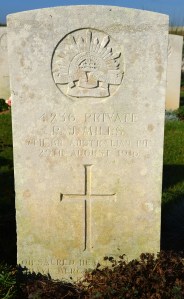
Word of their son’s death reached the family in just over a week (19/2/17). He was buried in Dernancourt Communal Cemetery. In late February 1918, one year after his death, the personal kit reached the parents: Letters, Photos, Pocket Books 2, Religious Book, Belt, Handkerchief, Badges, Diary, Coin.

As indicated, there were 2 other brothers who enlisted. Richard, who was 2 years older, enlisted in January 1915. The other brother, William, was 12 years older. He first enlisted in January 1916 but was discharged as medically unfit less than 2 months later. He subsequently re-enlisted in early December 1917.  Both these brothers survived the War.


References

Gippsland Standard and Alberton Shire Representative

O’Callaghan G (Comp) 2006, Clonmel to Federation: Guide to people in the Port Albert area 1841-1901, Vol 2, The Alberton Project

National Archives file for MASON James Oliver 2236
Roll of Honour: James Oliver Mason
First World War Embarkation Rolls: James Oliver Mason


100. E T Gay

Edward Thomas GAY (19797)
8 FAB Died of illness 2/1/17

Edward Gay was 19 yo when he enlisted on 31/12/15. He was single and he gave his occupation as ‘farm labourer’. He must have been working and living in the local area because his first medical was in Yarram (29/11/15) and, also, he was given a formal farewell from the Shire (23/2/16). He was born at Tarraville (25/4/1896) and grew up in the North Devon area, attending the state school there. His religion was Methodist. When his father, as next-of-kin, completed the information for the (National) Roll of Honour, he gave Devon, South Gippsland as the place with which his son was ‘chiefly connected’. Edward Thomas Gay’s name is included on both the Shire of Alberton Roll of Honor and the Alberton Shire Soldiers’ Memorial.

Gunner Edward Gay joined 8 Field Artillery Brigade (30 Battery). There was another person with the same surname in the same unit. This was Gunner Allan Richard Gay. It is difficult to establish the relationship between the two of them. They were not brothers but, given that they enlisted in the same unit and they were farewelled together – according to the Gippsland Standard and Alberton Shire Representative (1/3/16) there were 200 people at the farewell at North Devon – it is highly likely that they were cousins.

Gunner Edward Gay disembarked at Plymouth on 18/7/16. But at this point there were serious health issues. In fact, he was admitted to hospital the day after disembarkation (19/7/16). He was discharged 2 weeks later but then readmitted on 14/8/16 and it appears he remained in hospital – Military Hospital Fargo, Salisbury Plains – until his death on 2/1/17 (’tuberculosis of lungs’).

The family back in Australia were notified in November (22/11/16) that he was ‘dangerously ill’. Another cable on 2/12/16 advised that the condition was ‘stationary’ and another one at the end of the month (30/12/16) gave the condition as ‘still stationary’. However, the next cable on 4/1/17 brought the news that he had died 2 days earlier (2/1/17). He was buried at Durrington Cemetery, Wiltshire.

The personal kit was returned to the father in June 1917. The kit was extensive – although the items were mainly small –  presumably because he had never seen active service but, instead, had been a patient for most of his service in the UK:

Postcards, 2 shaving brushes, Cards, Hymnbook, Letters, Soldiers’ Guide, Cotton bag, 2 Brushes, Pr. Mittens, 2 Fly nets, Spring razor strop, 4 Badges, Pr. Scissors, Holdall, 2 Mirrors (one in case), 8 Handkerchiefs, 2 Razors in cases, Cycling jersey, 2 Combs, fountain pen in case, Housewife, 2 Knives, Wallet (damaged), 2 straps, Diary, Note book, 3 Devotional Books, 4 Military books, Leather belt, 2 identity-discs, Wristlet watch and strap, 4 coins.

As indicated, when he enlisted, Gunner Gay gave his father – Caleb Thomas Gay – who was then living at Kyabram, as his next-of-kin.  The records indicate that the father did receive all relevant correspondence, including the cables about his illness and death, as well as returned kit, medals, cemetery records etc. The records also indicate that there did not appear to be a will.

Correspondence in the file suggests that family relations were both complex and fraught and this may have been another reason why there was no will.

As already indicated, the father was living at Kyabram at the time Edward was living and working in the Yarram area. The mother – Sarah Gay – and at least one sister were living in Queensland. Moreover it was not just a case of physical separation because essential information did not appear to be shared between family members. For example, the file contains a letter from Gunner Gay’s youngest sister – Helena – seeking information on her brother’s death. She was the sister living in Brisbane. The letter was written some seven months after his death.  Incredibly, it appears that she had only recently found out about the death, and not from any family member but from a friend living in Traralgon.  Her request to Base Records in Melbourne sought the information that normally other members of a family would provide. She also appeared to have scant details on his enlistment.

Would you be so kind in helping me to find news of my only Brother Edward Thomas Gay late of South Gippsland Victoria [.] The news I have received from a friend in Traralgon my poor Brother died in England on 2.1.1917 [.] Will you find me his Battalion and where he enlisted from & also what part of London he died in & could I have a chance of getting one for (sic) his Photos [photographs of the grave ] [.]I am his youngest Sister & would love to get any news about him [.] Hoping to hear from you soon [.]

In May 1917 (19/5/17) there was letter to Base Records from an uncle, Richard Giles Gay of ‘The Willows, North Devon via Yarram’. The uncle was the younger brother of the father. The letter requested a copy of the death certificate and enquired as to whether there was any will:

Will you kindly send me Certificate of death of E T Gay deceased who died in Hospital England January 2nd 1917 and also let me know if he left any Will or Assignment of any kind.

Interestingly, even though the letter did not state that the writer was acting on behalf of the father, the formally designated next-of-kin, the uncle was sent a copy of the death certificate (‘report of death’) and advised that there was ‘no notification of a will to date.’  It also appears that the same uncle at least initiated a claim with the Australian Mutual Provident Society. It appears that even though the father was the designated next-of-kin and was in communication with the military authorities over his deceased son’s affairs, other members of the family were also pursuing their own enquiries and actions independent of the father.

Lastly, there is yet another letter in the file that touches on the same matter and highlights both past and present family tensions. The letter was written in November 1917 (12/11/17) by Edward’s grandmother (Catherine Gibbett) of Devon North. She was obviously seeking some sort of monetary claim against his estate, on the basis that she had cared for him as a child, right through, presumably, to the time he enlisted.

Please can I put in a claim for cash, or the half of money, left by my grandson, late Gunr Edward Thomas Gay son of Mr Caleb Thomas Gay now of Kyabram late of Devon North [,] because I had the said Edward Thomas Gay when a young child [.] His mother Sarah Gay left him without anyone to care for him so the father brought the said Edward Thomas Gay to me before he was old enough to go to school [.] When old enough I sent him to school and kept him seventeen [?] years [.] Surely I have a claim for keeping the said late Edward Thomas Gay.

Uncovering the family dynamics of 100 years ago is obviously a great challenge but it does appear that Edward Gay’s childhood and youth would have been difficult. Perhaps he saw in the AIF the sense of belonging which had eluded him in his own family.

References

National Archives file for GAY Edward Thomas 19797
Roll of Honour: Edward Thomas Gay
First World War Embarkation Rolls: Edward Thomas Gay

Gippsland Standard and Alberton Shire Representative

99. Flers (4) – G A Cowley

George Albion COWLEY (1331)
22 FAB KiA 31/12/16

George Albion Cowley was nearly 39 yo when he enlisted in August 1915 (5/8/1915). Also atypically, he was married (Marguerite) with 4 children (Albion, Myra, Lindsay and Francis). He had attempted to enlist earlier but had been rejected on medical grounds (knee).

George was born at Cowley’s Creek near Cobden in the Camperdown area. On his enlistment papers, George indicated that he had been a member of the Pomborneit Rifle Club – near Camperdown – for nine years.

The family must have moved to Yarram some time before 1914. From March 1914, he was employed by the Shire of Alberton as the driver of the council’s steam traction engine. The local paper – Gippsland Standard and Alberton Shire Representative – carried a story on 23/7/15 of his intention to enlist. In it, he was referred to as a ‘local’. He was one of 6 local men given a formal farewell at the shire hall in late October 1915. This event was also written up in the local paper (27/101/15). After his death, there was a brief report in the paper (26/1/17) –  Gunner G. A . Cowley, well known in Yarram, where some time ago he was employed by the Alberton Shire Council, as driver of the traction engine, has been killed in action in France.

When Private Cowley enlisted in Melbourne on 5/8/15 he gave his permanent address as Camperdown. This was also the address of his wife and family when he served overseas. It appears that he must have moved back to Camperdown at the point he enlisted. However it is also possible that in the few years he worked in Yarram, for the Shire of Alberton, the family had remained in Camperdown. On the information form for the (National) Roll of Honour, his wife gave Camperdown as the place with which he was chiefly connected. At the same time, his name appears on both the Alberton Shire Soldiers’ Memorial and also the Shire of Alberton Roll of Honor.

On enlistment, Private Cowley joined 13 Light Horse and left Melbourne on 23/11/15. He reached France, via Alexandria, in late March 1916 and transferred to 2 Australian Artillery Division. He was then posted to 22 Field Artillery Brigade (19 Battery) in August the same year and was serving in this unit when he was killed by shell fire on the very last day of 1916. Various unit diaries suggest that while front line troop operations had effectively ceased at this point because of the dreadful weather, there were still ongoing artillery exchanges between the two sides. Although there is no specific reference in any unit diary to the incident in which Gunner Cowley was killed, eye witness accounts taken from Red Cross reports give a clear picture of what happened.

I knew Cowley personally, he was known to us as “George”. He was an elderly man, short and with a dark moustache. I saw him killed by the bursting of a shell, at a place we called “Turks Lane” at Flers. I saw him buried, myself being in charge of the burying party. Cowley transferred from the 13th Light Horse. Cowley was a married man with two or three children, I think a Victorian. He and Reginald Lindsay were killed by the same shell, and buried together at Flers.
Cpl J. Gartrella A.M.C. London. 15.6.17.

I saw them just after they were killed between Guedecourt and Ginchy at 5.30 on December 31st last. I was in a dugout five yards from the one used as Q.M. store. I heard the shell coming and heard it explode right on top of the Q. M. store. I went out at once. All the men in the dugout were dead. I helped to get them out and saw Lindsey’s body taken out. There were 3 others in the dugout and all were dead. Lindsey’s body was badly smashed. He must have been killed instantly. Cowley was just outside the dugout and had got a splinter through the head. He was quite dead. Next morning the other three men were got out …. I helped to bury the 5 together on the spot where they got killed. We put up a cross made of used cartridge cases (brass). It has the 5 names on it. Lindsey’s name is Reginald and he is a brother of Norman Lindsey (sic), artist of the Bulletin. Cowley’s name is George. He used to belong to 13th L. Horse. He talked as if he was a farmer. Came from Victoria. Age about 37. Married, and I think 1 or 2 children.
Gnr J. A. Dunn. 6937 Etaples. 8.6.17

[Reginald Graham Lindsay (11867), of the same unit as George Cowley, was Norman Lindsay’s brother. Lindsay was, at the time, political cartoonist for the Bulletin. He was very pro-Conscription.]

The family was advised of the death by cable in mid January 1917 (16/1/17). The body was subsequently interred at the Guards’ Cemetery, Lesboeufs, France.

The impact that the death of the husband and father had on the family is evident from the following letter written by Gunner Cowley’s mother on 19/2/17. She was writing on behalf of her daughter-in-law and the children. The letter was sent to Andrew Poynton MHR, a key supporter of Hughes and avid Conscriptionist. At the time he was a member of the Federal parliamentary recruiting committee. The script is hard to read:

I am writing to you to know if you could advise me how I may learn the full particulars of my poor sons death [.] We received a cable in January 16th.1.17 stating he was killed in action on December 31st .12.16[.] What the nature of the cause was not stated nor what part of France it happened [.] He was a married man with four little children & a dedicated wife [.] With no home of their own how they are going to manage I do not know as his wife never had to battle before [.] I his mother is also a widow & has to provide for myself that it is impossible to help her [.] So if you would kindly let me know I will forward your answer on to her [.] She is at present paying 8/- per week for the house she now is living in [.] She also has not been getting her full army allowance. I also sent my son a wristlet watch from Merino Post Office on December in the first week and registered it [.] It has his name engraved in the inside [.] It is G. A. Cowley from his mother [?] 4th.12.16 [.] I would like to get it back safe for his sake [.] Since the cable saying he had been killed we have heard nothing else[.]

[?] it is hard to bother you but it is harder still not to know the last of your boy though I am proud he did his duty for King and Country[.]

There was a reply (3/3/17) from Base Records to Poynton’s office indicating that that there was no further information regarding the death but that, hopefully, the next-of-kin – in this case, the wife – … should receive, if the stress of operations permit, a letter from deceased’s Commanding Officer or Chaplain, giving such details as are available.

The soldier’s kit was eventually returned – August 1917 – to the wife in Camperdown and it did contain two wristlet watches, one damaged. The full kit returned was:  Photos, Cards, Letters, Bible, Money Belt, 3 Note books, 3 Razors, Knife, 2 Coins, Button, 2 Badges, Metal Wristlet watch, Pipe, Metal watch (Damaged), Watch Strap.

In terms of tackling the hardship faced by the widow and her 4 children, the following fortnightly pensions were paid from March 1917: widow (Marguerite Cowley) £2; oldest son (Albion Cowley) 20/- ; oldest daughter (Myra Cowley) 15/- ; son (Lindsay Cowley) 10/- ; and daughter (Francis Cowley) 10/-.

References

National Archives file for COWLEY George Albion 1331
Roll of Honour: George Albion Cowley
First World War Embarkation Rolls: George Albion Cowley
Red Cross Wounded and Missing file: George Albion Cowley

98. Flers (3) – G E JEFFS

George Edward JEFFS (3362A)
6 Battalion KiA 12/12/16

George Edward Jeffs was born in Boodyarn, near Won Wron. He grew up in the area and attended Won Wron State School. His father – George Edward senior – owned a dairy farm of nearly 200 acres at Won Wron and George worked on the family farm. He gave his occupation as  ‘dairy farmer’ when he enlisted. He was well known in the local area and his name is recorded on both the Shire of Alberton Roll of Honor and the Alberton Shire Soldiers’ Memorial. It is also recorded on the honor roll for Won Wron State School.

George Jeffs had his first medical in Yarram  and the enlistment was completed in Melbourne. His railway warrant (#146) was dated 12/7/15, which is also the formal date of his enlistment. At the time he enlisted he was 22 yo and single. His religion was listed as Church of England.

Private Jeffs joined as reinforcements for 6 Battalion and left for overseas service on 11/10/15, 3 months after enlistment. After further training in Egypt, his group of reinforcements finally disembarked in France on 30/3/16.

In late May (29/5/16), in fighting at Fleurbaix, Private Jeffs was wounded and repatriated to England. The wound appears to have been a shrapnel wound – ankle, leg & head – and there was 3 month recovery period. He rejoined 6 Battalion at the start of September 1916. He survived only another 3 months.

Private Jeffs was killed in action at Flers on 12/12/16. His body was not recovered and his name is recorded on the Villers-Bretonneux Memorial.

The War Diary of 6 Battalion records that it moved in to the front line at Flers to relieve 16 Battalion on 6/12/16. The troops found the trenches in poor condition and worked round the clock to repair them. However, the diary notes that the shocking weather conditions constantly undid their work and the trenches continued to collapse. The battalion also took over and consolidated some posts only recently given up by the Germans. On 12 December one such consolidation exercise was carried out and the diary records that while the operation was successful, the ‘consolidating party’ was shelled and one soldier killed. While the name of the soldier is not recorded, the reference must have been to Private Jeffs.

Other evidence relating to the death of Private Jeffs comes from the extensive Red Cross report. There are 9 witness statements in the report. While there are the usual inconsistencies in the statements, it is clear that Private Jeffs was killed, by shell fire, when involved in a consolidation operation and that his body was buried near where he fell. It was too dangerous to try to get the body back behind the lines. The most accurate description of the death is that of 2 Lt. N. McLachlan. McLachlan was in the consolidating party on 12 December and his name is recorded in the battalion’s war diary as having done ‘good work’ in the operation. At the time he was a corporal but not long after, he completed officer training in England and received a commission.

We occupied trenches on the right of Gueudecourt Wood and on the night of the 12.12.16. A. Coy. 6th Battn. Took some German Bombing Posts. We were heavily shelled, during which Pte. Jeffs was killed. He was buried on the field, where he was killed. Description, Height about 5’10” [height on enlistment was given as 5’6”], dark with moustache. He was previously wounded at Fleurbaix in May 1916. There is no doubt as to his identity for I had known him personally before leaving Egypt.

Bean covered the operation to consolidate the trench in his Official History (Vol 3, Chapter 26 p 953).

On the 12th [December] Captain Taylor of the 6th Battalion, taking Lieutenant Bill, walked down the gun-pits road into the enemy strong-point and found it abandoned. He was joined there by Lieutenant Rogers, the battalion intelligence officer. The 6th Battalion bombers were next brought up, and the trenches and dugouts searched and before nightfall occupied. The enemy, who through the misty drizzle had seen some movement, now heavily shelled the sunken road, but inflicted only slight damage. [notwithstanding the death of Private G E Jeffs]

Bean then went on and pointed out that this operation was virtually the only fighting on that part of the front between mid November and the close of the year. Private Jeffs, it appears, was extremely unlucky.

Advice on the death of their son to the family back in Australia must have been prompt because the formal report of death was dated 9/1/17 suggesting that the cable preceding this would have reached Australia in late December 1916.

Like so many other parents of soldiers killed in the War, Private Jeffs’ father was keen to recover the personal belongings of his son. On 15/6/17 he wrote to Base Records, Melbourne:

I now take the liberty of writing to you inquiring if my son’s private belongings have come to hand yet or not, and, if so, when I may expect to receive them. My son, No. 3362 Pte. George Edward Jeffs, 6th Inf Batt. A.I.F. was killed in action 12th Dec. 1916, and I have received information from his mate that his private belongings were given in charge of his officer to be despatched to the Kit Depot, London.
Anxiously awaiting the desired information.

The personal effects arrived back in Australia some two months later and on 27/7/17 were despatched to the father at Won Wron. There is no further correspondence on the matter but the father must have been distressed that the only effects returned from the Kit Store in London were a metal watch (damaged) and a brush.

The information for the (National) Roll of Honour was provided by Bernard Raymond Jeffs who gave Won Wron/Yarram as the location with which his brother was ‘chiefly connected’. Also included, were the names of 5 cousins who served in the AIF, 4 of whom were killed in action.

Trooper Patrick Joseph Sweeney 451, 8 LHR: KIA 7/8/15 (see Post 45)
Private Cornelius James Sweeney 1449, 21 B: KIA 11/4/17
Private Albert Henry Whitford 5103, 21 B: KIA 30/3/17
Private Roy Victor Whitford 3449, 10 B: KIA 16/10/17
2 Lieutenant Lewis Edmund Whitford MC, 11 B.

References

National Archives file for JEFFS George Edward 3362A
Roll of Honour: George Edward Jeffs
First World War Embarkation Rolls: George Edward Jeffs
Red Cross Wounded and Missing file: George Edward Jeffs

Bean, CEW Official History of Australia in the War of 1914-1918, Volume 3 – The Australian Imperial Force in France, 1916 (12th edition, 1941)

95. Flers (2) – G M NICHOLAS, C C APPLEYARD, A ROBINSON & F H SEBIRE

George Matson NICHOLAS Major DSO
24 Battalion KIA 14/11/16

George Matson Nicholas was born in 1887 at Coleraine. He was educated at St. Patrick’s College Ballarat (Catholic) – his religion was given as Church of England – and then at Melbourne University where he completed the BA. At the time of joining the AIF, he was a teacher (master) at the Melbourne Junior Technical School. He applied for and received his a commission in early 1915. He was 28 yo and single at the time. His parents lived at Trafalgar in Gippsland.

There was a younger brother – Bryon Nicholas – who also worked as a teacher in the Victorian Education Department and who also joined the AIF, on 10/3/15.  Both brothers received awards for bravery and both were killed in action. There were another 3 brothers from the family who served in, and survived, WW1.

The 2 Nicholas brothers – George and Bryon – who were killed had been teachers in the Shire of Alberton. Both had taught at Gormandale East State School and the younger brother – Lt Bryon Nicholas – prior to joining the AIF, had been in charge of part-time schools at Carrajung South and Willung South.  It appears that whereas the younger brother remained teaching in the local area, George Nicholas moved to Melbourne to pursue his teaching career.

On the strength of their teaching in local schools prior to the War, both brothers were included on the Alberton Shire Soldiers’ Memorial. Their names also appear on the relevant state school honor rolls.  However, neither brother appears on the Shire of Alberton Roll of Honor.

Prior to receiving his commission as a second lieutenant in 24 Battalion, George Matson Nicholas held the rank of lieutenant in the senior cadets and he had completed qualifications in military training. He embarked for overseas service on 10/5/15, just two weeks after securing his commission.

2 Lt Nicholas was promoted to full lieutenant on 26/6/15, a few days before he proceeded to Gallipoli (30/8/15). He was recommended for the French military award, the Croix de Guerre, for his conduct at Lone Pine on 4/10/1915. The citation read:

For his conduct at Lone Pine on 4th October 1915, when he directed the work of the battalion grenadiers during an attempted reconnaissance by the enemy, though to do so it was necessary for him to expose himself to the enemy’s rifle and machine gun fire. 

However the award was not given, even though it appears the recommendation was re-submitted in December 1916. By that point Major Nicholas was dead.

Lt Nicholas was wounded – ‘Shell wound, right arm. Severe.’ – on 12/12/15 in the closing days of the Gallipoli campaign. He spent the next six weeks in hospital in Egypt convalescing and rejoined 24 Battalion on 26/1/16. In March the battalion proceeded overseas to France and reached Marseilles on 26/3/16.

Lt Nicholas was promoted to the rank of captain on a temporary basis on 1/4/16 and this appointment was made permanent on 1/5/16.

For his bravery on 5/8/16 in the fighting at Pozieres, Captain Nicholas was recommended for, and this time awarded, the Distinguished Service Order. The citation read:

After the capture of the German trenches OG1&2 on the 5th August a patrol commanded by Captain George Nicholas found on returning from a reconnaissance in front that an enemy machine gun in a shell hole had been seriously menacing our men in the front lines. Captain Nicholas as soon as he located this gun gallantly went out again alone and by great dash and initiative succeeded in capturing the gun.

This citation appeared under the signature of Birdwood, ‘Lieut-General, Commanding 1st Australia and New Zealand Army Corps’, with the date of 6/8/16, one day after the fighting. Interestingly, the military honour first entered against the citation was the Military Cross, but this was crossed out and the D.S.O. had been added in its place. Also of interest is the fact that there is a second citation for the same award for the same incident. The second citation is undated but it appears against the recommendation of Brigadier General Gellibrand of 6 Infantry Brigade. A note next to the citation appears to read ‘already awarded’ which tends to suggest that the actions of Captain Nicholas had been drawn to at least two separate sources. Whereas the first citation had a focus on bravery or gallantry, the second citation focuses more on leadership.

For ability and skill in leading his company in the attack on the 4/5th Aug. For excellent work in consolidating the captured trenches on the following days and for his gallant reconnaissance already reported. A most capable officer who possesses the absolute confidence of his men.

Captain Nicholas was promoted to the rank of major soon after, on 12/8/16. There followed a short period attached to 2 Division Headquarters Staff and during this time, on 7/10/16, he married Hilda Rix in London.

Hilda Rix (Nicholas) was a significant Australian artist who studied under Frederick McCubbin. She left Australia in 1907 and studied in both London and Paris. Prior to the outbreak of the War, she regularly spent time in northern France in an artists’ colony at Etaples. She returned to Australia after the War and remarried (Edgar Wright, 1928). Her post-War art played a role in the development of the emerging ANZAC legend. As an example, her 1921 work, A man, in part based on her husband, is a striking study of the resoluteness of man, as soldier, faced with the certainty of his inescapable frailty and vulnerability in war.

Tragically, the marriage was very short. He returned to the front 3 days after the marriage. One month later on 10/11/16 he rejoined 24 Battalion and took over command. Just 4 days later (14/11/16), he was killed. According to the war diary of 24 Battalion, he was hit by a shell in Cobham Trench as he was leading 2 companies from 24 Battalion to relieve 5 Brigade. C E W Bean referred to the death of Major Nicholas in his diary – AWM38, 3DRL 606/66/1 – for November 1916,

Another who was lost … was Maj Nicholas of the 24th Btn – the youngster who for a time commanded his battalion & who made his name by going out himself scouting into no-mans-land in Pozieres.

In a footnote in his Official History, Bean (1941, p. 937) records Nicholas’ name together with those of at least another 30 officers who were killed at Flers over the short period of 13 -16 November 1916.

The cable of Major Nicholas’ death was dated 22/11/16, just 8 days after the actual death. The official ‘Report of Death of an Officer’ was completed on 20/12/16.

Prophetically, in Major Nicholas’ service file there is a letter dated 20/10/16 written by a Vernon Williams of Newport (Victoria) to Base Records in Melbourne asking for confirmation of a report that Major Nicholas has been killed in France. This was some 3 weeks before he was killed.

I have received a letter from France dated last August stating that my friend Captain George Matson Nicholas of 24th Battalion, 6th Infantry Brigade, A.I.F, has been killed. I should be obliged if you will be so kind as to let me know if this is, so far as known, correct.

Base Records replied on 23/10/16 that they had no such record; but the full reply points to the highly problematic nature of the information flow for the AIF between Australia and the Western Front,

In acknowledging receipt of your letter dated 20th instant, I have to state since the report he had been discharged to local Camp 8/5/16, from 24th General Hospital, Etaples, France no further reports have been received concerning Captain G. M. Nicholas, 24th Battalion, but if you will forward to this Office authentic evidence to the effect that he has been “killed”, upon receipt of same, and if such action is warranted, enquiries will be instituted and the result communicated to you, as well as to next-of-kin.

The reference to a period of hospitalisation in Etaples in May corresponds with an entry in his service record which has Major Nicholas in hospital in Etaples for about two weeks. However there is no indication of the injury or sickness at the time. It is likely that at this time in Etaples Major Nicholson came across some artwork of his future wife. There is a family story that he saw some of her work in Etaples and then sought her out when he was in London.

The personal kit of Major Nicholas reached his wife in January 1917. It came in one valise (sealed) and one box (sealed). In all, there were approximately 50 listed items, mainly articles of clothing. There were some more personal items such as 1 novel, Book of Poems and French Grammar.

There was some confusion over the location where Major Nicholas was buried. His wife must have received two different locations. When she queried the obvious contradiction, she was assured that a simple recording error was the problem and that,

There does not appear to be the slightest doubt that Grave 29, Row H, Flat 4, Grass Lane Cemetery, Gueudecourt is the last resting place of your late husband…

Unfortunately, and surprisingly, information for the (National) Roll of Honour was not supplied for either of the Nicholas brothers.

References

National Archives file for NICHOLAS George Matson Major
Roll of Honour: George Matson Nicholas
First World War Embarkation Rolls: George Matson Nicholas

Honours and Awards
Mention in despatches – Award
French Croix de Guerre – Recommendation
Distinguished Service Order – Award
Distinguished Service Order – Recommendation
Military Cross – Recommendation
French Croix de Guerre – Recommendation (2)

Bean, CEW 1941, Official History of Australia in the War of 1914-1918, Volume III – The Australian Imperial Force in France, 1916, 12th edition 1941

For more on Hilda Rix Nicholas see the entry on Nicholas, Emily Hilda (1884-1961) in the Australian Dictionary of Biography.


Charles Courtney APPLEYARD 3751 MM
23 Battalion DOW 15/11/16
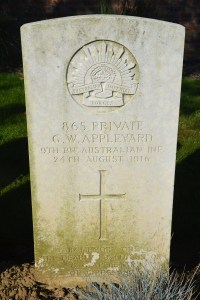
Charles Appleyard was one of 6 Appleyard brothers from Alberton who enlisted. One of these brothers, Gordon William Appleyard of 9 Battalion, had been killed at Pozieres, at the end of August 1916 (see Post 80).

On his enlistment papers, Charles gave Carlton as his place of birth. However, his mother gave it as Alberton when she completed the information for the (National) Roll of Honour. Even if he was born in Carlton, it appears he grew up in the Shire of Alberton. For example, his name is the honor roll for Binginwarri SS.

At the time of the outbreak of the War, the father was still farming in the area but Charles had moved to Melbourne. He was living at Carlton and working as a builder/carpenter. He had married (Rose Appleyard) and had three children (Clement, Merle, Lorna). Even though he was living in Melbourne, he was still regarded as local. His name is featured on both the Shire of Alberton Roll of Honor and the Soldiers’ Memorial. The notice of his death which appeared in the Gippsland Standard and Alberton Shire Representative on 1/12/16 described him as … a well known identity in this district. It also noted that he was … a fine, athletic young man. The consolation for his parents was that … he had died a hero’s death.

At the time of enlistment, he gave his age as 28 yo but information from his wife indicated that he was at least 5 years older. His religion was listed as Church of England.

He enlisted in Melbourne on 15/7/15 joining 23 Battalion. His group of reinforcements left Melbourne in early February 1916 (8/2/16) and reached France, via Egypt, in March 1916.

23 Battalion was involved in the fighting at Pozieres where, as mentioned, Charles’ brother was killed (DoW 24/8/16). Charles survived and in fact was awarded the Military Medal. The citation read,

At Pozieres on 4/5th August 1916, for gallant reconnaissance in daylight of the enemy’s trench, returning with valuable information.

By the time the medal was awarded – 2/9/16 – L/Corporal Appleyard had been promoted to the rank of sergeant (23/8/16) against a Sergeant Grantham who had been killed in action.

Sergeant Appleyard was wounded at the end of the first major attack at Flers. On 6/11/16, 23 Battalion’s war diary records how it took over part of the front line from 21 Battalion. The casualties that day were ‘1 killed 10 wounded’. Sergeant Appleyard had a shrapnel wound to the right shoulder. He was evacuated to 36 Casualty Clearing Station the next day but he died there 8 days later, on 15/11/16. He was not evacuated further back through the lines to a field hospital. Possibly, this was because of the difficulties of movement in the appalling conditions at Flers. C E W Bean (1941 ) raised this issue in his account of the fighting at Flers. He noted that it could take hours to get wounded men to any sort of medical post.

Sergeant Appleyard was buried near the town of Albert (Heilly Station Cemetery) and the cable advising of his death was sent on 22/11/16, with the final, formal notification of the death dated 27/12/16. Six months later (18/6/17) the Military Medal was forwarded to Sergeant Appleyard’s widow. In the letter, the Officer in Charge, Base Records, writing on behalf of the Minister, noted … the gallantry of a brave Australian soldier who nobly laid down his life in the service of King and Country. He added,

I am also to ask that you accept his [The Minister’s] deep personal sympathy in the loss which, not only you, but the Australian Army has sustained by the death of Sergeant Appleyard, whose magnificent conduct on the field of battle helped to earn for our Australian soldiers a fate which will endure as long as memory lasts.

A few days later, a family friend replied on behalf of an appreciative Mrs Appleyard,

Mrs Appleyard wishes me to return her heartfelt thanks to you and all concerned in your prompt attention dealing in all matters relating to her late husband.

The personal kit – Disc, Metal cigarette case, Comb, Pr nail scissors, Razor, Whistle, Brooch (metal), Metal wrist watch, 3 Note books, 3 Badges, 4 Coins, Letters. – reached his wife in August 1917.

References

National Archives file for APPLEYARD Charles Courtney 3751
Roll of Honour: Charles Courtney Appleyard
First World War Embarkation Rolls: Charles Courtney Appleyard

Honours and Awards

Military Medal – Recommendation
Military Medal – Recommendation (2)
Military Medal – Award

Bean, CEW 1941, Official History of Australia in the War of 1914-1918, Volume III – The Australian Imperial Force in France, 1916, 12th edition 1941


Alexander ROBINSON 2095
23 Battalion DOW 20/11/16

Alexander Robinson was born in Melbourne (Carlton) but by the time he enlisted he was living and working in the Shire of Alberton. According to the electoral roll, in 1915 he was a labourer at Blackwarry.

He had his first medical at Yarram on 27/3/15 but did not complete the enlistment until 14/6/15 in Melbourne.  There is no record of any medical issue involved with the delay. At the time he enlisted, he was 23 yo and single. He gave his religion as Presbyterian.

Private Robinson embarked for overseas on 26/8/15 as reinforcements for 23 Battalion. He was taken on strength of the battalion at Anzac on 12/10/15.

Following evacuation from Gallipoli, he was charged in early January 1916 in Egypt with being AWL for 39 hours. The punishment was 3 days detention and 3 days pay. Shortly after, he was hospitalised with mumps for 1 month. 23 Battalion reached France – Marseilles – on 26/3/16.

The war dairy for 23 Battalion for 18/11/16 records only that it was snowing and 2 men were wounded. One of the them must have been Private Robinson. His wounds were described as SW Loin & Buttock. He was taken to the casualty clearing station the next day (19/11/16) and then died of wounds there on 20/11/16. Presumably, he was another of the wounded at Flers who succumbed to their wounds because of the great difficulties in transporting the wounded to medical help. He was buried at Heilly Station Cemetery, Mericourt-L’Abbe, Picardie.

His mother – Mrs Agnes Robinson, Fitzroy – received his personal kit in August 1917: Wallet, Letters, Photos, Note Book, Cigarette Holder.

Unfortunately, there is very little information available for Private Robinson. However the mother did complete the information form for the (National) Roll of Honour and on that form she recorded that in fact 3 brothers enlisted in the AIF, and all 3 were killed. As well as Alexander Robinson 2095 (DoW 20/11/16) there was Albert Douglas Robinson 2889 (KIA 19/7/16) and Edward Robinson 986 (DoW 11/9/18).

The brother – Edward Robinson – who was not killed until September 1918, was also on the electoral roll as a labourer of Blackwarry. He will be covered in a future post. There is no indication that the other brother killed in July 1916 (Albert Douglas Robinson) had any connection to the Shire.

The 2 brothers who were living and working at Blackwarry are both recorded on the Blackwarry Roll of Honor. They also have their names on the Shire of Alberton Roll of Honor, but they are not marked as ‘Killed’ on this record.  Neither brother is included on the Alberton Shire Soldiers’ Memorial. Overall, there is little to show for such an extraordinary family sacrifice.

References

National Archives file for ROBINSON Alexander 2095
Roll of Honour: Alexander Robinson
First World War Embarkation Rolls: Alexander Robinson


Francis Henry SEBIRE 5441
60 Battalion KIA 20/11/16

Francis Sebire was born at Port Melbourne and grew up in Melbourne and attended Melbourne High School. As a student and young man he was heavily involved in the cadets and held a commission.

Francis Sebire’s connection to the Shire of Alberton was chiefly as a local teacher. He taught at Binginwarri and Wonyip state schools between 1911 and 1914. Binginwarri was his first appointment. In the time he was a teacher in the district, he was also a member of the Stacey’s Bridge Rifle Club. Further, he married a local girl. His wife, nee McInnes, came from one of the original pioneering families in the district.

The Gippsland Standard and Alberton Shire Representative gave a detailed report (22/4/14) when Francis Sebire was transferred from Binginwarri to Taggerty, near Marysville.  He was obviously well known in the local area and there is even a report (13/1/15) of when he returned to the district for New Year’s celebrations in January 1915. But for all the obvious links, his name is not included on either the Shire of Alberton Roll of Honor or Soldiers’ Memorial. His name does appear on the honour rolls for both Binginwarri and Wonyip state schools. When his father completed the information for the (National) Roll of Honour, he gave Taggerty as the place with which his son was ‘chiefly connected’. As indicated, this was where he was appointed after Binginwarri but he could have only been there for a maximun of one year before he enlisted.

There is confusion over the date of his enlistment. The embarkation roll shows 6/11/15 but the attestation papers show it as 29/6/16. On the papers there is a reference to an earlier failed medical:  ‘defective teeth’.  Possibly, the 29/6/16 date involved a ‘re-attestation’. Either way, he joined as reinforcements for 5 Battalion and embarked for overseas, almost immediately, on 3/7/16. The embarkation roll also indicates that he left as acting sergeant. Presumably this was because of his extensive involvement in junior and senior cadets.

On his enlistment papers he indicated that he was married – Flora Margaret Sebire – and there was a son. His wife was then living at Middle Brighton. He was 25 yo and his occupation was given as state school teacher. His religion was Church of England. His parents were John and Christina Sebire.

When the father completed the information for the (National) Roll of Honour he noted that his son … was acting Sergeant till arrival in England. Gave up his stripes to get into action without delay. In support of this claim, the records indicate that Sergeant Sebire reached Perham Downs for training on 15/9/16 and then reverted to private on 23/10/16. Soon after, he was taken on strength of 60 Battalion in France (12/11/16).

Private Sebire was reported missing on 20/11/16 but it was not until 21/3/18 – 16 months later – that a court of enquiry determined that he had been killed in action on the same day. There is no clue in the war diary of 60 Battalion as to his fate. At the time, 60 Battalion was at Needle Trench and the pressing issue was ensuring rations – including water – reached the men. There is a brief reference to casualties – 1 killed 6 wounded – on 20/11/16 but no mention of any men missing.

There is extensive correspondence in the file covering the attempts by both his wife and parents to uncover what happened. The Red Cross was contacted and the father also sought the support of John H Lister, M.P. However they had little success. The transfer to 60 Battalion in mid November 1916 did not appear to have been known to the family in Australia and this added to the confusion. The following letter- formal and respectful in tone – was sent to Base Records in Melbourne by the wife, Mrs Flora M Sebire, in late April 1917, nearly 6 months after her husband went missing.

Having received no communication since one dated Nov. 10th 1916 from my husband who is serving with the A.I.F. in France I am writing to ask you to be so good as to let me know whether you have any information to give me respecting his condition and whereabouts. He was then (Nov.1916) going into the trenches in France.
His No and Name are
5441 Pr. Francis Henry Sebire
He left here as Sergt. in the 18th Reft. of V Batt last July but returned to the ranks voluntarily after being in Eng. a few weeks in order to go to the front.
Some 6 weeks ago a cablegram was sent through the Red Cross Information Bureau by Mr Chormley, but no reply has reached me.
This absence of news extending over 6 months is causing his family and me intense anxiety and I respectfully request that the Defence Dept. be so good as to make further effort to obtain tidings of him.
I am
Sir
Your obedient servant

The most likely account of Private Sebire’s fate was given to the Red Cross, nearly one year after his disappearance, by Private Fred Marr (5404). The statement was dated 23/10/17. The reference to the men he was supporting probably not knowing him – presumably because he had so recently joined 60 Battalion – appears very pertinent.

He [Sebire] was a hard worker. I last saw him at Needle Trench beyond Flers on Nov 20th. It was then dusk and I spoke to him and asked him what he was doing, and he told me that he was guiding ration parties to the front line; he had one or two more journeys to make. Two of our companies were in the front line and our other two companies took rations to them from Needle Trench which was in the support line. The Germans put up rather a heavy barrage fire that night. I often asked about him afterwards but could learn nothing definite. Some of the men he was guiding very likely did not know know him.

As late as July 1921, the AIF was still keen to know if the family had received, over the period since the war had ended, any further information about Private Sebire’s fate. The father’s reply – It is practically certain that my son was killed at or near Needle Trench near Flers between 20-22 Nov. 1916. – was based largely on his own investigations. He had personally contacted Private Marr after he returned to Australia in 1920. He had also followed up the report of another soldier (Smith).  Smith had put the date of Private Sebire’s disappearance at 22 November and this was reflected in the extended time frame in the father’s reply.

The personal kit of Private Sebire – 1 Brief Bag (containing: – 3 Handkerchiefs, Field Glasses in Case, 1 Scarf, Cap comforter, 3 Khaki Collars, 2 Ties, 1 Mitten, 1 Shirt. – was not returned to the wife until October 1918.

It is obviously difficult to uncover family dynamics, employing only correspondence, from so long ago; but there is one letter in the file that suggests that over time – and distance – relations between the wife and her parents-in-law became strained. It appears that she and her son shifted quite a bit and eventually settled in Queensland. It also appears, based on the letter, that the parents effectively ‘reclaimed’ their son. The letter was dated February 1936, nearly 20 years after her husband’s death. It was in response to advice she had received on the inscription that appeared in the register for the Villers-Bretonneux Memorial: Son of John and Christina Sebire, of 94, Marine Parade, St. Kilda, Victoria. Born at Port Melbourne, Victoria

In reference to your notification regarding the inscription on the Memorial for members of the AIF who have known graves, I was leaving Victoria and my husband’s father, who is now dead, offered to attend to the matter for me, and promised that my name and that of my son would be inscribed but [he] has substituted his own and his wife’s. Under the circumstances there is nothing to be done.

If true, it is a striking example of how the impact of the War continued to work its way through people’s lives long after the death of the soldier and loved one.

References

National Archives file for SEBIRE Francis Henry 5441
Roll of Honour: Francis Henry Sebire
First World War Embarkation Rolls: Francis Henry Sebire
Red Cross Wounded and Missing file: Francis Henry Sebire

94. A V FARTHING

Arthur Vincent FARTHING (5685)
13 Battalion DoD 9/11/16

A V Farthing remains a mystery. His name does appear – as Farthing, A. V. – on the Shire of Alberton Roll of Honor; but he is not marked as ‘Killed’ on this list. He is not included on the Alberton Shire Soldiers’ Memorial. Nor are there any references to him on any other memorial in the Shire, and there is no mention of him in the Gippsland Standard and Albeton Shire Representative. The family name Farthing was not common in the Shire at the time, and it did not appear on the 1915 electoral roll for the sub-division of Yarram. There are limited references to the name Farthing in local genealogical references – Clonmel to Federation: Guide to people in the Port Albert area 1841-1901 – but the references are to the 1860s.

In terms of AIF records, there is only one A V Farthing on the Nominal Roll. The full name is given as Albert Vincent Farthing (5685) but this is a mistake and it should be Arthur Vincent Farthing (5685). The correct name appears on the Embarkation Roll. Importantly, there were only 11 men with the family name Farthing who served in the AIF in WW1, and of the eleven, there was only one with the initials of A V Farthing. So there is no question that reference to a member of the AIF with the name A V Farthing is to Arthur Vincent Farthing (5685).

While there is nothing to tie Arthur Vincent Farthing to the Shire of Alberton – apart from his name on the Shire’s roll of honor – there is abundant evidence to tie him to Bective (near Tamworth) in NSW.

Arthur Vincent Farthing was born at Tamworth, NSW. He grew up at Bective and attended the public school there. When he enlisted on 12/1/16, at Liverpool, he was 19 yo and single. He gave his occupation as ‘farm hand’. His religion was Church of England.

Arthur gave his father – Henry Farthing – as next-of-kin. The father was well known in the local district of Bective. He was involved in the Bective Farmers and Settlers’ Association and in fact the monthly meetings were held in his home.

The Tamworth Daily Observer (3/5/16) recorded the farewell organised for Private Arthur Farthing at Bective. It was held just before he embarked for overseas. He was presented with a luminous wristlet watch. In response, Private Farthing expressed his gratitude and stated that he … would do his best to uphold the name of Australia.

Private Farthing’s service was very short. He enlisted on 12/1/16 and embarked as reinforcements for 13 Battalion on 3/5/16. He reached England from Alexandria in early August and started further training with 4 Training Battalion at Perham Downs. He was admitted to hospital – King George Hospital – on 26/8/16 with pneumonia. It appears he stayed in this hospital until 6/11/16 when he was transferred to 1st Auxillary Hospital, Harefield. He ‘died of disease’: cerebral abscess on 9/11/16.

Cables sent to the parents in Australia, over the period the son was in hospital with pneumonia, reveal a rather grim story. On 2/10/16 they were advised that their son was ‘seriously ill pneumonia’. On 13/10/16 his status was described as ‘condition stationary’. On 26/10/16 they were informed he was ‘progressing favorably’. Again, on 1/11/16, the news was positive: ‘now progressing favorably’. Just over one week later he was dead. The parents also did not even know the name or address of the hospital where he was a patient. On 30/10/16 they had written seeking these details.

There is strong evidence that Private Farthing should never have even been in England with the AIF. In his service file are the records of the medical board, dated 14/1/16, which recommended he be discharged from the AIF. This was just 2 days after he had enlisted. The suggestion is that in fact he had enlisted before (8/6/15) but then came down with ‘double pneumonia’ and was discharged. Perhaps he was not formally discharged – there is no record of an earlier enlistment- and it was more the case that the initial enlistment did not go ahead when he became ill with pneumonia. Then he (re) enlisted (12/1/16) and either the same problem flared again or the ongoing medical debility from the earlier sickness became more obvious. At the medical board it was stated his disability would continue for ‘at least 12 months’. Moreover, the board … recommends his discharge as unfit for military service. It is not clear why the recommendation was not carried out but it is possible that the necessary paper work was held up and he embarked for overseas service before it could be actioned. What is clear is that he was affected by a significant, ongoing medical condition long before he was hospitalised in England in August 1916. The  medical advice was that he should have been discharged immediately after he enlisted.

Private Farthing was buried in the Australian Section, Harefield Churchyard, Harefield.

After the death, his parents placed a personal notice in The Tamworth Daily Observer (18/11/16, p.7):

Roll of Honor
Farthing – At 1st Australian Auxillary Hospital, London. Private Arthur V Farthing, youngest son of Mr. and Mrs. H. Farthing, Bective. Aged 20 years. At rest.

In May 1917, the parents received the following personal items:

Scarf, Belt, 9 Foreign Coins, Devotional Book, Hairbrush, Piece Crewel Work, Wallet, Photos, Razor, Shaving Brush, Identity Disc, 2 Badges, Handkerchief, Pipe, Fountain Pen, Letters.

When they completed the information for the (National) Roll of Honour, the parents gave Tamworth as the location with which their son was ‘chiefly connected’. On the face of it, there is nothing to suggest a link to the Shire of Alberton. However, the name definitely appears on the Shire of Alberton Roll of Honor; and there was only one Farthing A V. The only plausible explanation appears to be that he worked in the local area as a farm labourer for some time before mid 1915.

References

National Archives file for Farthing Arthur Vincent 5685
First World War Embarkation Rolls: Arthur Vincent Farthing
Roll of Honour: Arthur Vincent Farthing

The Tamworth Daily Observer

O’Callaghan, G 2006, Clonmel to Federation: Guide to people in the Port Albert area 1841-1901


92. Flers (1) – N W BOOTH, A LAING & A L NEWLAND

Flers November 1916

From mid October 1916, the Australian divisions were moved from the front near Ypres to the section of the Somme front near Bapaume. It was the closing stage of the Battle of the Somme. In November, the Australians took part in two unsuccessful attacks – 5 and 14 November – in the immediate area of the destroyed village of Flers. Bean covered the battles in Chapter XXV – ‘Flers. The Somme Battle Ends’ – of volume 3 of his Official History.

While Australian casualties – 2,000 for the 2 failed attacks – were far lower than at Pozieres, Bean concluded that Flers amounted to … a series of operations which, through the weather and the state of ground, were undoubtedly the most difficult in which the A.I. F. was ever engaged. (940)

In the preceding months there had been repeated unsuccessful attacks on the same section of the front, and now it was Winter. However, the Australian attacks went ahead because by this point in the Somme campaign the objectives were more political than military. For the Australians, there was no element of surprise because German intelligence knew in advance of both attacks. Once again, coordination broke down between the artillery barrage and the movement of troops across no-man’s-land. The Germans were able to either hold or counter attack and regain all their positions.

Bean identified additional problems faced at Flers. The weather was the critical consideration. It was not just the extremes of Winter; but also the impact of the weather on the terrain over which the battles were fought, and stretching back several miles from the front line. Specifically, it was the mud.

Even the movement of the troops from the staging camps and reserve lines to the front line was a nightmare. Comparatively short distances took hours to cover. Bean described how troops took six hours to cover distances of only two miles and whenever they had to move under such conditions they always arrived exhausted. (900 – 902)

His description of the dreadful conditions leaves little to the imagination.

On his journey into the trenches, each infantryman now carried his greatcoat, waterproof sheet, one blanket, 220 rounds of ammunition, and, when fighting was in prospect, two bombs, two sandbags, and two days’ reserve rations, besides the remnant of that day’s “issue”. Thus burdened, the troops dragged their way along the sledge-tracks [sledges were employed to pull both supplies and the wounded] besides the communication trenches, the latter – except in the actual front-system – being now never used. But the sledge-tracks also were by this time deep thick mud, which, especially when drying, tugged like glue at the boot-soles, so that the mere journey to the line left men and even pack-animals utterly exhausted. In the dark those who stepped away from the road fell again and again into shell-holes; many pack-animals became fast in the mud and had to be shot, and men were continually pulled out, often leaving their boots and sometimes their trousers. (918)

Bean also detailed how once the men finally made it to the front line trenches, the weather conspired to make matters even worse.

Coming into the trenches under such conditions, and starting their tour of duty in a state of exhaustion, the garrison at the front line usually had to stay there forty-eight hours before relief. At first the men tried to shelter themselves from rain by cutting niches in the trench-walls, but this practice was forbidden, several soldiers having been smothered through the slipping in of the sodden earth-roof, and the trenches broken down. If, to keep themselves warm, men stamped or moved about, the floor of the trench turned to thin mud. At night the officers sometimes walked up and down in the open and encouraged their men to do the same, chancing the snipers; but for the many there was no alternative but to stand almost still, freezing, night and day. (919)

These were the conditions in which the incidence of ‘trench foot’ multiplied. As Bean observed,

After a tour in the line during this continued wet-weather offensive, practically all the men in many Australian battalions were suffering from “trench feet,” at least in its incipient stages. Thus, when the 27th Battalion (7th Brigade) was relieved after the fight of November 5th, ninety per cent of its men were said to be affected. (920)

Importantly there was hardly any relief from the weather and the appalling conditions anywhere in the battle zone. Troops slept in the open even in the reserve lines. Men had to improvise what shelter they could, with their ‘blankest and water proof sheets’ (899).

Bean suggested that the Australian troops found the dreadful winter conditions even more difficult to manage because of what they remembered of the weather ‘back home’.

There can be no question that the Australian force, reared in a land of almost continual sunshine and genial warmth, was throughout this period being subjected to intense suffering: the reserve trenches were little better than the front line; the camps now springing up in the rear of the ridge, were ankle-deep or knee-deep in mud. In the nearer rest billets… the rain poured through the leaky barns, drenching the straw on which men were supposed to rest. Firewood, through difficulties of transport, was unobtainable, and the troops even in the billets could not dry their sodden clothes except by the heat of their bodies or by using for fuel the farmers’ gates and fences, or the matchboard lining of military huts. (941)

Hardly surprising, the appalling conditions had an impact on the men. Bean alludes to it in terms of ‘morale’.

It would be idle to suppose that any force could support without signs of bending the tremendous stresses which – for the Australians – began at Pozieres and reached their climax at Flers. The morale of the A.I.F. was never low; even in the worst conditions at Flers the response of the troops often amazed even those who knew them best; but this period represented the bottom of the curve. (940)

Apart from the obvious contradiction in the claim, it is clear from Bean’s writing that morale was in fact low. For example, in the very next section he went on to acknowledge one or two cases of desertion – ‘almost unknown in the Australian force’ – by … young soldiers who, finding themselves at the limit of their endurance, walked over to the enemy. (940) Then he follows up with the story of one soldier from 24 Battalion who had tragically reached the limit of his endurance.

At least one man of finer fibre [as opposed to those who tried to avoid ‘trench service’], when his battalion – the 24th – was ordered to undertake the nightmare journey through the crater-field back into the line, turned to his mates and, saying simply “I’m not going in – I’m finished,” shot himself. (941)

Flers took place just days after the first conscription referendum and it demonstrated, yet again, that as a direct consequence of the ruthless – and arguably, pointless – manner in which the fighting on the Western Front was being waged, the demand for reinforcements would be unrelenting. And the demand was always going to be greater than the numbers that could be raised through voluntary recruitment.

References

Bean, CEW 1941, Official History of Australia in the War of 1914-1918, Volume III – The Australian Imperial Force in France, 1916, 12th edition 1941.


Norman Waterhouse BOOTH 2 Lt
18 Battalion  KIA 7/11/16

Norman Booth enlisted at Liverpool, NSW on 26/7/15. He had tried to enlist earlier in the year but had been rejected. At the time of enlistment he was 39 yo and he gave his occupation as  accountant. As his next-of-kin he listed his mother – Mrs Emma Booth – and her address was “The Rectory”, Milton, NSW. His father was deceased. Norman had been born at Parramatta on 16/11/1875. He joined reinforcements for 18 Battalion and left from Sydney on 8/3/16.

Despite the obvious NSW connection, 2 Lt Booth had a direct association with the Shire of Alberton. In January 1915, the Anglican reader at Yarram, William Vernon Rymer, had enlisted and Norman Booth was appointed as his replacement. The appointment was reported in the Gippsland Standard and Alberton Shire Representative on 24/3/15:

Mr Booth, the new Church of England reader, has arrived in Yarram, and conducted services on Sunday last. He is a genial sort.

It is also possible that Norman Booth’s father had been a Church of England minister in Yarram in the late 19C.

His work as reader – he was also described as the curate – in the local church did not last long. From late May 1915 there were reports in the local paper (26/5/15, 2/6/15) that he had passed his medical and that he was going to Melbourne to enlist. He was issued with a railway warrant by the Shire Secretary, dated 31/5/15, for the trip to Melbourne. However, he must have been rejected, presumably on his second medical, when he reached Melbourne. This is based on the evidence of a MT 1486/1 (1915-1915) for him, and the obvious fact that he did not enlist in Melbourne but at Liverpool, nearly 2 months later.

When he was in Yarram, he attended Empire Day celebrations at the Yarram State School. He accompanied Rev George Cox, who as noted in earlier posts, had a strong link to the school. At the school, he spoke to the students. What he said that day offers an insight to his own motivation. It was reported in the Gippsland Standard and Alberton Shire Representative  (26/5/15) and it is quintessentially Imperial in tone:

The text of his [Mr. Booth] address was “courage.” The best boys were not always those with the biggest muscles and biggest physique (Laughter). The big Germans were given to bullying. He instanced Lord Nelson as a type of courageous man – a weakling as a boy, who was taken to sea by his father, and ordered aloft. Asked if he were afraid, Nelson replied, “Yes, I’m afraid, but I’m going to the top of the mast.” And he did so. That showed the difference between physical power and moral quality. They sang “Britons never never shall be slaves.” [the students had just finished the tune] There was no slavery under the Union Jack, which floated for freedom. Unfurling the flag, he said the cross represented the sacrifice for the whole world – and for the Redeemer. They used their powers but not for themselves. They were fighting for the Belgians, that those people might have that freedom which the British nation enjoyed. (Applause).

When he embarked from Sydney, Booth held the rank of 2 Lt. His service record indicates that, in terms of previous military experience, he had spent only 1 year in each of the junior and senior cadets – so his rise in the ranks was very rapid. He passed his exam and secured his commission in early December 1915, less that 6 months after enlisting.

He joined 18 Battalion in France in June 1916. He was wounded – GSW head and neck – at Pozieres on 3/8/16 and repatriated to England. In the telegram to his mother, the wounds were described as ‘severe’.

2 Lt Booth recovered and was discharged from hospital on 21/10/16. He rejoined his unit on 23/10/16. However, just 2 weeks later, he was killed in action (7/11/16). There is confusion over the exact date of death. The official date is given as 7/11/16 but there is strong evidence that it was 6/11/16. Certainly, the battalion war diary specifically records his death – 2/Lieut BOOTH N. W. KIA – on 6 November. He was killed by shell fire. The battalion was at Montauban, about 7 Km from Flers. The war diary also records the appalling conditions – Trenches in fearful condition. Mud everywhere & knee deep in the trenches. Men suffering badly from wet and cold.

The cable advising of 2 Lt Booth’s death was dated 16/11/16. He was buried in a temporary grave and then, finally, at AIF Burial Ground, Grass Lane, Gueudecourt (AIF Burial Ground, Flers, Picardie).

As an example of the difference in status in the AIF between an officer and other ranks, the personal kit belonging to 2 Lt Booth, which was returned to his mother, was composed of no less than 5 lots: one valise, one black kit-bag, one black tin trunk, one suit case and one small tin trunk. There were at last 100 individual item listed. The greater part of the kit was clothing but there were also many books, maps, writing equipment and unique officer kit such as ‘walking canes’ and field glasses. The field glasses in themselves also interesting. The mother returned the ones she received in the kit because she was sure they were not her son’s. She wrote, giving a more detailed description of the pair of glasses her son owned, and requested that they be located because her son had specifically requested, if he were killed, that they be given to one of his brothers. After considerable investigation – and correspondence – the Commanding Officer 18 Battalion was able to locate and return to the mother a pair of field glasses that, most probably, was the pair that had belonged to her son. The provenance of the glasses returned was certainly not definite but, more importantly, the whole episode suggested the length that fellow officers had gone to, in order to accommodate the request.

The mother, who from the start had been identified as the next-of-kin, was highly indignant that she had to establish that her husband was dead before she could receive her son’s medals.

Unfortunately, the mother did not complete the information for the (National) Roll of Honour. 2 Lt Booth’s name is recorded on the Shire of Alberton Roll of Honor but his death is not indicated. His name is not included on the Alberton Shire Soldiers’ Memorial. This omission is striking, given the direct link with the Shire. On 29/11/16 his death was reported in the Gippsland Standard and Alberton Shire Representative:

We learn with regret that Lieutenant Norman W Booth, formerly a reader in connection with the Yarram Church of England, was killed in action in France about the 17th [sic] of the present month. The sad happening will be regretted by the large number of friends he made whilst engaged in spiritual work here.

References

Gippsland Standard and Alberton Shire Representative

National Archives file for BOOTH Norman Waterhouse 2 Lt
Roll of Honour: Norman Waterhouse Booth
First World War Embarkation Rolls: Norman Waterhouse Booth


Alexander LAING 766
23 Battalion DOW 7/11/16

Alexander Laing was born at Drouin in Gippsland and was nearly 19 yo when he enlisted on 1/3/15. His connection with Yarram is not completely clear from his file. On the form to record background information for the (National) Roll of Honour, his father identified the Melbourne suburb of Kew as the town or district with which his son was ‘chiefly connected’. The father, as next-of-kin, also lived in Kew. Further, Kew State School was given as the school attended. It appears that even though he was born in Gippsland, Alexander grew up in Kew; and then he returned as a young man to work in Gippsland. His occupation on enlistment was listed as farmer, by which he intended farm labourer.

There was a brother – Duncan McLaren Laing (2224) – who also enlisted. Duncan was also born in Gippsland, at Warragul. He was some two years older than Alexander but he enlisted nearly fourteen months after his younger brother, in April 1916. At the time of his enlistment, Duncan’s occupation was given as farm labourer. Duncan was injured in 1917 – gunshot wound to left leg and right hand – and had two fingers amputated. Subsequently he was returned to Australia in 1918 and discharged. There is correspondence to indicate that he was living in Yarram in the early 1920s.

It appears that, prior to enlistment, both brothers had returned to Gippsland and were working in the Yarram area as farm labourers. Certainly, Alexander was sufficiently ‘local’ to be included on the Alberton Shire Soldiers’ Memorial. Both brothers also feature on the Shire of Alberton Roll of Honor.

Private Laing was attached to 23 Battalion which was only formed in Melbourne in March 1915. His unit embarked for Egypt on 10/5/15. After the battalion completed training in Egypt it was despatched to Gallipoli at the very end of August 1915 and did not return to Alexandria until early January 1916. On Gallipoli, 23 Battalion was heavily involved in the fighting at Lone Pine.

23 Battalion left Alexandria for France in mid March 1916 and reached Marseilles on 26/3/16. The battalion moved to the Armentieres section in April 1916 for a relatively ‘quiet’ introduction to the Western Front. Then in late July and early August and then again in late August, 23 Battalion was involved in the savage fighting at Pozieres and Mouquet Farm. The casualty rate was so great that, effectively, by the end of the fighting, 90% of the original battalion, raised in Melbourne just 18 months earlier, had gone: killed, wounded, missing or taken prisoner.

Private Laing’s file shows that he was charged with and convicted of two charges at a Field General Court Martial, held on 26/6/16 ‘in the field’. The two charges were ‘disobeying a lawful command’ and ‘using threatening language’. The files from the court martial reveal that on 9 June 1916, Private Laing and another soldier from the same company – Private F J Staig (2793) – had clashed heatedly with Acting Company Sergeant Major Kirby over the order to join a fatigue party. Private Laing had sworn at the CSM, while Private Staig had actually attempted to strike him. Drink was a major factor. The most succinct account of what happened came from one witness, Corporal Osborn.

On the morning of the 9th Ptes Staig & Laing fell in on parade drunk. They abused Sgt Maj Kirby & called him a Bastard. Pte Staig attempted to strike Kirby.

Private Laing was found guilty and sentenced to 90 days field punishment 2. Private Staig, convicted of the more serious offence, was sentenced to one year imprisonment with hard labour.

On 11/8/16 the conviction from the court martial was quashed. The timing is probably significant because it was just a few days after 23 Battalion was brought out of the line at Pozieres. It was relieved on 7/8/16.

Three months later, Private Laing was seriously wounded in the fighting at Flers. On the day (7/11/16), 23 Battalion relieved 21Battalion in the front line. The battalion’s diary records that on that day 1 soldier was killed and 18 were wounded.

Private Laing was evacuated to 36 Casualty Clearing Station with either gunshot or shrapnel wounds to his legs. The file also records that there were compound fractures and at least one of his legs had to be amputated; but even this extreme action did not save him and he died from his wounds on the same day. He was buried at Heilly Station Cemetery, Mericourt-L’Abbe, about 25 kilometres from Flers.

It appears that the cable advising of his death reached Australia on 16/11/16, just over a week after his death.

In contrast to the personal kit of 2 Lt Booth above, Private Laing’s kit was rather sparse: Disc, Pocket Knife, Song Book, Correspondence.

References

National Archives file for LAING Alexander 766
National Archives Court Martial records for LAING Alexander 766 [NAA Series Number A471, Control Symbol 5193, Barcode 3540193]
Roll of Honour: Alexander Laing
First World War Embarkation Rolls: Alexander Laing

For background information on Field Punishment see AWM reference 1 and reference 2.


Alfred Lindsay NEWLAND 2 Lt
6 Australian Machine Gun Company KIA 8/11/16

Alfred Newland was born at Pomborneit in 1895. When he enlisted in early 1915 (19/2/15) – 22 Battalion – he was still only 20 yo and required the consent of his parents. At the time he gave his address as that of his father: W A Newland, Laverton Victoria. He was single and his religion was Methodist. His occupation was recorded as labourer.

Alfred Lindsay Newland was the much younger brother of William Andrew Newland who was the recruiting sergeant appointed to assist the work of the Yarram Recruiting Committee in 1916. William had enlisted earlier, on 19/8/14. At the time he was 34 yo. He was also married and his wife resided in Yarram.

The 2 brothers were living and working in the Shire of Alberton in 1914. Their names feature in the Gippsland Standard and Alberton Shire Representative as players for the Yarram team in the local football competition (13/5/14, 3/6/14) and also local bike races (13/3/14, 27/3/14). Both worked for the local council. William was ‘engine driver to [the] shire’, a position from which he resigned (11/9/14) after he enlisted. Alfred was a labourer for the Shire. Alfred was also involved with the local fire brigade (18/11/14).

Both brothers’ names are recorded on the Shire of Alberton Roll of Honor and Alfred’s name is featured on the Alberton Shire Soldiers’ Memorial. On both memorials, Alfred Lindsay Newland is recorded as L (indsay) Newland.

Private Alfred – more commonly known as Lindsay – Newland rose through the ranks. He was made corporal then sergeant in early 1916 and in mid October 1916 he was commissioned as 2nd Lieutenant. Tragically, he was killed in action (8/11/16) less than a month after receiving his commission.

At the time he was killed, 2 Lt Newland was serving in 6  Australian Machine Gun Company. His death was recorded in the war dairy for this unit. He was one of 2 officers from the unit killed that day. The fighting was in the area of Bayonet Trench, near Gueudecourt on the Flers battlefield. He was buried at AIF Burial Ground, Flers.

The cable advising of his death was dated 20/11/16. Word reached the Shire of Alberton in late November. The following appeared in the Gippsland Standard and Alberton Shire Representative on 24/11/16:

We are informed that a cable message has been received in Yarram announcing that Private L. Newland has been killed in action in France. The news was received with feelings of regret, as when a resident of Yarram he was a very popular young man, and a member of the Yarram Football Club.

In due course – July 1917 – 2 Lt Newland’s personal kit – (1) Military Books, 4 Handkerchiefs, Holdall, Pr Mittens, Pr Socks, Note Books, 2 Devotional Books, Arabic Book, Correspondence and (2) Photos, Gum Leaves, Railway Ticket – were returned to the family. The parents received his commission in November 1918. Unfortunately, the parents did not complete the information for the (National) Roll of Honour.

References

Gippsland Standard and Alberton Shire Representative

National Archives file for NEWLAND Alfred Lindsay 2 Lt
Roll of Honour: Alfred Lindsay Newland
First World War Embarkation Rolls: Alfred Lindsay Newland

Note: While only 2 of them had a direct connection to the Shire of Alberton, there were 4 Newland brothers who served in the AIF. One of the other 2 brothers was Lieutenant Colonel James Ernest Newland VC. The Victoria Cross was awarded for conspicuous bravery in April 1917. For further information on the family contact Rob J Newland, Rye: robjnewland@yahoo.com.au


90. P M ORMSBY

Philip Michael ORMSBY (2562)

Details of Philip Michael Ormsby’s life prior to his enlistment  on 12/8/15 come from comments his mother wrote for the (National) Roll of Honour and his personal entry in The Education Department’s [Victoria] record of war service 1914-1919. He was born at Ballangeich in rural Victoria in 1892. He was a very successful student at the local state school but when he left school he worked with his father on the family farm. Then at 18 yo he returned to his studies, supported by the local Presbyterian clergyman, and managed to win a place at Teachers’ College (short course) in 1914. His actual teaching career was short but in his one year of service he taught at Tyrendarra, Madalya and 2 schools near Apollo Bay (Skene’s Creek and Wongarra). All the schools were isolated and small.

It was the time he spent at Madalya school that ties Philip Ormsby to the Shire of Alberton. He is included – as a teacher – on the Madalya School & District Roll of Honor 1914-1919. His name is not included on either the Shire of Alberton Roll of Honor or the Alberton Shire Soldiers’ Memorial. The omission of his name is significant because he was certainly known in the district. For example, when he left to take up the appointment at Apollo Bay, he was given a formal farewell from the Devon Football Club. The report of the event in the Gippsland Standard and Alberton Shire Representative (2/7/15) makes it clear that he was well known:

The Devon football team and supporters met at Smethurst’s Hotel on Saturday night to bid farewell to one of their players, Mr. P. M. Ormsby, school teacher at Madalya, who has received notice of transfer to the Western District, near Apollo Bay, and proposed a toast to the health of the departing guest. Pleasing reference was made to the good qualities of Mr. Ormsby as a sport and a man, and he was assured of their good wishes wherever he might go.

There are other newspaper reports which reveal that he served on the committee of the Devon Football Club (14/4/15) and that he played in the local competition.

The transfer to Apollo Bay could not have lasted long because he enlisted, in Melbourne, on 12/8/15, just a month after his farewell from Madalya. At the time he enlisted he was 23 yo and single. His religion was Presbyterian.

Private Ormsby enlisted as reinforcements for 29 Battalion. His group left Melbourne in March 1915, spent time in the Middle East and then trained in the UK. He did not join the battalion in France until 22/9/16, and he died of wounds, not much more than one month later, on 2/11/16.

29 Battalion had moved to the front lines at Flers on 22/10/16. The war diary of the battalion gives an indication of the appalling conditions that would come to characterise the Flers campaign when it began on 4/11/16. For example, the entry of 22/10/16 stated:

Rain continues and the trenches were in an awful condition. The communication trench (FISH ALLEY) will long be remembered, as it was knee deep in mud and it took the front line Coys. 5 hours to reach the front line.

The weather was not the only problem. The entry for the next day (23/10/16) described a wretched scene:

At dawn signs of recent heavy fighting were plainly to be seen as enemy dead, as well as English, were thickly scattered over the whole area.

On the day that Private Ormsby was wounded – GSW chest, penet. – the diary stated (29/10/16), Enemy artillery fire was almost continuous while we held this position and our casualties were numerous. Another reference to Private Ormsby’s wounds stated that he had been wounded in the chest and lungs, and given the artillery bombardment on the day it is likely that the wounds were caused by shrapnel rather than a bullet. In either case, he was taken to 36 Casualty Clearing Station where he died of his wound on 2/11/16. He had been in the AIF just short of 15 months and he lasted less than 2 weeks on the front line.

Private Ormsby was buried the day he died at Heilly-sur-Ancre cemetery (Heilly Station Cemetery, Mericourt-L’Abbe). The family was advised of the death within a week.

Within a few weeks, the family was writing asking for any personal items. As the mother put it in correspondence (20/5/17), No doubt you will understand how we would value the few momentoes left by our dear son.

In due course (30/7/17), the personal kit was returned: 2 Identity discs, Metal wrist watch and strap, 8 Coins, 2 sets of Chevrons, Belt, Testament, 4 Military books, Diary, Letters, Fly net, 1 Mitten. However the mother was particularly keen to recover another wristlet watch which a friend had given to her son before he embarked for overseas. This second watch never appeared, despite assurances from the Commanding Officer of 29 Battalion itself that Full enquiries have been made regarding the watch and I regret no information is available as to its whereabouts. Realistically, at the time the chances of recovering or finding out what had happened to a small personal possession such as a watch were negligible. However, for the family, the loss would have been a cruel blow and they would have been left with doubt and suspicion. Presumably, the CO of the battalion became personally involved because he recognised the need to reassure the parents that proper process had been followed.

The mother gave Ballangeich – the location where Philip Ormsby was born and grew up – as the place with which her son was ‘chiefly connected’. However, as indicated, he was certainly living and working – and known – in the Shire of Alberton before he enlisted.

The mother also noted that her son … was one of eleven cousins who enlisted, five of whom made the supreme sacrifice. 1 on Gallipoli 4 in France.

References

Victoria. Education Department, 1921, The Education Department’s record of war service 1914-1919, Government Printer.

Gippsland Standard and Alberton Shire Representative

National Archives file for Ormsby Philip Michael 2562
First World War Embarkation Rolls: Philip Michael Ormsby
Roll of Honour: Philip Michael Ormsby
Red Cross Wounded and Missing file: Philip Michael Ormsby

86. J CARTER

James CARTER (1527)

According to the Gippsland Standard and Alberton Shire Representative (23/9/14), James Carter was one of the large group who enlisted at Yarram on Wednesday 16/9/14 and then left by train for Melbourne the following Monday (21/9/14). However, there are records in his service file which suggest that he actually enlisted in Melbourne, one month earlier, on the 15 August, not long after the formal declaration of war. Further, the date of enlistment on the Embarkation Roll is given as 15/8/14. Perhaps he enlisted in Melbourne but then returned home to Port Albert and effectively re-enlisted with the rest of the local men. Whatever the exact situation, his name was definitely included on the list of those who enlisted in Yarram on 16/9/14.

At the time, James Carter was 21 yo and single. His religion was given as Church of England. He was a local boy who had been born at Port Albert, went to school at the Port Albert SS and grew up in the district. His occupation was described as  both labourer and ‘hospital assistant’. The papers also suggest that he was another recruit who was enlisted for the ‘Light Horse South Gippsland’ but ended up in the infantry. Two of James Carter’s brothers enlisted and both were fortunate enough to survive the War.

Private Carter was initially attached to 8 Battalion and he left Melbourne for Egypt on 19/2/15. He saw action at Gallipoli until he was taken off the Peninsula in late August (27/8/15) suffering from ‘diarrhoea’. The war diary for the 8 Battalion from the time shows that there was a crisis in the troops’ health, with a steady stream of men being hospitalised. In the 10 days leading up to Private Carter’s evacuation, the diary recorded 134 men from 8 Battalion being hospitalised. Many others remained ‘sick in the lines’. The main problem appeared to be diarrhoea and there is an entry on 18/8/15 that has 419 men with ‘diarrhoea’ and 118 with ‘Barcoo rot’.*

Private Carter was evacuated to Mudros and then to Malta. His condition was then described as ‘dysentery’. Then in late October he was sent by hospital ship to England and was admitted to hospital in London. He recovered and was sent back to Egypt, disembarking at Alexandria on 13/1/16. By that point, the Gallipoli campaign had finished.

When he returned to Alexandria, Private Carter, together with half the strength of 8 Battalion, was reassigned to the newly formed 60 Battalion. The new battalion left Alexandria on 18/6/16 and disembarked at Marseilles on 29/6/16.

60 Battalion was involved at Fromelles in July. Private Carter survived Fromelles but was wounded 2 months later (17/9/16). At the time, 60 Battalion was  about 10km from Fromelles in the region between Le Doulieu and Estaires. The war diary refers to the specific location as Rue de Bois. Private Carter was evacuated to hospital – 7 General Hospital, St. Omer – but died about one month later (13/10/16) and was buried at the St. Omer Souvenir Cemetery.

The circumstances surrounding the wounding of Private Carter are unclear. There is very little detail in the war dairy for 60 Battalion for that day and no report of any major action. But there were were reports that both sides were involved in sporadic shelling. Most likely, he was wounded by shrapnel and it appears that he was hit in both the left leg and back. The wounds were described as ‘serious’ and ‘dangerous’.

As indicated, Private Carter died in hospital on 13/10/16. At the time, there was a major breakdown in communication between the AIF in France and Base Records in Melbourne. It is unclear what caused the breakdown but the effect was that on 13/10/16 – the exact day that Private Crater died in hospital in France –  Base Records in Melbourne wrote to Private Carter’s father at Port Albert informing him that … advice has been received to the effect that No 1438(1527) Private J. Carter, 60th Battalion, is pronounced out of danger. It went on to reassure the father … that in the event of any further reports being received concerning the above soldier you will be promptly notified.

This was the first the family knew that there was a problem. But then just 2 days later (15/10/16) – presumably after another communication from France –  Base Records sent a telegram to the father advising,

Now Reported Son Private James Carter Suffering Gunshot [sic] Wound Leg And Back Will Promptly Advise If Anything Further Received.

It would have been difficult for the family to reconcile the timing of the 2 communications. Clearly, their son had been wounded but, presumably, they would have reasoned that the order of the 2 communications had been reversed somehow or other and they could be confident that, although badly wounded, he was at least out of danger.

It is not clear exactly when the family found out that far from being out of danger their boy was dead. However, a letter written by the father on 31/10/16 indicates that it was sometime over the next 2 weeks. The last sentence in the father’s letter must stand as a classic expression of understated dismay:

Re my son James Carter reported died of wounds on 13th Oct. Will you kindly inform me when he was wounded. The Hospital he died in and if he left any will or any other details you may have knowledge of. I have been taken by surprise after receiving report from you that he was pronounced out of danger
Yours obediently

The Official Report of Death of a Soldier was duly completed on 22/11/16.

While the AIF clearly botched the reporting of Private Carter’s death and thereby caused unnecessary grief for the family, on several earlier occasions Base Records in Melbourne had helped maintain communication between the family and their son serving overseas. Private Carter was not very diligent at writing letters home, nor even responding to letters the family wrote to him. This was the case even when he was recovering in hospital in England at the start of 1916. On 3 occasions, the father had written to Base Records requesting information on his son. On each occasion, there was a detailed and helpful reply from Base Records.

In July 1917, a  small amount of personal kit – Book, Wallet, Note Wallet, Discs 2, (1 on Chain); Letters, Card, Post Card, Photo Case, Photo. – reached the family in Port Albert.

The family did not complete the information for the (National) Roll of Honour. Private Carter’s name is included on both the Shire of Alberton Roll of Honor and the Soldiers’ Memorial.

  • Barcoo rot – named after Barcoo in Western Queensland – was a relatively common skin disease in the Outback. One cause was dietary deficiency in fruit and vegetables. It was also known as ‘desert sore’.

References

Gippsland Standard and Alberton Shire Representative

National Archives file for Carter James 1527
First World War Embarkation Rolls: James Carter

80. Pozieres: Moquet Farm from 10/8/16 – G W APPLEYARD, A REEVES, J NEIL & P J MILLS

Gordon William APPLEYARD 865
9 Battalion DOW 24/8/16

Gordon William Appleyard was one of 6 brothers of the Appleyard family from Alberton who enlisted. Gordon and another brother – Charles Courtney Appleyard MM – were both killed in 1916, Gordon in August and Charles in November. In addition, there was a cousin – Edgar Appleyard, from Alberton – who was also killed, in Egypt in 1917. The names of all three are on the Shire of Alberton War Memorial.

Gordon’s mother – Jane Appleyard – recorded the following when she completed the information for the (National) Roll of Honour:

Pte. W. G. Appleyard was one of 6 brothers who enlisted with the A.I.F. My Mother’s Father and only Brother served their time under Queen Victoria. This boy said when very young if war broke out when he was a man he would be a soldier. He proved himself one.

Private Gordon Appleyard enlisted on 3/9/14, just one month after the formal declaration of war (4/8/14). At the time he enlisted he was living and working in Queensland. He enlisted at Rockhampton. But even though he enlisted interstate, he was clearly still regarded as ‘local’. He had been born in Yarram, grew up in the district and attended school at Binginwarri. It is not evident when he moved to Queensland, but it was probably in his early twenties because he had been a member of the South Gippsland Rifle Club.  His name is recorded on both the Shire of Alberton War Memorial and the Shire of Alberton Roll of Honor.  Also, his mother gave Binginwarri as the location with which he was ‘chiefly connected’.

At the time of his enlistment, Gordon was single and 26 yo. His occupation was listed as labourer. Back in Gippsland, the father had a farm at Binginwarri, with at least some of the boys helping out.

Private Gordon Appleyard joined 9 Battalion, one of the very first units of the AIF. It embarked within a couple of months of being formed and reached Egypt in December 1914. It was involved from the very beginning of the Gallipoli campaign.

Private Appleyard was evacuated from the Gallipoli Peninsula to a hospital ship in September 1915. He appears to have been suffering from dysentery and rheumatic fever. He was in hospital in Malta before being transferred to England in October 1915. Hospitalisation and treatment continued right through to July 1916. He left England for the front in late July and rejoined his battalion on 8/8/16, nearly a year after being evacuated from Gallipoli. At Pozieres, and  less than 2 weeks after rejoining his unit, he was wounded on 20/8/16, and then died from the wounds just 4 days later on 24/8/16, at the 44th Casualty Clearing Station. He was buried in a marked grave at Puchevillers British Cemetery.

In terms of the specific action in which Private Appleyard died, the war diary for 9 Battalion indicates that, as part of the 1 Division, it was involved in heavy fighting at Pozieres, in the vicinity of Mouquet Farm, from August 19 – 23. The fighting was characterised by intense enemy artillery barrages. There was one such barrage on the afternoon of the 20 August.  Most likely this was when Private Appleyard was wounded.

Over the course of the 5 days (19-23 August), 9 Battalion suffered 164 casualties. The war diary also offers a telling insight on why the casualty levels from artillery bombardments were so high. Essentially, the shelling was so intense that the front line was being levelled, day after day.

I desire to draw attention to the inadequate arrangements for the improving of the communication trenches to the very forward positions. Owing to the short time a Battalion is in the line it is impossible to secure a continuity of Policy. The main communications should be in the hands of an Officer who has control of Pioneers and salvage men and these trenches should be built in the most concealed position and maintained. Considering the enemy levels them every day, it is difficult work, but it should be done. I consider half my causalities were due to defective communications [trenches].
25th August 1916
Lieut. Col. Commanding 9th Battalion.

The formal Report of Death of a Soldier for Private Appleyard was issued on 30/9/16, five weeks after his death, but it appears that word of the death was passed to the family in mid to late September 1916. The following letter, dated 27 November 1916, again points to the way families were informed via the local clergy. It also clearly reflects the pressing need for as much information as possible in relation to deaths. The letter was written by the father (George Appleyard). It was sent to Senator Hon, G. F Pearce, Minister for Defence.

Will you please give me particulars of the death of my son who died of wounds on the 24th August 1916. That is all the information I received from a telegram sent to the Church of England Clergyman of Alberton. I would like to know where he died. Also particulars of deferred pay and any pay due to him. He sailed from Queensland on 15th Sep.1914 on the troopship Omrah and died on 24th Aug 1916. Hoping you will give this your favourable notice.

The response came from Base Records on 4 December 1916. It was effectively the form letter of the time; and the only additional piece of information offered was the name of the casualty clearing station.

With reference to the report of the regrettable loss of your son, the late No. 865 (1027), Private G. W. Appleyard, 9th Battalion, I am now in receipt of advice which shows that he died at No. 44 Casualty Clearing Station, France, on the 24th August 1916, of wounds received in action.

It is clear from the records that the family continued to try to uncover details of the son’s fate. Even though he was never ‘missing’, it appears that the Red Cross Society (Melbourne) took up the case on behalf of the mother in late 1918 (25/11/18).

The above named soldier is officially reported as died of wounds on the 24th August, 1916 – he is one of five brothers who enlisted and his mother is particularly anxious to get any information that is available concerning his death and burial.

The Red Cross was able to track down the details of the burial – He was buried at Puchevillers Military Cemetery on the 25/8/16 by the Capt. Rev. Knevitt C.E. padre to the Forces.

The Red Cross correspondence of 25/11/18 refers to 5 brothers from the Appleyard family having enlisted. This figure of 5 brothers is one less than previously highlighted. The discrepancy came about because in early October 1916, after word of Private Gordon Appleyard’s death had reached the family, the parents wrote to the Minister of Defence (1/10/16) requesting that the most recent, and the sixth son to enlist, be discharged from the AIF. The request was approved:

I have 6 sons in the A.I.F. The first one [Gordon William] went at the outbreak of the war in Oct 1914. He was in the Dardanelles for 6 months when he was invalided to England. He recovered was sent to France some time ago and was killed on 24th Aug.

Another son was wounded about the same time in France and I cannot hear where he is or any tidings of him. 3 other sons are in the thick of the battle. The 6th son is still here in camp. He was ill and sent to the Base Hospital where he was operated on a month ago. He came home yesterday on sick leave for 14 days. I am writing to ask you to give this son his discharge. He is the only one we have. His Father is too old to look after the farm and I think we have given our share with the 5 boys who we might never see again. Please grant this request and discharge our son. We shall be ever grateful to you. I am yours most respectfully

The son in question, Ernest, enlisted on 26/4/16. He was 30 yo and his occupation was given as farmer. He was assigned to reinforcements for the 46 Battalion but never embarked. He was operated on for ‘varicocele’ in late September 1916 and, as indicated, his recuperation involved being nursed at home for two weeks, from 29/9/16. When he returned to the hospital he was ordered to report to Royal Park, where under instructions from Divisional Headquarters he was discharged, on 20/10/16. Private Appleyard himself recorded as the reason he was requesting his discharge – family circumstances as stated in correspondence already forwarded to D. H. Q. 3rd M.D. The official records show that he was discharged forthwith for family reasons.

Three lots of personal kit for their son – (1) Belt, part of pipe lighter, cigarette holder, Button protector and (2) Identity Disc, Chain, Pipe, Cigarette Lighter, Cards, Photos, Wallet, Note Book, Money belt, Linen Bag and (3) Testament, Fountain pen, letter – were returned to the family over 1917 and 1918.

References

National Archives file for APPLEYARD Gordon William 865
Roll of Honour: Gordon William Appleyard
First World War Embarkation Rolls: Gordon William Appleyard
Red Cross Wounded and Missing file: Gordon William Appleyard


Alfred REEVES 3342
24 Battalion DOW 25/8/16

Alfred Reeves was yet another young, English immigrant farm worker who found himself in Gippsland at the outbreak of World War 1. And like so many of them, there is very little detail of his life, both in the Shire of Alberton and in the AIF. His name is not included on either the Shire of Alberton War Memorial or the Shire of Alberton Roll of Honor. Yet he was definitely living and working in the Shire prior to enlistment. He completed his initial medical at Yarram 30/7/15 and was then issued with a railway warrant (No. 190, dated 30/7/15) by the Shire Secretary so that he could travel to Melbourne to complete the enlistment. Fish Creek is given as the place of association on the (National) Roll of Honour, but the basis for this association is unclear.

When he enlisted in Melbourne (4/8/15) he gave his age as 18 yo and his occupation as farmer, again reflecting how the descriptors ’farmer’ and ‘farm hand’ or ‘farm labourer’ were often used interchangeably. He would have been younger than 18 yo at the time because he was only recorded as 18 yo when he died one year later (25/8/16) in France. He had been born in Leicester and he gave his father, also of Leicester, as his next-of-kin. His religion was Church of England.

There was some confusion and contradiction in terms of his initial time in the AIF and there is even an incorrect reference to him being a deserter. The very date from which he was said to have been missing – 25/11/15 – was in fact the the day his group of reinforcements for 24 Battalion left Melbourne for the Middle East.  To add to the confusion, the same date is also given as the date he ‘re-attested’ or re-enlisted. Perhaps his initial enlistment papers went missing at the point he embarked for overseas service and, back in Australia, the AIF authorities were searching for a soldier who was in fact on his way to Egypt.

He spent a short time in hospital in Egypt and then reached Marseilles on 18/5/16 and was taken on strength with 24 Battalion on 31/7/15.

Less than one month later he was wounded (25/8/16) – shrapnel wound chest and buttocks – and died the same day. He was another killed by the ferocious artillery barrages that characterised the fighting at Pozieres. The war diary for 24 Battalion for that day reported Heavy shelling all day. The other item to feature in the diary for the same day was a reference – one of the very first – to German soldiers carrying flame throwers – One cylinder when struck exploded & blew the man to pieces.

Private Reeves was buried at Warloy-Baillon Communal Cemetery, Picardie. The family was advised on his death on 21/9/16. A handful of items from his personal kit – Letters, Wallet, Cigarette Cards – were also returned. The mother received a pension of £2 a fortnight from 25/10/16.

There is no correspondence in the service file from the family in England. Nor did the family complete the information for the (National) Roll of Honour. So there is very little to add to the short life of this largely unknown and unacknowledged young English immigrant. However, there is a transcribed copy of a letter that Private Reeves wrote to his mother in England when he was in training – at the military camp at Flemington – in August 1915. This does at least serve as some acknowledgement that he was probably a naive, and certainly patriotic, very young volunteer. He was also very close to his mother:

Dear Mother
Just a few lines to let you know that I am alright and happy hoping this letter will find you the same. You will see by the address [Methodist Soldiers’ Institute. Military Camp, Flemington] where I am, and I am under training. I am getting on alright, and I am very glad I got in. I have been in a fortnight and I have had a good bit of training. I have signed papers that in the event of my being killed all my wages go to you and if I get wounded it will go to you just the same. When you [are] writing your letter write this, A. Reeves, 2 Section, 4th Platoon, and then I will get them alright. I am sending you some photos of me and I hope in three weeks I will send some more. You see, I have not got my pay. We only get paid 1 a month and I will have to go another 14 days before I get my money. I have not had a letter from Ada for about 18 weeks but I don’t care. If she doesn’t want to write she need not bother. I am very sorry to hear such a lot have been killed from Home but we will win. I shall probably be gone to the War by the time you get this letter

Well Dearie. Au Revoir. Ever your loving son. Alfie.
remember me to all.

References

National Archives file for REEVES Alfred 3342
Roll of Honour: Alfred Reeves
First World War Embarkation Rolls: Alfred Reeves


James NEIL 3897
22 Battalion KIA 26/8/16

James Neil was born at Tarraville. His father, as next-of-kin, was Richard Neil who was on the electoral roll as labourer of Tarraville. James grew up in the district and attended state school at both Tarraville and Alberton. He had been in the Port Albert Rifle Club for 6 months prior to enlistment. He gave his occupation on the enlistment papers as labourer. His religion was Church of England and he was 21 yo and single. There was an older  brother – William Neil – who had enlisted about one month earlier (29/6/15).

James Neil had his initial medical in Yarram and then completed the enlistment in Melbourne on 29/7/15. He was taken on as reinforcements for 22 Battalion. His group left Melbourne for overseas service in early 1916 (8/2/16) and reached France at the end of March (27/3/16).

Within days of arriving in France, he was hospitalised for two weeks with ‘scabies’. After his discharge from hospital he was finally taken on strength for 22 Battalion on 31/7/16, less than 1 month before he died.

22 Battalion, as part of 2 Division, first saw action at Pozieres on 29/7/16. This attack failed. 2 Division next featured in the attack on 4/8/16. This time there was limited success, but the men were subsequently subjected to a ferocious two day artillery bombardment. By this point, 2 Division had suffered nearly 7,000 casualties. The third appearance was on 26/8/16 and on this occasion it managed to reach Mouquet Farm, one of the key objectives, but was not able to hold it. Private Neil was one of the casualties on 26 August.

The War Diary of 22 Battalion indicates that in the fighting on that day – 26/8/16 – it reinforced its sister battalion, 21 Battalion, at the two locations known as ‘Toms Cut’ and the ‘Quarry’. The actual level of casualties for 22  Battalion was not very high, only approximately 50; and Private Neil would have been one of the 8 reported as ‘missing’. By contrast, 21 Battalion suffered nearly 300 casualties in the same action.

Private Neil was initially reported as ‘missing’ and then at a court of enquiry held 15 months later – 26/11/17 – this was changed to ‘killed in action’ on the same day. His body was never recovered and his name appears on the Villers-Bretonneux Memorial.

There was only one piece of correspondence from Private Neil’s family in Tarraville over his fate.  In October 1916 (15/10/16)  another brother – John Neil – wrote:

Please supply me with the information of Private James Neil who was recently reported missing a few weeks back and I have not heard anything since.

The response from Base Records – 21/10/16 – indicated that he was still ‘reported as missing on 26-8-16’ and promised prompt communication should any further information ‘come to hand’.

However, it appears that the family knew of their son’s fate well before the official committee of enquiry determined that he had been killed. The Red Cross report for Private James Neil suggests that news of the death was conveyed to the older brother – Private William Neil – by men from 22 Battalion. Private William Neil was in 14 Battalion (4 Division) and he had been wounded – GSW lower extremities and shell shock – in action at Pozieres on 12/8/16. He was hospitalised first in France and then in England. Presumably, while recovering in hospital, with the very many other casualties from the extended series of battles at Pozieres, he heard first-hand accounts of his brother’s death. He would have then conveyed this information to his family back in Tarraville.

Surprisingly, there is no indication that any personal kit was ever returned to the family.

The information for the (National) Roll of Honour was provided by the brother – William Neil – who identified Tarraville as the place with which his younger brother was ‘chiefly connected’.  Strangely, James Neil is listed on the Shire of Alberton War Memorial but his name is not included on the Shire of Alberton Roll of Honor.

References

National Archives file for NEIL James 3897
Roll of Honour: James Neil
First World War Embarkation Rolls: James Neil
Red Cross Wounded and Missing file: James Neil


Patrick Joseph MILLS 4236
7 Battalion DOW 29/8/16

note: Patrick Joseph Mills was the brother of my wife’s grand father (Frederick John  Mills).

Patrick Joseph Mills was born at Gordon, about 25 Km from Ballarat. He came from a very large family of 18 children and one foster child. Similar to the Appleyard family above, at least 5 Mills brothers saw service in WW1. Two served in the New Zealand army – John Francis Mills KIA and George Thomas Mills – and at least 3 served in the AIF: Patrick Joseph Mills, William Mills and Gordon Francis Mills. Of the 3 in the AIF, William Mills returned to Australia in 1919 with an English wife – Margaret New – but the other 2 brothers were killed: Gordon Francis Mills 4/10/17 and Patrick Joseph Mills 29/8/16.

The Mills boys grew up at Gordon. They went to St. Patricks, the Catholic primary school in Gordon. When the father completed the information for the (National) Roll of Honour for Private Patrick Mills, he even gave Gordon as the location with which his son – Patrick – was ‘chiefly connected’. However, by the outbreak of WW1, three of the Mills brothers – Patrick Joseph Mills, James Patrick Mills and Frederick John Mills – were living and working in the Shire of Alberton.

Private Patrick Mills (4236) enlisted on 7/8/15 in Melbourne. At the time he was 26 yo and single. He gave his occupation as labourer. He was Roman Catholic.

The records suggest that Private Mills was initially in 10 Battalion but was transferred to 7 Battalion on 25/11/15. He embarked for overseas service at the end of December 1915 (29/12/15). He was not involved in the Gallipoli campaign and his unit reached Marseilles from Alexandria at the end of March 1916.

He was hospitalised in France at the end of June 1916 and rejoined his battalion one month later (29/7/16). He was wounded in action at Pozieres on 18/8/16 and died 2 weeks later on 29/8/16. The wound was described as ‘Shell wound Abdomen and Thigh’. Like Private George Appleyard, he died at the 44th Casualty Clearing Station and, also like Private Appleyard, he was buried in the Puchevillers British (Military) Cemetery.

The war diary for 7 Battalion gives details of the background fighting at the time Private Mills was wounded. On 17 August, 7 Battalion was ordered to relieve 5 Battalion and take over the front line from ‘Tramway to Bapaume Road’. This was completed by 0700 on 18 August and, generally, that day itself passed reasonably quietly with only 3 casualties recorded. However, the Diary also indicates that beginning that night, 7 Battalion was involved in a major attack which involved a far higher level of casualties.

The ‘notes’ reproduced below, are taken from operational orders for 7 Battalion, issued at 5.20 PM on 18th August 1916. They detail the perilous nature of such attacks, particularly when they involved advancing towards the enemy positions as their own side’s artillery barrage was in progress, ‘creeping forward’. All this needs to seen against the background reality that the Australians’ own artillery could fall short and hit the advancing troops. It was certainly not an exact science. Also evident is the need to prevent the troops from panicking and falling back to their own lines at the nearest suggestion of any order to withdraw. Doubtless the last claim [(d)] would have been seen as exceptionally gratuitous advice, presuming of course that the men survived the enemy’s bombardment. There were 164 casualties in this particular action.

NOTES.
(a) Men should be warned to follow barrage closely but not to run into it.

(b) When objective is reached, not to pursue small groups of men, but to follow with fire. If our men rush past the object they will run into our own barrage of artillery and M. Gun fire.

(c) Impress on all ranks that the words RETIRE and EVACUATE are not to be obeyed and no excuse will be accepted for troops withdrawing on such commands. N.C.Os. should particularly be warned that they must not take such orders from anyone, but until received from a known superior they must stick and keep their men with them.

(d) Men who have stood through an enemy bombardment have nothing to fear from his infantry attack when his artillery lifts.

Because Private Mills died at a casualty clearing station, the formalities associated with recording the death and informing the family were discharged relatively quickly. The Report of Death of a Soldier was issued on 20/9/16, about 3 weeks after his death; and in the normal course of events the family would have been notified by either late September or early October, 1916.

However, whenever the notification of death did arrive it would have been a truly cruel blow, because earlier, on 13 September, some 2 weeks after Private Mills had died from his wounds, the family was in fact advised that their son had been wounded. Worse, the letter to the father assured him that the wound was … not stated as being serious and in the absence of further reports it is to be assumed all wounded are progressing satisfactorily. As seen in earlier cases, the father was then given an address for writing to his wounded son, who was, unfortunately, already dead. When the formal confirmation of death came it would have been a brutal reversal in fortune for the family.

The father wrote in March 1917 asking if any of his son’s kit or other effects had ‘come to hand’. Several months later (August 1917) a small number of personal items – Discs (2). Coins (2). Purse. Belt with buttons attached – were returned to the family. After the War, the medals went to the ‘eldest surviving brother’ –  Kenneth Gordon Mills, born 1866 – because by that point both parents had died. The mother died in early 1915 (24/2/15) and the father in late 1920 (29/10/20).

Private Mills’ name is recorded on both the Shire of Alberton War Memorial and the Shire of Alberton Roll of Honor.

References

National Archives file for MILLS Patrick Joseph 4236
Roll of Honour: Patrick Joseph Mills
First World War Embarkation Rolls: Patrick Joseph Mills